
Kitchen cabinet cost runs about $100 to $1,200 per linear foot, depending on whether you buy stock, semi-custom or custom, according to national cost guides. For a 30-foot run of cabinets, the size used in the industry’s standard remodeling benchmark, that works out to roughly $3,000 at the low end of stock and $36,000 at the high end of custom. Prices are moving, too. The tariff on imported cabinets and cabinet parts is scheduled to rise from 25 to 50 percent on January 1, 2027. Prices charged by U.S. wood kitchen cabinet and countertop makers already rose 5.4 percent in the year to September 2026.
We are an authorized Fabuwood dealer, but our own prices are not in this guide. Every figure links to a public source, and where the cost guides disagree, we say so. Online comments are labeled as one person’s account.
If you are pricing a kitchen this fall, read the tariff sections as closely as the price ranges. They explain why “assembled in the USA” does not mean tariff-free, and what to get in writing if you order before January. For how Fabuwood builds and ships its cabinets, see our contractor’s guide to how Fabuwood cabinets are made. For our verdict on the brand, read our Fabuwood review.
The short version
- Cost per linear foot: about $100 to $300 for stock, $150 to $650 for semi-custom and $500 to $1,200 for custom, per Fixr’s January 2026 guide. HomeGuide, whose figures include installation, puts the top of stock at $400 and semi-custom at $700.
- Cabinets take roughly a quarter of a kitchen remodel budget. Fabuwood’s 2022 cost guide says 25 percent; HomeAdvisor says nearly 30 percent.
- Imported cabinets and cabinet parts carry a 25 percent tariff, scheduled to rise to 50 percent on January 1, 2027. Because parts are covered, a cabinet assembled in the U.S. can still carry tariff cost.
- U.S. producer prices for custom cabinets and vanities rose 9.1 percent in the 12 months to September 2026. Stock cabinets rose 1.6 percent.
- Before you pay a deposit, get the price hold, any surcharge terms, the ship date, the deposit terms and every line item in writing.
Prefer to listen? This guide is also an episode of our podcast, The Cabinet Room. It runs about 14 minutes and covers the same prices, the tariff dates and what to get in writing before you pay a deposit.
Kitchen cabinet cost per linear foot
Cabinet prices are usually quoted per linear foot, measured along the walls where cabinets go. The tier you buy sets most of the price:
| Tier | Per linear foot (Fixr) | Per linear foot, installed (HomeGuide) | 30 linear feet (Fixr range) | What you are paying for |
|---|---|---|---|---|
| Stock | $100–$300 | $100–$400 (stock and RTA) | $3,000–$9,000 | Set sizes and finishes; fillers close the gaps |
| Semi-custom | $150–$650 | $150–$700 | $4,500–$19,500 | More sizes, finishes and factory modifications |
| Custom | $500–$1,200 | $500–$1,200 | $15,000–$36,000 | Built to the room, any size or finish |
Sources: Fixr, updated January 22, 2026; HomeGuide, page dated April 2023. The 30-foot column is our arithmetic on Fixr’s ranges. Fixr lists these as installation cost by cabinet type but does not say whether labor is included; HomeGuide says its figures include materials and installation.
Treat these as a starting point. The guides largely repeat one another: Fixr’s 2026 bands match the ones HomeAdvisor was publishing years before the 2025 tariff, so they are not independent checks on today’s prices. They are also national averages, and labor and delivery vary by market.
Manufacturers publish their own versions. Fabuwood’s cost guide, posted in September 2022 and built, it says, from figures gathered from its dealers, puts ready-to-assemble cabinets at $50 to $100 per linear foot, semi-custom at $300 to $500 and custom at $500 to $1,200. Those figures predate the tariff. The guide also says that “Fabuwood exclusively sells semi-custom cabinets.”

What a 10×10 kitchen costs, and what a real kitchen costs
Cabinet sellers compare prices on a “10×10” kitchen, usually an L-shaped layout with two 10-foot walls. Fixr applies a mid-range cost of $150 to $650 per linear foot to 16 linear feet of cabinets and gets $2,400 to $10,400. HomeGuide, which assumes 20 to 22 linear feet, puts it at $3,000 to $11,000 installed for stock or semi-custom and $10,000 to $26,500 for custom.
A 10×10 is a tool for comparing brands. Fixr says the average kitchen needs 25 to 30 linear feet of cabinets, more than a 10×10 holds, so budget from your own measurements. Zonda’s 2025 Cost vs. Value report models a 200-square-foot kitchen with 30 linear feet of cabinets. Its midrange major remodel, with semi-custom wood cabinets and a 3-by-5-foot island, averaged $82,793 nationally for the whole project. Its midrange minor remodel keeps the cabinet boxes and replaces only the doors and drawer fronts, with new appliances, counters and flooring, for $28,458.

What homeowners spend tends to be lower. In the 2026 Houzz & Home study, the median spend on all kitchen renovations in 2025 was $24,000. Major remodels, where all cabinets and appliances are replaced, had a median of $35,000 for small kitchens and $55,000 for kitchens of 200 square feet or more.
To turn a remodel budget into a cabinet budget, use the share the guides give. Fabuwood’s 2022 guide says cabinets take 25 percent of a kitchen budget, and HomeAdvisor says “nearly 30%.” On Houzz’s $35,000 median for a major remodel of a smaller kitchen, where all the cabinets are replaced, that is about $8,750 to $10,500 for cabinets. The $24,000 median covers all kitchen projects, including smaller ones that may not replace cabinets.
What pushes a cabinet quote up or down
Two quotes for the same kitchen can differ by thousands of dollars without either being wrong. These are the line items that move the total.
The box and its construction
Plywood boxes usually cost more than particleboard or furniture board, and dovetailed solid-wood drawers more than stapled particleboard ones. Metal drawer boxes are a different design altogether, so compare them on the spec sheet. Within one brand, the series sets this. Fabuwood’s framed Allure line uses a plywood box and solid wood dovetail drawers, while its frameless Illume line uses engineered furniture board and Blum metal drawer boxes. Our cabinet construction guide explains how to read the spec sheet.
Door style and finish
Painted finishes usually cost more than stains, and designer or custom colors cost more than stocked ones. They also take longer to ship. One special color or custom piece can hold up an entire order, as our Fabuwood lead time breakdown shows.
A Fabuwood dealer who carries eight brands put numbers on one upgrade in a Reddit thread started in late April 2026: Macadamia, a color upgrade, “takes 8 weeks to arrive and is 35% more.” Door construction moves the price further. Inset doors, which sit flush inside the cabinet frame, cost the most. When a homeowner posted a quote of about $48,000 for inset cabinets alone, one commenter replied that “Inset absolutely puts a project into ‘you want HOW MUCH for cabinets?’ territory.”

Sizes and modifications
Standard widths with fillers cost less than modified widths, depths or heights. Every modification is a separate charge and, on most lines, more lead time.
Trim, panels and accessories
Finished end panels, fillers, crown and light-rail molding, toe kicks, scribe and valances are priced separately, and they add up across a whole kitchen. When one quote is far below another, check whether these lines are on it.
A cabinet dealer helping a homeowner compare two quotes on Reddit gave the same advice: “Make both price the identical list: finished end panels for the island and the peninsula, fillers, toe kick, crown, and the fillers the hood is forcing on you. That’s where a 2-3k gap closes or opens.”
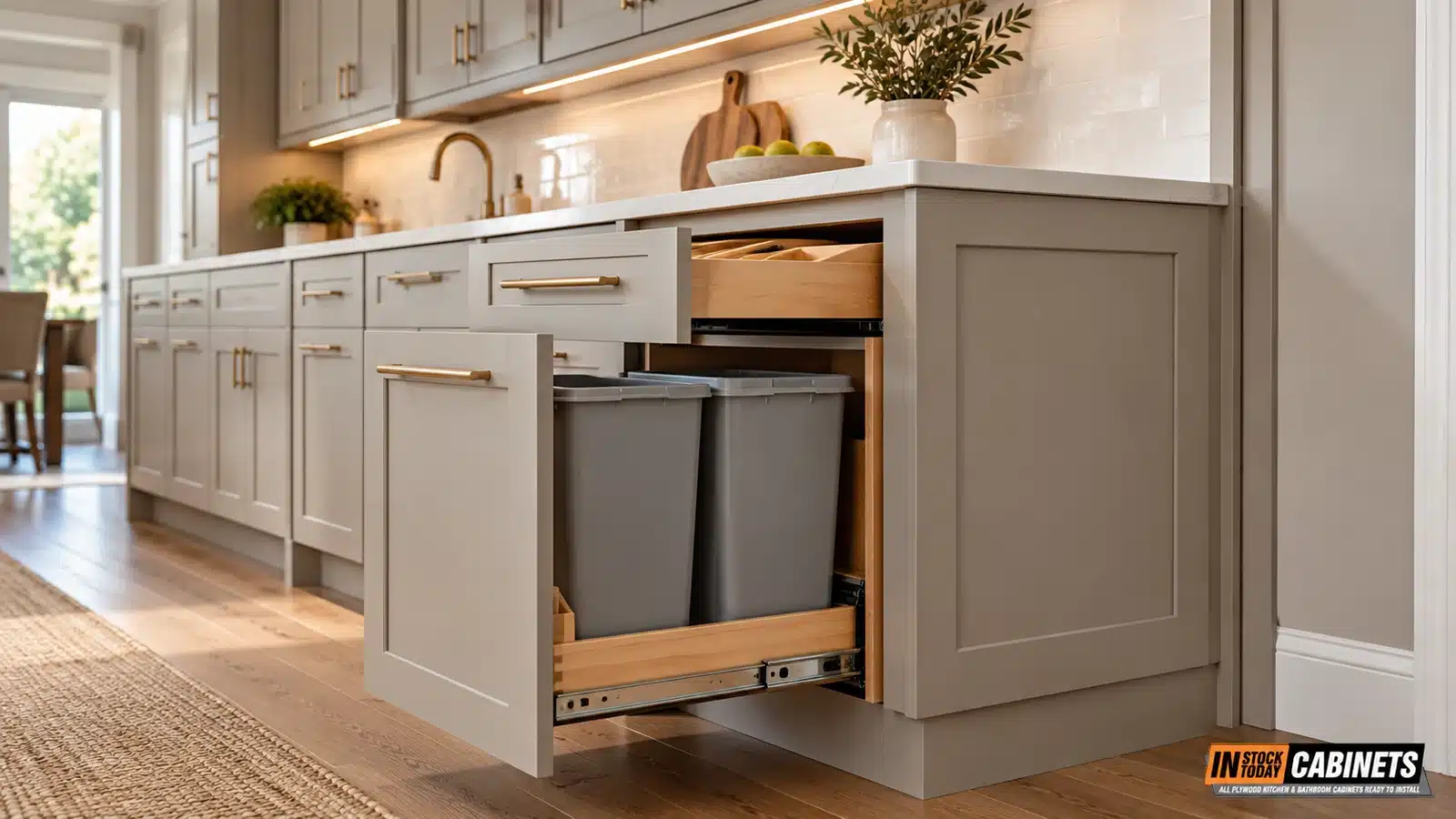
Accessories work the same way. Pull-out trash, tray dividers, lazy Susans and drawer organizers are each a line item, and enough of them turn a budget kitchen into a midrange one.
Assembly and installation
RTA boxes cost less to buy, but someone has to build them. Our RTA vs. pre-assembled comparison runs that labor math. For installation, Fixr puts labor at $50 to $200 per linear foot, or $40 to $100 an hour. HomeGuide’s hourly range is $40 to $80. Removing old cabinets, moving plumbing or electrical, and leveling a bad floor are extra.
Cabinet tariffs now, and what changes on January 1, 2027
Since October 14, 2025, imported kitchen cabinets and vanities have carried a 25 percent tariff under Section 232 of the Trade Expansion Act. Proclamation 10976 applies it to “completed kitchen cabinets and vanities as well as parts imported for use in kitchen cabinets and vanities.” The rate was due to rise to 50 percent on January 1, 2026. Proclamation 11000, signed on December 31, 2025, pushed that increase back a year. It is now scheduled for January 1, 2027, except for countries that reach an agreement with the United States.

| Where the cabinet or part comes from | Rate now | From January 1, 2027 |
|---|---|---|
| Most countries, including China, Vietnam, Malaysia, Mexico and Canada | 25% | 50% |
| Canada, wooden vanities only | 25%, plus a 50% Section 338 duty since September 15, 2026 | 50%, plus the 50% Section 338 duty |
| European Union and Japan | Capped at 15%, including regular duties | No change scheduled |
| South Korea (since November 14, 2025) and Taiwan (since May 1, 2026) | Capped at 15%, including regular duties | No change scheduled |
| United Kingdom | Capped at 10%, on top of regular duties | No change scheduled |
| China, in addition to the above | Antidumping and countervailing duties since 2020, plus a 25% Section 301 tariff since 2019 | Unchanged |
As of late October 2026, we found no newer proclamation or Federal Register notice changing the January 1 date. Most of 2026’s other tariffs do not stack on top of it. Proclamation 10976 exempted these products from the reciprocal tariffs, which ended after the Supreme Court’s February 2026 ruling. The 10 percent Section 122 surcharge that ran from February 24 to July 24, 2026 excluded Section 232 goods, and the forced-labor Section 301 duties that began on July 24 exempt goods covered by the wood-products tariff. The exception is Canada: since September 15, 2026, wooden vanities of Canadian origin have also carried a 50 percent Section 338 duty on top of the Section 232 tariff. Canadian kitchen cabinets and cabinet parts are not on that list. The January date has moved once already and could move again.
Three details matter more to a buyer than the headline rate.
“Assembled in the USA” does not mean tariff-free
The duty covers imported parts, so a cabinet assembled here from imported doors, drawer fronts or panels carries tariff cost on those parts. Fabuwood, for example, says on its FAQ that its cabinets combine U.S. and globally sourced components, all assembled in the USA. It does not publish how much of each cabinet is imported, so nobody outside the company can say how much of the tariff reaches its prices.
Chinese cabinets can pay far more than 25 percent
The Commerce Department’s 2020 antidumping order on wooden cabinets and vanities from China found dumping margins of 4.37 to 262.18 percent, with antidumping cash-deposit rates of 0 to 251.64 percent after subsidy offsets. The countervailing duty order set subsidy rates of 13.33 to 293.45 percent. Rates for individual exporters have been revised in later reviews. Chinese cabinets have also carried a 25 percent Section 301 tariff since 2019, according to the U.S. International Trade Commission. All of these stack with Section 232. A 2024 Commerce Department scope ruling found that cabinets completed in Malaysia or Vietnam with Chinese-made doors, drawer fronts or frames are covered by those orders.
The rate is set when goods clear customs
The proclamation applies to goods “entered for consumption, or withdrawn from warehouse for consumption” on or after the effective date. Cabinets and parts entered before January 1 pay 25 percent. Anything entered on or after January 1 pays the new rate, including goods that arrived earlier but stayed in a bonded warehouse until after that date. So prices on cabinets that have already cleared customs may hold for a while after January 1, then rise as importers restock.
How a tariff reaches your quote
A tariff is charged on the import value of the goods, which is what the importer paid for them. The showroom price is several steps further down the line, and that is why a 50 percent tariff does not make a kitchen 50 percent more expensive. By the time a cabinet reaches your house, its import cost sits alongside freight, warehousing, assembly, the dealer’s margin and installation.
A worked example, for illustration only
Say an importer brings in a base cabinet for $200. At 25 percent, the duty is $50. At 50 percent, it is $100, so the increase is $50 per cabinet.
If that cabinet sells for $500 and the extra $50 is passed on at cost, the price rises 10 percent. If the seller’s markup is applied on top of the duty, it rises more. If the importer or dealer absorbs part of it, it rises less. Domestic cabinets with some imported parts sit lower on the same scale, because only the imported share is taxed.
Imports are a large part of the market. In its September 2025 review, the U.S. International Trade Commission put apparent U.S. consumption of wooden cabinets and vanities at $6.7 billion in 2024. It built that estimate from import statistics and data from the domestic producers that responded to its review, and noted that the domestic figures may be understated. Imports from countries other than China made up 34.5 percent, led by Vietnam, Canada, Malaysia and Italy. China’s share had fallen to 0.3 percent under the 2020 duties, and domestic producers held the remaining 65.2 percent.
Domestic makers are not insulated either. MasterBrand, which calls itself the largest residential cabinet manufacturer in North America, completed its merger with American Woodmark on May 28, 2026. In August it told investors that gross tariff costs would equal about 5 to 6 percent of its 2026 net sales. The company expects to offset them dollar for dollar on a run-rate basis by the end of the year, and it credited part of its average selling price to “the flow through of tariff pricing.” Before the merger, American Woodmark estimated its unmitigated tariff cost at 3.5 to 4 percent of annual sales and listed price increases among its responses. Neither figure includes the step-up to 50 percent.
Federal price data points the same way. The U.S. Producer Price Index for wood kitchen cabinet and countertop makers rose 5.4 percent from September 2025 to September 2026, after rising 1.5 percent the year before. Prices for custom cabinets and vanities rose 9.1 percent, almost all of it in June 2026. Stock cabinets rose 1.6 percent. The index measures what U.S. manufacturers charge. It does not track retail or import prices, and on its own it cannot show that the tariff caused the increase. The figures for June to September 2026 are preliminary and can still be revised.
On the sales floor, the increases have been uneven. In January 2026, one cabinet dealer wrote on Reddit: “I have received minimal increases from cabinet manufacturers for this quarter. My southeast Asian imports have not implemented tariff increases.” A homeowner in the same thread said their price went up “a decent amount between our first estimate and our deposit,” which they guessed was about 15 percent; they did not say how much of that was tariffs. In August, a dealer for one ready-to-assemble brand reported quoting a job where a tariff surcharge of almost 10 percent and almost $4,000 in freight together added about 30 percent to the dealer’s cabinet cost. The customer did not buy.
Should you order cabinets before January 1?
Only if the kitchen is ready to order. A rushed order with guessed measurements can cost more in reorders and delays than the tariff increase would add. If the design is final and the field measurements are done, ordering this fall can make sense, as long as the price is locked in writing.
A quote is not a price lock. Before you pay a deposit, get these in writing:
- How long the quoted price is held, and whether it is fixed when you order or when the cabinets ship.
- Whether a tariff, freight or fuel surcharge can be added after you sign, and how it would be calculated.
- The estimated ship date, and what happens to the price if the order ships after January 1.
- The deposit amount, when the balance is due and whether the deposit is refundable.
- Every line item, including boxes, fillers, panels, moldings, toe kicks and hardware, so two quotes can be compared line by line.

Contractors have a second exposure: a client contract signed in November for cabinets ordered in January. If your contracts do not already have one, a price-escalation clause tied to documented supplier increases keeps a tariff change from coming out of your margin.
Protect the deposit, too. Wren Kitchens, a U.K.-based kitchen maker with about 15 U.S. showrooms, mostly on the East Coast, and a factory in Pennsylvania, shut its U.S. operations abruptly in April 2026. It filed for Chapter 7 bankruptcy on April 24. Customers who had paid deposits were left waiting on the bankruptcy process. Fabuwood responded with a relief program that credits up to $3,000 of a lost deposit toward a new Fabuwood order through participating dealers. It covers closures of U.S.-based manufacturers and assemblers, is valid for 45 days after a qualifying closure and, as described in May 2026, runs at least through the end of 2026. The wider lesson holds for any brand: keep deposits proportionate, pay them in a way you can dispute, and buy from a dealer whose showroom and warehouse you can visit.
When a cabinet price is too good to be true
High duties create an incentive to dodge them, and enforcement cases keep coming. In July 2026 the Kitchen Cabinet Manufacturers Association summarized five recent cases. One is a federal indictment alleging more than $109 million in duties evaded on Chinese quartz, cabinets and vanities, and tile, in part by routing goods through Malaysia. In another, a container at the Port of Norfolk was declared as 10 cabinets worth $500. It held 781 cartons of kitchen cabinets appraised at $123,554.
For a buyer, the risk is practical. A seized container is a kitchen that does not arrive, and a supplier caught evading duties may not be around to honor a warranty. If one quote is far below the others for comparable cabinets, ask where the cabinets are made, where the doors and boxes come from and how long the seller has been in business.

How much Fabuwood cabinets cost
Fabuwood does not sell directly to homeowners. Its FAQ says it does not sell to end users and that quotes are provided through its dealers. The company describes its product as premium cabinets “at an affordable price.” Its 2022 cost guide says Fabuwood sells only semi-custom cabinets and gives $300 to $500 per linear foot as the average for semi-custom cabinets in general, based on figures it gathered from its dealers. That figure predates the tariff and covers semi-custom cabinets as a category, so it says little about a Fabuwood quote for your kitchen.
Within the brand, the price of a kitchen depends on the series, the door style, the finish and any modifications. Fabuwood’s current series include Allure, Illume, Ovela, Value Premium and Quest. Fabuwood does not publish a price ranking of those series, so the way to compare them is on a quote for your own layout.

Quotes for the same kitchen can also differ in what they include. In October 2026, a homeowner wrote on Reddit that an online distributor had priced their Fabuwood kitchen at “around 10-12k,” against a Cabinets.com quote a few thousand dollars higher. A dealer who replied suggested making both sellers price the same list of panels, fillers, toe kicks and crown, and checking which door series the Fabuwood quote is on, because “pricing jumps between series on the same color name.” The same dealer added a point about service: “Ask who handles freight damage, because on an online order you’re the one opening 30 boxes on your driveway.”
If you find a Fabuwood price list PDF online, check its date. One printed before October 2025 predates the tariff and will not match a quote today. On tariffs, Fabuwood says it assembles its cabinets in the U.S. from U.S. and globally sourced components. It has not said which components are imported or how much of the tariff reaches its prices. Our guide to how Fabuwood cabinets are made covers where its cabinets come from in more detail.
From our showroom floor
The fastest way to know what Fabuwood costs for your kitchen is to bring the layout. Send us the plan and field measurements and we will come back with an itemized quote, with finished ends, fillers and moldings listed, and a written ship date. Then ask us how long the price is held, the same question you should ask any dealer this year.
How to lower the cost without buying worse cabinets
Start with the room. Moving the sink, range or a wall adds plumbing, electrical and drywall work that has nothing to do with the cabinets. Keep the old footprint and more of the budget goes into the boxes themselves.
Then design to standard sizes and stocked finishes. Fillers and standard widths cost less than modified boxes and ship faster, and a designer can usually solve an odd wall with a filler or a different cabinet combination. Our Kitchen Visualizer is a quick way to try layouts. Stocked colors cost less than designer or custom colors and arrive weeks sooner. If you want a statement color, put it on the island and keep the perimeter in a stocked finish.
Spend where you touch. Drawers, pull-outs and the cabinets around the sink get the most use, so better drawer boxes and hinges there are a better trade than decorative extras on wall cabinets.
Before you sign, put two quotes side by side line by line. A big gap usually traces back to missing panels and moldings, a different box material or a cheaper finish tier.
And ask about discounts. Customers can join the free IST Loyalty Rewards Program, which earns 2 points per dollar spent and unlocks $100 off at 10,000 points. We also offer a standing military discount for veterans, separate from the loyalty program.
Get an itemized quote before January
Send the plan and field measurements through the free estimate form on your nearest showroom’s page: Alexandria, Fairfax, Columbia, Bear or Houston. We will come back with an itemized Fabuwood quote and a written ship date, so you can compare it line by line.
See all showroomsContractors: see our wholesale program.
Frequently asked questions
How much do kitchen cabinets cost per linear foot?
About $100 to $300 per linear foot for stock cabinets, $150 to $650 for semi-custom and $500 to $1,200 for custom, according to Fixr’s January 2026 cost guide. HomeGuide, whose figures include installation, puts the top of the stock range at $400 and semi-custom at $700. These are national averages, and the same bands appeared in guides published before the 2025 tariff, so check them against a current local quote.
How much do cabinets cost for a 10×10 kitchen?
A 10×10 is usually an L-shaped kitchen with two 10-foot walls. Fixr applies a mid-range cost of $150 to $650 per linear foot to 16 linear feet of cabinets and gets $2,400 to $10,400. HomeGuide, which assumes 20 to 22 linear feet, puts it at $3,000 to $11,000 installed for stock or semi-custom and $10,000 to $26,500 for custom. Fixr says the average kitchen needs 25 to 30 linear feet, so budget from your own measurements.
What is a good budget for kitchen cabinets?
Plan on cabinets taking about a quarter of a kitchen remodel budget. Fabuwood’s 2022 cost guide says 25 percent and HomeAdvisor says nearly 30 percent. The 2026 Houzz & Home study put the median major remodel of a smaller kitchen, where all cabinets and appliances are replaced, at $35,000 in 2025, which suggests roughly $8,750 to $10,500 for cabinets. The median for larger kitchens was $55,000.
Are there tariffs on kitchen cabinets?
Yes. Since October 14, 2025, imported kitchen cabinets, vanities and parts for them have carried a 25 percent Section 232 tariff. It is scheduled to rise to 50 percent on January 1, 2027, except for countries that reach an agreement with the United States. The UK, EU, Japan, South Korea and Taiwan have lower caps. Cabinets from China also face antidumping, countervailing and Section 301 duties, and wooden vanities from Canada carry an extra 50 percent Section 338 duty.
Will kitchen cabinet prices go up in 2027?
Pressure is upward. The tariff on imported cabinets and parts is scheduled to double to 50 percent on January 1, 2027. Prices charged by U.S. wood kitchen cabinet and countertop makers were already up 5.4 percent in the year to September 2026. How much reaches buyers depends on how much each brand imports and how much its dealers pass on. Cabinets that cleared customs before January 1 paid the lower rate.
Do tariffs apply to cabinets made in the USA?
Partly. The Section 232 tariff covers finished cabinets and also parts imported for use in them. A cabinet assembled in the U.S. from imported doors, drawer fronts or panels carries tariff cost on those parts, while a cabinet built entirely from U.S. materials does not. Most brands, including Fabuwood, do not publish how much of each cabinet is imported.
How much do Fabuwood cabinets cost?
Fabuwood does not sell directly to homeowners. Its FAQ says quotes are provided through its dealers, so the price comes from a dealer’s quote for your kitchen. Fabuwood’s own 2022 cost guide calls it a semi-custom brand and puts semi-custom cabinets in general at an average of $300 to $500 per linear foot, based on dealer figures gathered before the 2025 tariff. The series, door style, finish and modifications set the final price, so ask a dealer for an itemized quote on your layout.
Is there a Fabuwood price list?
A dealer’s quote is where you get a Fabuwood price: the company’s FAQ says it does not sell to end users and that quotes are provided through its dealers. If you find a price list PDF online, check its date: one printed before October 2025 predates the tariff and will not match a quote today. A dealer can price your exact layout, finish and series.
Is it cheaper to buy RTA cabinets?
The boxes cost less, but someone has to assemble them. Fabuwood’s 2022 cost guide puts ready-to-assemble cabinets at $50 to $100 per linear foot, against $300 to $500 for semi-custom, figures that predate the tariff. Whether RTA saves money overall depends on who assembles the boxes and what their time costs. Our RTA vs. pre-assembled comparison runs that math for contractors.
How much does it cost to install kitchen cabinets?
Fixr puts installation labor at $50 to $200 per linear foot, or $40 to $100 an hour, and HomeGuide at $40 to $80 an hour. Removing old cabinets, moving plumbing or electrical and leveling an uneven floor cost extra. Get installation priced on the same quote as the cabinets, or confirm in writing who is responsible for each step.
Should I buy kitchen cabinets before the tariff increase?
Only if the design is final and the measurements are done. If it is, ordering before January 1 can avoid a price change, but only if the dealer holds the price in writing. Ask how long the quote is held, whether a surcharge can be added, what the ship date is and whether the deposit is refundable. The date was postponed once before and could move again.
Keep reading: How Fabuwood cabinets are made covers lead times, warranty fine print and where its cabinets come from. Our Fabuwood review gives our verdict on the brand. How to read a cabinet spec sheet explains what you are paying for at each tier.
Written by the IST Cabinets Editorial Team and reviewed by our showroom designers. Cost ranges are national averages from the cost guides named in the text. IST’s own prices are not included. Tariff status is as of October 28, 2026; check the Federal Register for later changes. Online comments are individual accounts and have not been independently verified. Published October 2026.