
Someone walks into our Fairfax showroom with a competitor’s quote and one question: is this a good cabinet? The quote says all-plywood construction, dovetail drawers, soft-close hardware. So does every other quote in the folder — five companies, the same three specifications, and nine thousand dollars between the cheapest and the most expensive.
So here is what those specifications actually mean, what the industry test standard really measures, and which parts of a cabinet genuinely fail. Some of what follows argues against specs we happen to sell, and one section says plainly where Fabuwood loses. We would rather you buy the right cabinet than buy ours for the wrong reason.
Written by
Hatice Halac, In Stock Today Cabinets
Hatice writes the Fabuwood comparison series and works with the showroom design teams in Alexandria, Fairfax and Columbia. Every specification below is sourced and linked — to a published standard, a manufacturer’s own spec sheet, or a trade discussion. Where a figure comes from a manufacturer rather than an independent standard, the article says so, because those are not the same kind of evidence.
Published August 2026. Test values current to ANSI/KCMA A161.1-2022.
The short answer
If you check only five things on a cabinet quote
- Get the box material and its thickness in writing. “All-plywood” with no number attached is not a specification. Half-inch is normal on a framed box, three-quarter on a frameless one, and no standard requires either.
- Ask whether every cut edge is banded — including the sink base bottom and any holes drilled for under-cabinet lighting. This is the spec nobody sells and the one that decides whether a leak is a repair or a replacement.
- Ask who makes the hinges and slides, by brand and model. Drawer boxes carry no published load rating. Slides do. Any weight figure you are quoted belongs to the hardware.
- Ask whether the specific line is KCMA certified. Certification is voluntary and granted line by line, so “we are a certified manufacturer” is not the same claim as “this cabinet is certified.”
- If the doors are painted, ask what the centre panel is made of. Solid wood centre panels crack at the joints under paint. This is normal, documented, and excluded from most warranties, including ours.
600 lb
Static load a certified wall cabinet must survive, at 24″ tall and up to 36″ wide
25,000
Open-and-close cycles for doors and for loaded drawers
40–50%
Of manufacturers fail KCMA certification on the first attempt
200,000
Cycles Blum tests its concealed hinges to
1½″
Drawer width a face frame costs you against frameless
None
Thickness-swell limit ANSI sets for the particle board grades used in cabinet boxes
The three specs everyone asks for
Plywood box. Dovetail drawers. Soft-close hardware. Homeowners have learned to ask for exactly those three, which means the three have stopped sorting anything — every quote claims them. Here is what the trade says when nobody is selling.
A man who ran a cabinet factory for years, on the plywood upgrade:
“I loved making plywood cabinets though. I could charge almost triple for materials with only a 50% additional cost. The perception that plywood is exponentially “better” just put more money in my pocket.”
A cabinetmaker on dovetails:
“Most shops buy their dovetailed drawers…it’s basically a sales gimmick. Doweled drawers are just as good, allows them to put your money where it counts.”
None of this makes plywood or dovetails bad. It makes them table stakes. A quote that leads with all three is telling you what every other quote also says, and the differences that survive a decade sit further down the sheet — on the lines nobody prints.
The showroom rule: of the famous three, soft-close is the one still worth insisting on — not because it is rare, but because it now costs a shop almost nothing at wholesale, which makes a large itemised “soft-close upgrade” on a 2026 quote a fair thing to question.
Bring us the quote you already have
Any IST showroom will read a competitor’s quote line by line with you and tell you which specifications on it are real and which are filler. No obligation to buy from us.
Find your nearest showroomWhat KCMA certification actually tests
ANSI/KCMA A161.1 is the American cabinet performance standard. The current edition is A161.1-2022, and KCMA describes it as a battery of fourteen tests. These are the numbers worth carrying into a showroom.
| Test | What the cabinet has to survive |
|---|---|
| Wall cabinet static load | 600 lb gradually applied, with no visible failure of the cabinet or its mounting system. Applies to units 24″ and taller, up to 36″ wide; wall-hung base cabinets from 36″ to 60″ are tested to 800 lb |
| Shelf and bottom load | 15 lb per square foot, held for seven days |
| Base front joint | 250 lb against the inside of the front stiles with a drawer rail, 200 lb without |
| Door cycling | 25,000 full 90-degree open and close cycles, then it must still latch and the hinges must be undamaged |
| Loaded door | 65 lb hung on the door, ten cycles, then held for ten minutes |
| Drawer cycling | 25,000 cycles loaded at 15 lb per square foot of drawer bottom |
| Impact | A 3-lb steel ball dropped from 6 in, and a 10-lb sandbag swung against a closed door |
| Finish, heat | 120°F at 70% relative humidity for 24 hours |
| Finish, cold check | 120°F and 70% RH for an hour, back to room temperature, then −5°F for an hour |
| Finish, detergent | A standardised detergent formula on the door edge for 4 to 24 hours, depending on door type |
| Finish, spills | Vinegar, lemon, orange and grape juice, ketchup, coffee, olive oil and 100-proof alcohol for 24 hours; mustard for one hour |
Two things about that table matter more than the numbers in it.
The 600-pound figure is current and 500 is not. The wall-load requirement was raised from 500 lb to 600 lb by ANSI in January 2012. If a spec sheet or a salesperson quotes 500 pounds, they are reading literature that is more than a decade out of date, which tells you something on its own.
And certification is voluntary, and granted line by line. In the language of KCMA’s own Directory of Certified Cabinet Manufacturers, the program is “open to all cabinet manufacturers including non-KCMA members,” and manufacturers “may certify one, several, or all of their cabinet lines.” So the question is never whether a company is certified. It is whether the line on your quote is. One more exclusion worth knowing, printed on the certificates themselves: “Flat pack (unassembled) cabinets, if sold by this manufacturer, are not certified.” Anyone shopping ready-to-assemble should read that twice.
Is the standard demanding? KCMA says 40 to 50 percent of manufacturers fail on their first attempt. Where they fail is the useful part: the base front joint loading test, and, in KCMA’s phrasing, “seamed doors fail when moisture penetrates the adhesive and causes the wood to swell.”
The box: plywood, particle board and what moisture really does
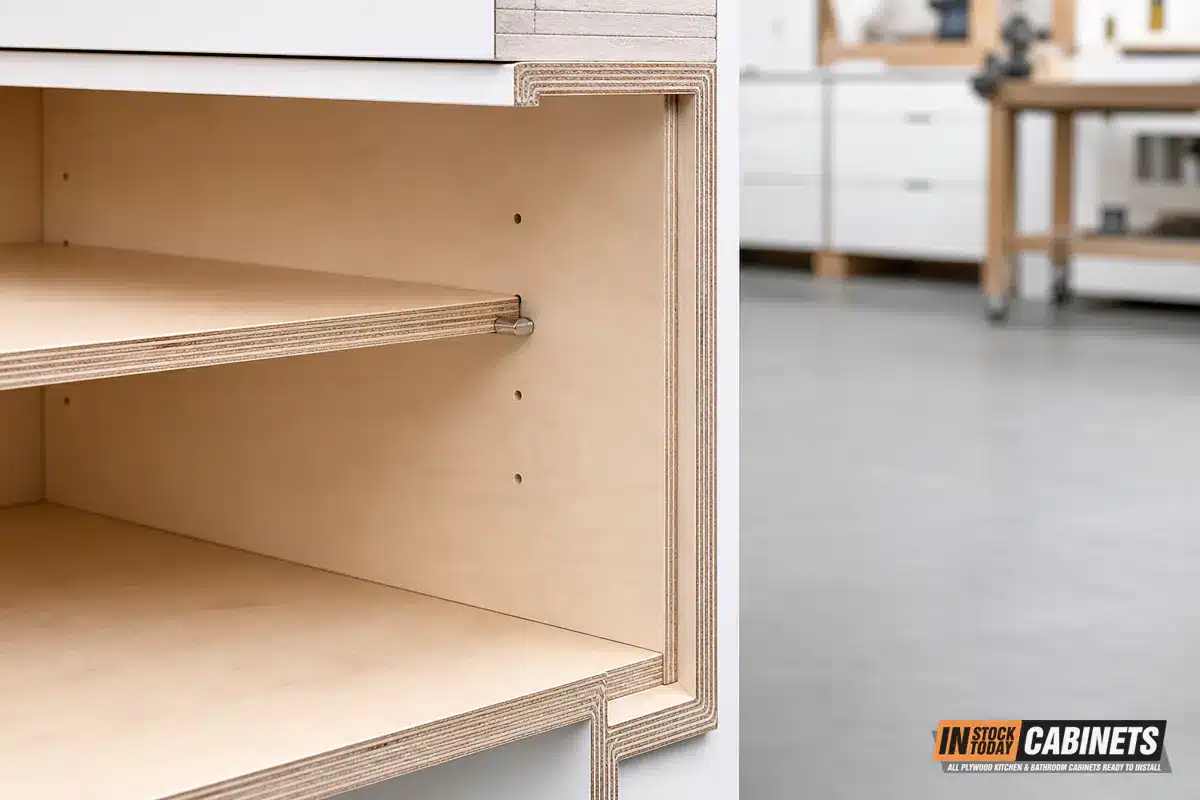
Start with the correction almost every cabinet article gets wrong. No standard requires any particular box thickness. A161.1 is performance-based; the actual requirement is only that materials be of sufficient thickness for rigidity. When KCMA overhauled its Severe Use standard in 2024 it went the same direction, replacing material and construction requirements with performance ones.
So half-inch versus three-quarter-inch is a market convention, not a rule — and the convention tracks construction type rather than quality.
| Tier | Sides | Back |
|---|---|---|
| Framed, stock or builder grade | 1/2″ engineered wood | 1/8″ hardboard |
| Framed, mid-market | 1/2″ plywood | 1/4″ to 1/2″ plywood, one piece on better lines |
| Frameless | 3/4″ plywood or particle board | 1/4″, with 5/8″ hanging rails |
Frameless runs thicker because there is no face frame carrying load. Selling 3/4″ as simply better without that context is misleading — it is compensating for something, not gilding it.
The moisture argument, done properly
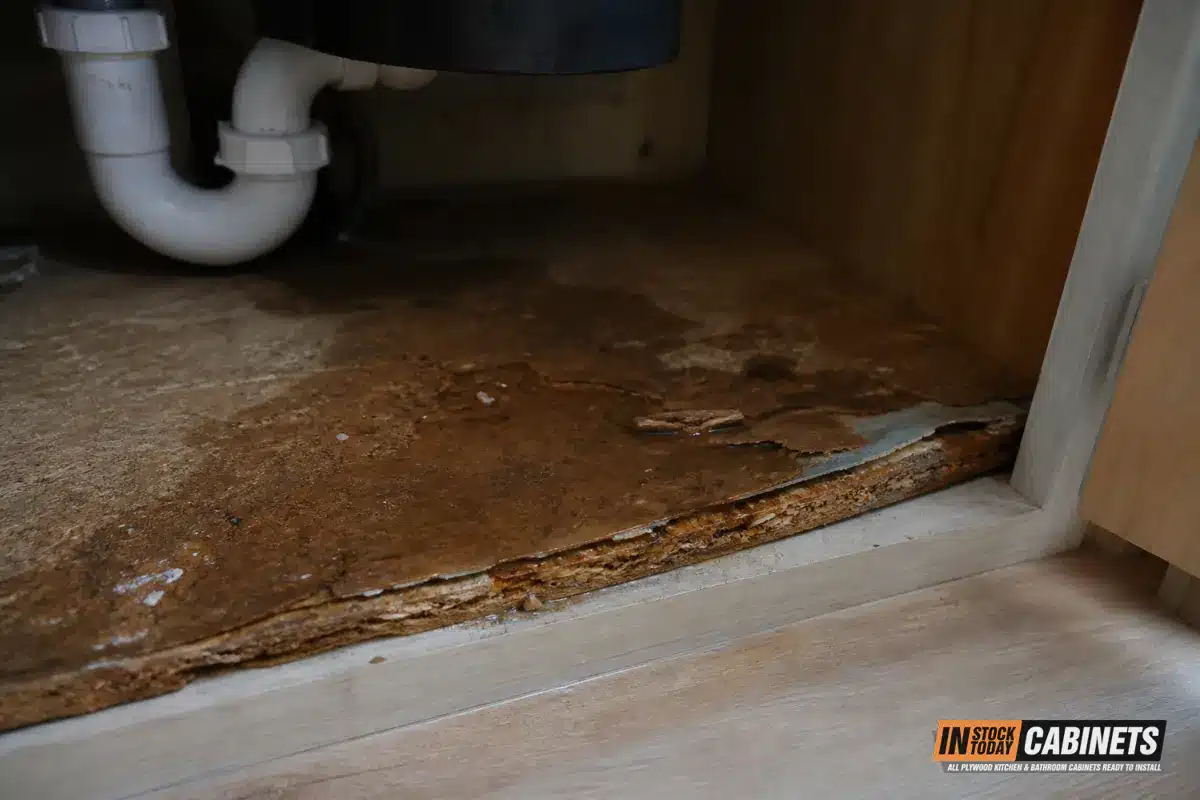
Every cabinet dealer says particle board swells. It does. But the strongest version of that claim is not in anyone’s marketing — it is in the standard.
Under ANSI A208.1, the US particleboard standard, the grades used for cabinet boxes are not required to meet any thickness-swell limit at all. The standard applies that test only to manufactured-home decking grades, capped at 8 percent, and to the moisture-resistant MR10 and MR50 grades, capped at 5.5 percent. The MR grades are defined for interior applications of high humidity or intermittent wetting — which is not the board a standard kitchen box is made from.
For a sense of magnitude, published typical figures put standard particle board somewhere around 8 to 15 percent thickness swell after 24-hour submersion depending on panel thickness, against roughly 3 to 7 percent for moisture-resistant particle board. Those come from an Australasian panel association testing to a different national standard, so treat them as illustrative rather than as US specification values. The useful detail in the same document is that the swell is overwhelmingly in thickness — roughly 0.3 to 0.5 percent per one percent change in moisture content, against 0.03 to 0.06 percent in length and width. Which is exactly why edges and bottoms fail first, and why the next section matters more than this one.
Edge banding: the spec nobody sells you
If the swell happens through the thickness, then what protects a box is not the core material so much as whether every exposed edge is sealed. Nobody itemises this. It never appears on a quote. And it is repeatedly what homeowners identify after the fact as the actual cause.
“sometime after initial installation, someone drilled into the bottoms to install under cabinet lights. The holes where they drilled weren’t edge banded or covered in silicone or any other type of waterproofing. Those holes swelled.”
u/Odd_Tap_1137, r/cabinetry
The same homeowner’s conclusion, after pulling the kitchen out: “So I bet if all the cuts got edgebanded, and you aren’t at risk for sweating walls or pipes, then laminated particle board could last well over 20 years and still look good!”
And it is not only a budget problem:
“I’ve seen some absurdly expensive kitchens with particle board sides that werent even edge banded to keep moisture out.”
u/EllisHughTiger, r/HomeImprovement
Worth balancing this against the view from the people who pay for the damage:
“The only way this will get damaged is with a water leak. But to be honest a water leak will likely ruin the cabinets even if their plywood. Source: I work in insurance and any water leak inside forces us to replace all the cabinets 95% of the time”
u/michaelrulaz, r/HomeImprovement
Both things are true. Banded edges buy you survival against the slow drip nobody notices, not against the burst supply line.
Drawer boxes: dovetail, dowel and melamine
Three constructions, in order of what they cost a manufacturer.
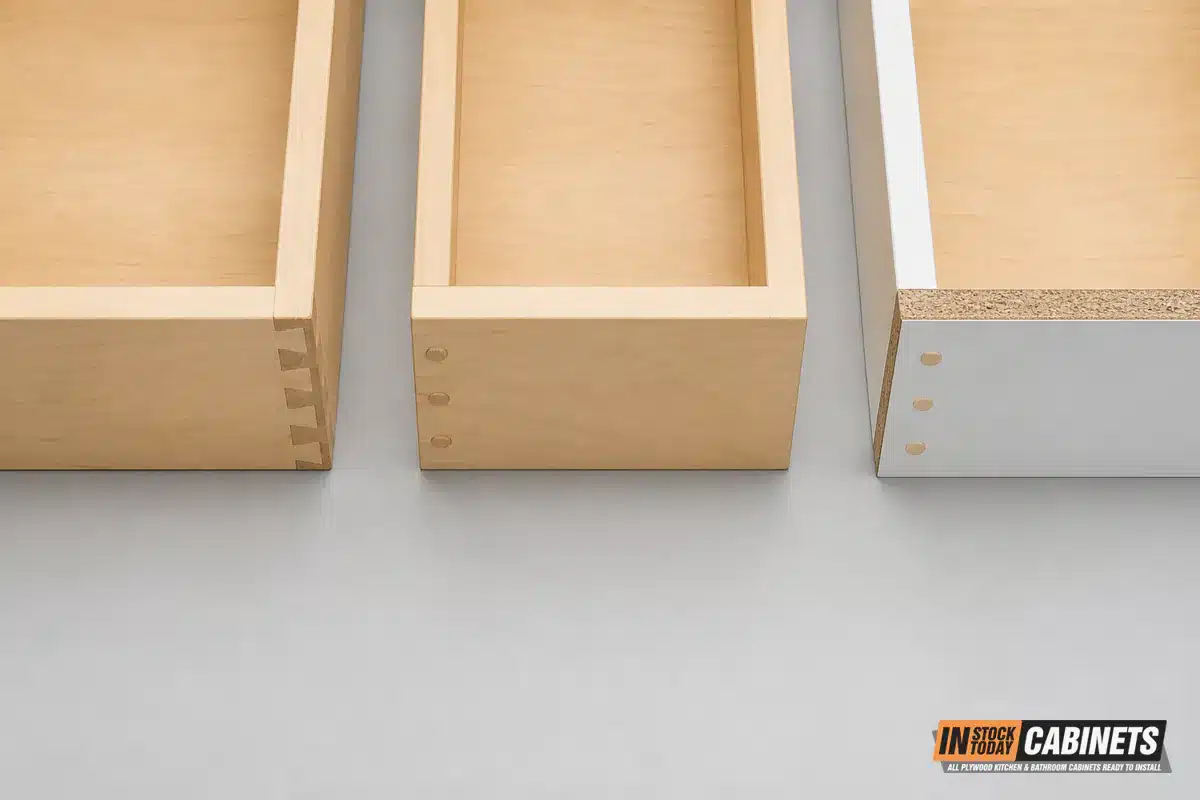
Dovetailed solid wood. The industry standard is 5/8″ sides with a captured 1/4″ or 1/2″ plywood bottom. Worth knowing that 5/8″ dovetail now appears on stock builder-grade lines as well as premium ones — which is precisely why it no longer sorts anything.
Bore-dowel. Structurally sound with modern adhesives: typically 6mm dowels, 25mm long, a minimum of two per joint. The one real published limitation we found is height — a dedicated drawer box manufacturer caps doweled boxes at 16″ tall against 22″ for dovetailed.
Melamine over a fibreboard core. Usually doweled, and this is what shows up on entry-level frameless lines, generally with a 1/4″ MDF bottom. But note that the joinery is a cost convention, not a material rule: dovetailed Baltic birch plywood is a standard catalogue item at WalzCraft and Hardware Resources, and CCF’s melamine drawers are “available in dovetail or dowel & bore joints.” Dowel-and-bore does correlate with melamine — CCF says it is used “mostly with Melamine drawers” — but nobody is forced into it by the joint.
Two things worth knowing before you specify.
A 3/4″ tier exists, but check the slide before you order it. 5/8″ is the residential default — Scherr’s and Western Dovetail build to it, and Hardware Resources publishes its sizing formulas only for 5/8″ hardwood and 1/2″ plywood. But WalzCraft lists boxes “available with 1/2″, 5/8″, or 3/4″ thick side walls,” CCF offers the same three, and Eagle Woodworking makes 3/4″ a special order. The catch is hardware: Blum’s TANDEM 563H is rated for 1/2″ to 5/8″ sides and MOVENTO for 13–16mm, so 3/4″ forces you onto the TANDEM 563F variant and takes MOVENTO off the table entirely. Thicker is not automatically an upgrade if it costs you the slide you wanted.
Drawer boxes do not carry published load ratings. We could not find one from any drawer box maker, and slide manufacturers publish theirs prominently — so every “holds a hundred pounds” claim in cabinet marketing traces back to the slide underneath, not the box.
Slides and hinges: where the ratings actually live
This is the part of the cabinet that moves thousands of times a year with weight in it, and it is the part where real published numbers exist. It is also, in the words of a shop owner who builds cabinets for a living, the part that goes first: “The hardware almost always fails before the case/doors/drawers so paying for Blum or salice is always worth it.”
Slides
| System | Static load | Extension |
|---|---|---|
| Blum TANDEM | 100 lb | Full or partial, depending on model |
| Blum MOVENTO | 125 lb, 170 lb heavy duty | Full, with overtravel |
| Blum LEGRABOX | 125 lb, 170 lb heavy duty | Full |
| Epoxy side-mount roller glide | 75 lb | 3/4, so the back quarter stays under the counter |
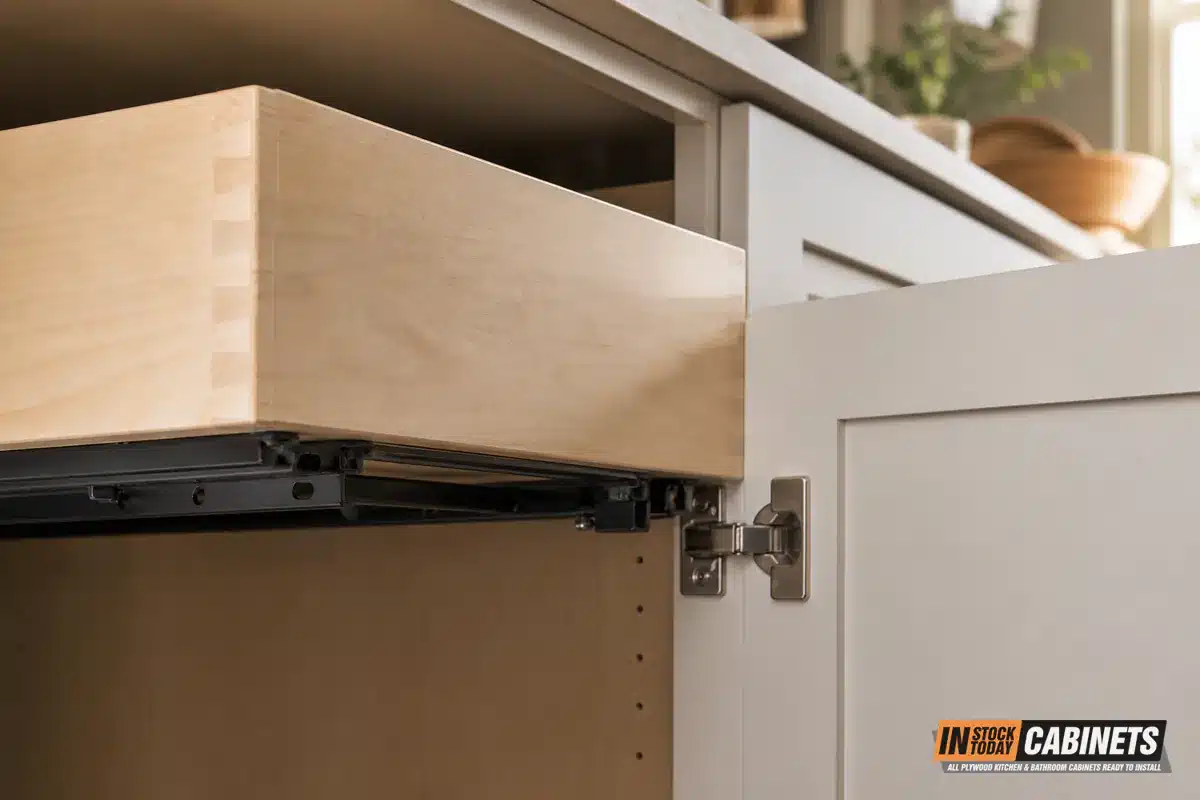
Three precisions worth having. These are static ratings, not working loads — Blum labels them explicitly as static load ratings per ANSI/BHMA A156.9, which is not the same claim as “holds a hundred pounds of plates.” Undermount does not automatically mean full extension; TANDEM ships in a partial-extension version, so check the model number rather than the category. And “self-closing” and “soft-close” are different products — an epoxy glide snaps shut on a spring ramp and is not damped at all. Conflating the two is the most common error in this category and it is not always accidental.
On cycle life, Blum states that MOVENTO and TANDEM are designed to be opened and closed at least 100,000 times. Useful context: the ANSI/BHMA A156.9 Standard Duty Grade 1 requirement for drawer slides is 50,000 cycles at 50 lb. So Blum’s figure is roughly double the standard, and it is Blum’s own design claim rather than a certification grade. Blum publishes no cycle figure for LEGRABOX, so nobody should be quoting one to you.
Hinges
Blum tests hinges to 200,000 opening and closing cycles, and to 100,000 cycles with an extra 11 lb applied. That figure covers all CLIP hinges, so there is no cycle-life argument to have between CLIP top BLUMOTION and COMPACT — they are tested the same.
About “6-way adjustable.” Blum says three: side, depth and height. CLIP top BLUMOTION gives roughly ±2mm side, ±2mm height and +3/−2mm depth. “Six-way” is those three axes counted in both directions. It is a marketing convention rather than six independent adjustments — which does not make the adjustability less useful, only less impressive than it sounds.
Integrated versus clip-on soft-close. Integrated BLUMOTION lives in the hinge cup and needs no assembly step after adjustment. The add-on damper retrofits onto existing hinges, and Blum’s own claim for it, in its concealed hinge specifications, is that it “offers the same quality of motion.” The real differences are model compatibility and an extra part to lose, not inferior feel.
Is soft-close standard in 2026? Across mid-market US framed brands, yes. KraftMaid Simplicity, Shiloh and Cabinet Maker’s Choice all list soft-close hinges and undermount soft-close guides as standard construction, not as options. Which is exactly why a large itemised soft-close upgrade deserves a question:
“The cost difference for the Blum hinges I buy from my distributor is about $1.50 per hinge to go to soft close. I love soft close. For drawer slides, if it’s under mount slides, the cost difference is a less than $10 per drawer… But yeah, builders like to offer the soft close upgrade because they can charge a lot more than the actual cost difference.”
u/steppedinhairball, r/homeowners
One documented exception to soft-close being universal: narrow-reveal inset doors hung on knife hinges cannot soft-close. Shiloh’s own 2026 brochure states it flatly — “3/8″ inset uses knife hinge that does not soft-close.”
Want to open and close it yourself?
Every specification on this page is something you can feel in five minutes on a display. Our six showrooms have full cabinet runs built, not door samples on a wall.
Visit a showroomOverlay: full, partial and inset
| Style | Overlay per side | Frame visible | Gap |
|---|---|---|---|
| Partial / standard overlay | about 1/2″ | about 1″, sometimes 2″ | Frame sits between doors |
| Full overlay | about 1¼″ | about 1/4″ | Usually 1/8″ or less |
| Inset | None — flush inside the opening | The whole frame | 1/16″ to 1/8″, 3/32″ typical |
Does full overlay cost more? Directionally, yes — more door material per opening. But we could not find a single manufacturer publishing a quantified premium, and the dealer price ranges that do exist overlap so heavily that they are measuring brand tier rather than overlay. Anyone quoting you a clean percentage is estimating and should say so.
The inset upcharge is worse. CliqStudios publishes 15 to 30 percent over full overlay on one page of its own site and 35 to 45 percent on another. Trade discussion ranges from near-parity up to 30 percent. The honest answer is that a real premium exists, it is commonly cited around 15 to 30 percent, and you should price it on your own quote rather than trust anybody’s percentage. The driver is tolerance and hand-fitting, not wood movement.
Two inset claims to stop repeating
Inset does not lose opening width against full overlay. Same box, same face frame, same opening. What it loses is interior depth — put at 3/4″ by one dealer’s technical sheet and at as much as 1½″ by a cabinetmaker writing about inset’s drawbacks, once the door sits inside the frame and the hinge hardware intrudes. His example: “we’ve seen dinner plates not fit into 12″ deep upper cabinets.” That is a real problem, and it is a depth problem.
Inset does not require butt hinges. Concealed inset hinges are standard at most manufacturers, six-way adjustable, with soft-close available. Exposed butt, knife and finial hinges are a style choice — a beautiful one — and choosing them costs you both soft-close and most of your adjustability, which compounds the problem in the next paragraph rather than causing it.
What inset genuinely costs you in ownership
The door sits inside the frame with roughly a 3/32″ gap all round, so seasonal wood movement shows up as sticking and needs periodic adjustment. And because no door overlaps the frame, every chip on the frame edge stays permanently on display. Three accounts, from two sides of the counter:
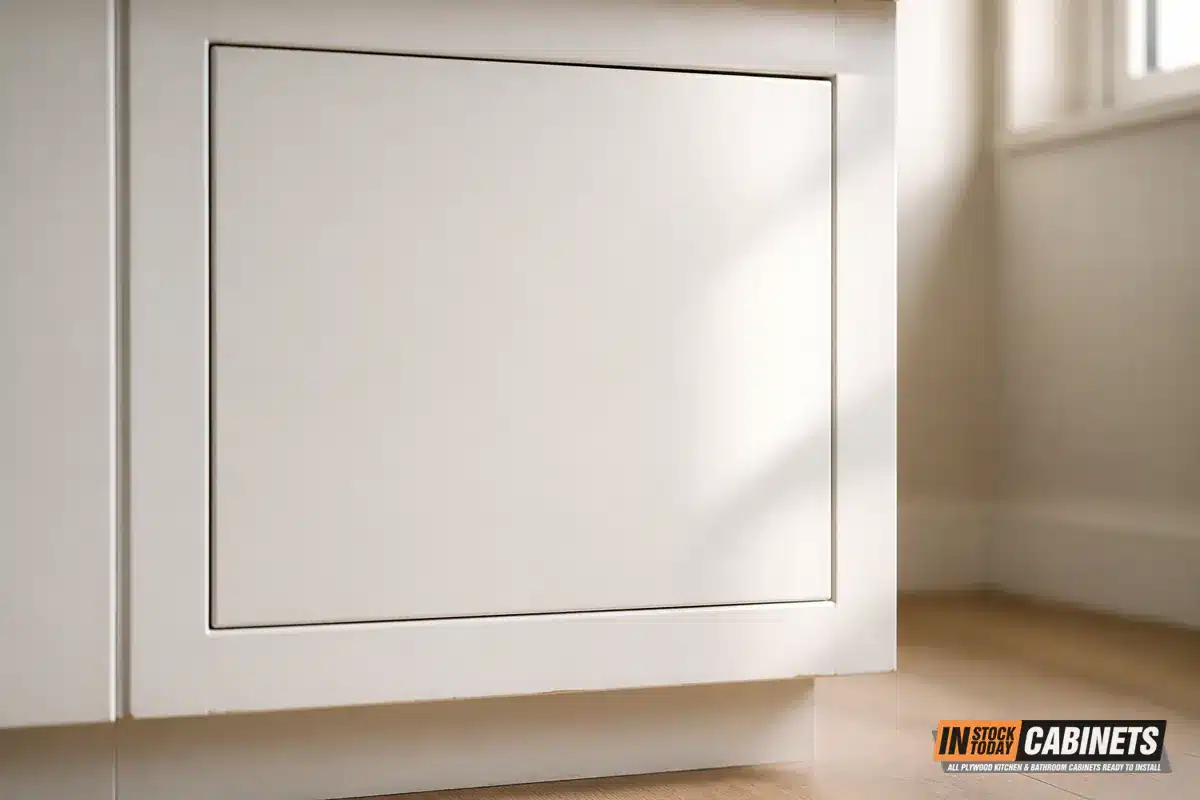
“Cabinet guy here- for rich peoples houses, I fully endorse inset doors. They can afford to have a guy come in every couple years and tune up/straighten up doors and touch up rubbed paint. For everyone else, I recommend full overlay doors. They’re more forgiving, they’re less expensive, and they just seem to last longer.”
“Inset looks great … when new. I had them and found I chipped the lowest rails when putting away cups etc. and since there was no door covering, those chips were always on display. Full overlay for me from now on.”
“I worked for a cabinet touch up company for two years, both from install and from general wear and tear. Inset cabinets show a lot of wear. Before you decide, take a look at the inside edges of your face frames and see how chipped the edges are from plates or the silverware drawer. Those chips won’t be hidden behind the door or drawer front with inlays.”
Our position, with a disclosure attached: we recommend full overlay for most kitchens — and you should know that Fabuwood does not offer inset in its standard catalogue, so we do not sell it and have nothing to gain from recommending it. Read the recommendation with that in mind. If you want inset, you want a custom shop, and you should budget for the tune-ups as an ongoing cost rather than a one-off.
Framed and frameless
A framed cabinet has a face frame around the front of the box and the doors mount to it. A frameless cabinet has none, so the doors mount straight to the box sides.
The access difference is real, and it is smaller than the marketing suggests. A kitchen design firm that ran the comparison line for line found a drawer interior in a framed line runs about 1½″ narrower than the frameless equivalent — roughly eight percent less capacity per drawer, but only about four percent across a whole kitchen, because wall and tall cabinet shelf storage loses essentially nothing. A component manufacturer puts the face-frame penalty in the same place, at “up to an inch and a half less” than full-access.
Certification alone does not make either one categorically stronger. Both certify to the same ANSI/KCMA A161.1 at the same load values, reaching that threshold by different means — the face frame resists racking in one, thicker panels do the work in the other. Worth being precise about what that proves: passing a shared minimum says both are capable of the same certified performance, not that they have identical ultimate strength. Nobody publishes a head-to-head test beyond the standard. KCMA does note that frameless units face more scrutiny on the base front joint loading test, to confirm the box stays stable under the stress of installation — which is an inspection note, not a verdict on the finished cabinet.
Fabuwood sells both. Allure, Quest and Value Premium are framed. Illume is frameless with engineered furniture-board boxes, and Ovela, launched in November 2025, is frameless with all-plywood boxes.
Painted doors and why they crack
If you are buying painted cabinets — and most people are — this is the specification that decides how the kitchen looks in year five.
Manufacturers use MDF or HDF centre panels on painted doors for one reason: engineered panel has no grain, so it has no differential movement. In one manufacturer’s own words, “MDF does not expand and contract with changes in humidity and temperature, which are the primary causes of paint cracking.”
A solid wood centre panel under paint does the opposite. The panel moves seasonally, the paint film does not stretch with it, and the film splits along the stile-and-rail joint. The trade calls the result a witness line. As one cabinet dealer explains it: “Since the paint is not ‘elastic’ enough to keep up with this wood moving below it, the paint is forced to give and it does so at the corner joint, splitting in a hairline right at the joint.”
And it is not a warranty claim. Witness lines are described across the industry as standard in stock, semi-custom and custom cabinets with wood centre panels, and manufacturers exclude them explicitly. Fabuwood’s own warranty language says the same thing, and it is better read before you sign than after:
“Painted finishes may exhibit visible joint lines, hairline cracks, or stress lines at seams and joints due to natural expansion and contraction of wood components in response to seasonal temperature and humidity changes. These conditions are normal and are not defects.”
Fabuwood builds its doors with solid wood stiles and rails around a 3/8″ MDF centre panel, mortise-and-tenon joined. That is the construction that reduces the problem — but be precise about what it reduces. An engineered centre panel removes the panel’s seasonal movement; it does not remove the stile-and-rail joint, which is still solid wood meeting solid wood, and that joint is where the witness line actually appears. The only painted door with no such joint to crack is a one-piece slab, which is a different look entirely. If you want a five-panel Shaker door in paint, you are accepting a joint that moves.
What “builder grade” actually means
It is not an insult and it is not a standard. KCMA’s own description of who it certifies covers “everyone from stock/builder-grade manufacturers (using particle board and simple construction) to high-end custom shops (using premium plywood and custom-made finishes)” — all under the same test.
What you are buying at that tier is a narrow range of sizes in three-inch increments, a small door and colour selection, cheaper slides, and no frills. The trade’s own summary is fairer than most marketing:
“Low/stock/builder’s grade: small amount of sizes, mostly doors or drawers with cheap slides. Smaller selection of colors and fronts. These are the stock cabinets you find in most stores. They’re not “bad”, they’re just engineered to a price point and wont have any frills.”
And here is the pricing trap that catches most people, from the same comment: the customisation, not the construction, is what moves the number. “One trick is selling you the same basic cabinets, but adding some drawers, glass doors, extra crown molding, and it literally doubles the cost! The customization is what kills your budget.”
Which is why we tell people to ask for an itemised quote by cabinet rather than one lump number. If a designer will not break it out, that is information.
The spec sheet decoder
Print this, or open it on your phone at the counter. Left column is what to ask. Middle is the answer that should worry you. Right is the answer you want.
| Ask | Weak answer | Strong answer |
|---|---|---|
| What is the box, and how thick? | “All-plywood construction” | “1/2″ plywood sides and a one-piece 1/2″ plywood back” — in writing |
| Is every cut edge banded? | “It’s a quality cabinet” | “Yes, including the sink base bottom” — and they know why you asked |
| Is this line KCMA certified? | “We’re a certified manufacturer” | The line name, and where it appears in the KCMA directory |
| Who makes the hinges? | “European soft-close” | A brand and a model number |
| Who makes the slides, and what extension? | “Undermount soft-close” | Brand, model, and full versus partial extension stated |
| Is soft-close standard or an upcharge? | A separate line item with a big number | Included in the base price |
| What is the drawer box made of? | “Dovetail” | “5/8″ solid birch, dovetailed, 1/4″ captured plywood bottom” |
| On a painted door, what is the centre panel? | “Solid wood throughout” (said as a boast) | “MDF centre, solid stiles and rails” — plus an honest warning about witness lines |
| Is the warranty transferable, and what does it cover? | “Lifetime warranty” | Parts or labour, transferable or not, and the exclusions named out loud |
| Can I see it itemised by cabinet? | One lump number | A line per cabinet, accessories priced separately |
| What is the lead time, in writing? | “A few weeks” | A date on the estimate, and what happens if it slips |
How Fabuwood scores against this list, honestly
We have been an authorized Fabuwood dealer since 2014, so hold this section to a higher standard than the rest of the page.
Where it wins. Blum hardware — Compact Clip hinges with Blumotion, and full-extension runners — is standard in the base price across the main lines rather than an upcharge. Given everything above about where the money hides, that is the single most meaningful item on the whole list, and it is where Fabuwood beats most brands at its price. Allure boxes are 1/2″ plywood throughout with a one-piece 1/2″ plywood back, tested to the KCMA 600-pound wall load. Drawers are 5/8″ solid birch, dovetailed. On certification, keep two things separate. KCMA, CARB2 and TSCA Title VI are independent standards administered by third parties. Q12 is Fabuwood’s own quality program — its twelve internal commitments — not an outside audit, and it should not be read as one. Ask us which independent certifications apply to the specific line on your quote, which is the whole point of the section above.
Where it does not. There is no inset in the standard catalogue, so if that is the look you want, we are the wrong shop. There is no true hard maple — birch is used in the maple-look finishes. The limited lifetime warranty is parts only and non-transferable, and it excludes commercial, rental and multi-unit common-area use unless approved in writing, which matters if you are buying for a rental. The complaints we hear most across the counter are chipping on the white painted finishes and damage in transit — that is our own service experience, not a published figure, and we would rather say so than dress it up as data.
What we would want you to ask us. Whether the specific line you are quoting is KCMA certified. What the box thickness is on that line, stated on the estimate. Whether the sink base edges are banded. If we cannot answer those three on the spot, that is a fair mark against us, and you should ask the next dealer the same thing.
What the trade actually says
Showroom conversations are filtered. Trade forums are not. Two of the most useful comments we found argue directly against how cabinets are usually sold, including by us.
“Somebody fussing over HDF but never once mentioning drawer slides or hinges or finishing methods (for example) probably isn’t thinking realistically about cabinet quality.”
“The hardware almost always fails before the case/doors/drawers so paying for Blum or salice is always worth it as they come with a lifetime warranty.”
“if you’re going painted stay away from solid wood doors. Wood expands and contracts. the joints where the rail and style meet will develop hair line cracks with seasonal changes in humidity and look like crap after a few years. That’s not a defect it’s just a fact of the material.”
“The last place we lived the particle board cabinet under the sink was trashed by water problems. I’ve seen similar often enough back in my career as a carpenter that it seems more common than not. The quality of the install is irrelevant. Particle board swells badly in contact with water and there’s no repairing it.”
“What I found difficult, is that the cabinets shops that I have dealt with won’t show you an itemized breakdown. They quote you the Cadillac version but don’t show you how much the customized wine rack, utensils pullout and garbage can pullout really are.”
That last one is a fair hit and we will take it. Ask us for the itemised version. If a showroom — ours included — will not give you one, you have learned something about the quote that the quote was not going to tell you.
Questions to ask yourself before you order
- Is this kitchen for ten years or for resale in two? The answer changes which specifications are worth paying for and which are vanity.
- Is the box thickness written on the estimate, or only said out loud?
- Do you know who makes the hinges and the slides, by brand and model?
- Is soft-close in the base price, or is it a separate line with a number attached?
- Has anyone confirmed the sink base edges are banded?
- Are your doors painted? If so, do you know what the centre panel is made of, and have you accepted that witness lines are not a defect?
- Is the specific line KCMA certified, or just the company?
- If you want inset, have you budgeted for periodic adjustment as an ongoing cost rather than a one-off?
- Does the warranty transfer if you sell the house, and does it cover labour or only parts?
- Is the quote itemised by cabinet, so you can see what each accessory actually costs?
Get a free kitchen design and an itemised quote
Send your measurements and we will come back with a layout, a Fabuwood quote broken out cabinet by cabinet, and a real delivery date. No charge, no obligation.
Start my free designCabinet construction FAQs
Are plywood cabinets really better than particle board?
Under sustained moisture, yes. The strongest evidence is in the standard itself: under ANSI A208.1, the particleboard grades used for cabinet boxes carry no thickness-swell limit at all, while the moisture-resistant grades that do carry one are defined for high humidity or intermittent wetting and are not what standard boxes use. But the difference is smaller than most quotes imply. A factory owner who made both told a trade forum he could charge almost triple for plywood materials at only 50 percent more cost. And a commenter who says he works in insurance reports that any real leak forces full cabinet replacement 95 percent of the time regardless of material. Plywood buys you survival against the slow drip, not against the burst pipe.
What does KCMA certification actually mean?
It means that cabinet line passed ANSI/KCMA A161.1, a set of 14 tests. The headline requirements are a 600-pound static wall-cabinet load, shelves loaded at 15 pounds per square foot for seven days, and 25,000 open-and-close cycles on both doors and loaded drawers, plus finish tests for heat, cold, detergent and household spills. It is demanding: KCMA says 40 to 50 percent of manufacturers fail on their first attempt. Two things to watch — certification is voluntary and granted line by line, not company-wide, and flat-pack unassembled cabinets are not covered.
How thick should a cabinet box be?
There is no required thickness. ANSI/KCMA A161.1 is performance-based and asks only that materials be of sufficient thickness for rigidity. In practice, framed cabinets commonly use 1/2-inch sides because the face frame carries load, and frameless cabinets commonly use 3/4-inch because there is no frame to help. So 3/4-inch is not automatically better construction — it is compensating for a different structure. What matters more is whether the back is one piece or a thin sheet stapled into a groove, and whether every cut edge is banded.
Are dovetail drawers worth paying extra for?
Less than the marketing suggests. Cabinetmakers point out that modern adhesives make bore-dowel joints comparable in strength and longevity, and that dovetails were historically necessary because hide glue became brittle over decades. Dovetails also now appear on stock builder-grade lines, so the specification no longer separates tiers. The useful spec is 5/8-inch solid wood sides with a captured plywood bottom, whichever joinery joins them. One real published limitation: a dedicated drawer box manufacturer caps doweled boxes at 16 inches tall against 22 inches for dovetailed.
How much weight can a kitchen drawer hold?
That number belongs to the slide, not to the drawer box — no drawer box manufacturer publishes a load rating. Blum’s published static load ratings are 100 pounds for TANDEM, and 125 pounds for MOVENTO and LEGRABOX with 170-pound heavy-duty versions. A common budget epoxy side-mount roller glide is rated 75 pounds at three-quarter extension. Note the word static: Blum rates these per ANSI/BHMA A156.9 as static loads, which is not the same as a working load of groceries.
Is soft-close hardware worth the upgrade cost in 2026?
Soft-close is worth having, but in 2026 it should rarely be an upgrade at all. KraftMaid Simplicity, Shiloh and Cabinet Maker’s Choice all list soft-close hinges and undermount soft-close guides as standard construction, and Blum hardware is standard in the base price on Fabuwood’s main lines. A shop owner posting his own distributor pricing put the hinge difference at about $1.50 each and under $10 per drawer for undermount slides. So if soft-close appears as a large separate line item on your quote, ask what it is actually buying.
What is the difference between full overlay, partial overlay and inset?
It is how much of the face frame the door covers. Partial or standard overlay covers about half an inch per side and leaves roughly an inch of frame visible. Full overlay covers about an inch and a quarter and leaves about a quarter-inch reveal. Inset sits flush inside the opening with a gap of a sixteenth to an eighth of an inch, typically 3/32, so the entire frame stays visible. These are manufacturer conventions rather than standards, and they vary — one brand publishes two inches of exposed frame on its partial overlay, and face-frame stiles themselves are not standardised, running anywhere from an inch and a half to an inch and five eighths depending on the maker.
Do inset cabinets give you less storage?
Less depth, not less width. Inset and full overlay on the same box share the same face frame and the same opening, so the opening width is identical. What inset costs you is interior depth — put at three-quarters of an inch by one dealer’s technical sheet and at as much as an inch and a half by a cabinetmaker writing about inset’s drawbacks, once the door sits inside the frame and the hinge hardware intrudes. His example is dinner plates that will not fit into a 12-inch upper cabinet. If someone tells you inset loses opening width, they have the mechanism wrong.
How much more do inset cabinets cost?
A real premium exists and published figures disagree badly. CliqStudios states 15 to 30 percent over full overlay on one page of its own site and 35 to 45 percent on another; trade discussion ranges from near-parity up to 30 percent. Treat 15 to 30 percent as the commonly cited range and price it on your own quote rather than trusting a percentage. The premium comes from tighter tolerances and hand-fitting, not from wood movement. Also budget for periodic door adjustment as an ongoing cost — inset doors shift with the seasons and need tuning.
Do inset doors have to give up soft-close?
Only if you choose exposed hinges. Concealed inset hinges are standard at most manufacturers, are six-way adjustable and are available with soft-close. Exposed butt, knife and finial hinges are a style choice, and they cost you both soft-close and most of your adjustability. Shiloh’s own brochure states it directly: 3/8-inch inset uses a knife hinge that does not soft-close. Since inset doors already need seasonal adjustment, giving up adjustability is a bigger trade than it first appears.
Why do painted cabinet doors crack at the corners?
Because the wood underneath moves and the paint film does not. A solid wood centre panel expands and contracts with seasonal humidity, and the paint splits along the stile-and-rail joint. The trade calls these witness lines. They are described across the industry as normal in stock, semi-custom and custom cabinets with wood centre panels, and manufacturers exclude them from warranty — Fabuwood’s warranty states that visible joint lines and hairline cracks from seasonal expansion “are normal and are not defects.” This is why painted doors are usually built with an MDF or HDF centre panel: engineered panel has no grain, so it has no differential movement.
Are framed or frameless cabinets stronger?
Certification does not settle it either way. Both certify to the same ANSI/KCMA A161.1 at the same load values, reaching that threshold by different means — the face frame resists racking, and frameless compensates with thicker panels. Passing a shared minimum shows both are capable of the same certified performance; it does not establish identical ultimate strength, and no one publishes a head-to-head test beyond the standard. The real difference is access. One kitchen design firm that compared the two line for line found a drawer interior in a framed line runs about an inch and a half narrower than the frameless equivalent, which is roughly eight percent less capacity per drawer but only about four percent across a whole kitchen, since wall and tall cabinet shelf storage loses essentially nothing.
Our showrooms
Alexandria, VA 5731 General Washington Dr, Alexandria, VA 22312 (703) 259-9030 Fairfax, VA 2817 Dorr Ave Unit A, Fairfax, VA 22031 (703) 972-4030 Columbia, MD 9315 Snowden River Pkwy Suite E, Columbia, MD 21046 (410) 429-1414 Bear, DE 835 Pulaski Hwy, Bear, DE 19701 (302) 321-1771 Houston, TX 4660 Pine Timbers St STE 110, Houston, TX 77041 (346) 295-9555
Keep reading: what you need to know about kitchen cabinets covers types, sizes, cost and lead time. Fabuwood vs CNC Cabinetry applies the specs on this page to two real brands, and our Fabuwood review does the same for the brand we sell.
About the author
Hatice Halac writes for In Stock Today Cabinets, an authorized Fabuwood and FIBO distributor with showrooms in Alexandria and Fairfax VA, Columbia MD, Bear DE, Roselle IL and Houston TX. She works alongside the showroom design teams and writes the Fabuwood comparison series, which judges Fabuwood honestly against brands the company does not sell.