
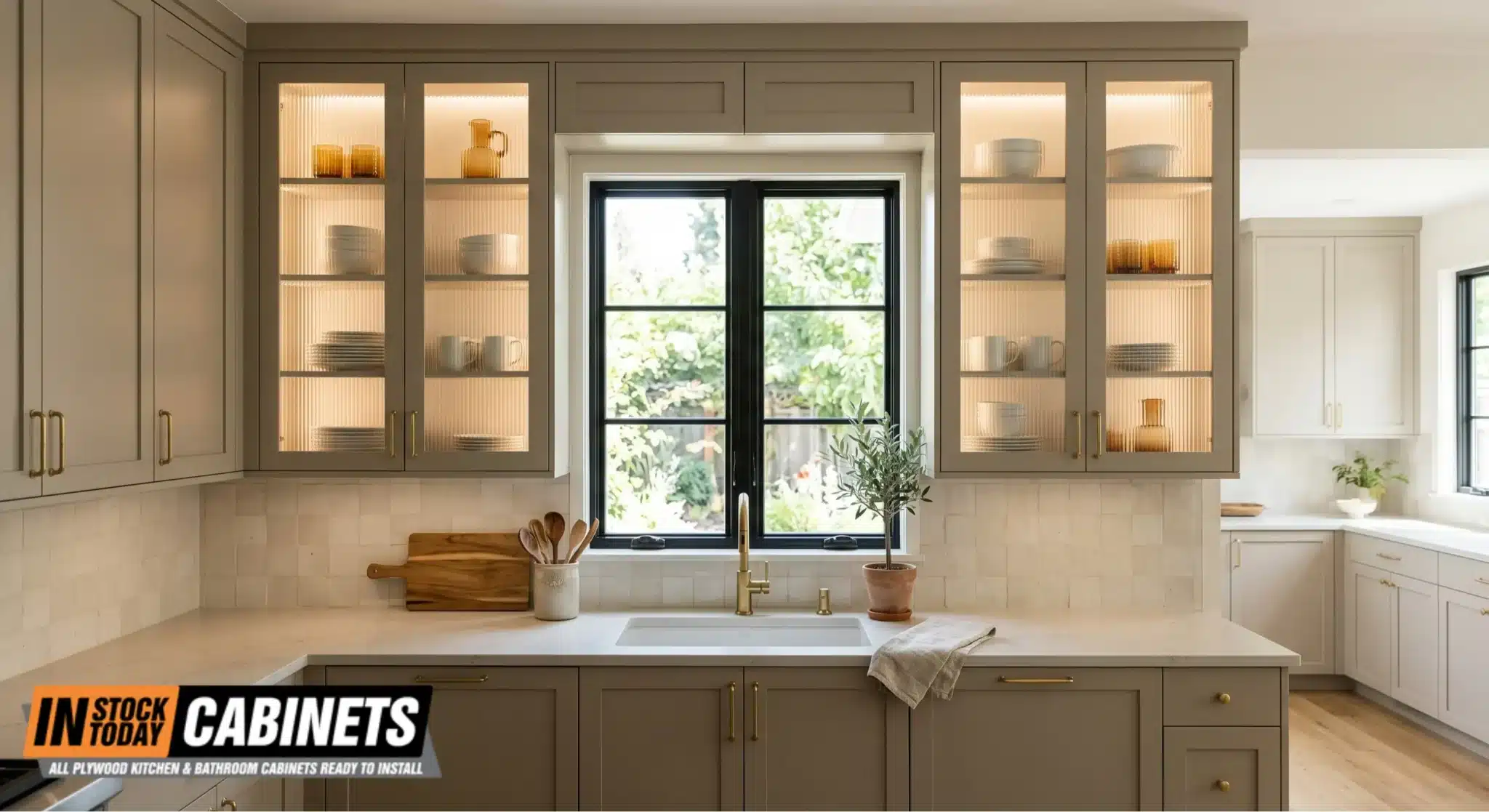
Glass cabinet doors do two things at once: they make a kitchen feel bigger and brighter, and they turn a row of closed boxes into something you actually want to look at. They are also having a real moment in 2026, helped along by reeded and fluted glass that hides a little mess while still letting light through.
This guide covers the part most articles skip: the glass itself. You will find every type of cabinet glass compared side by side, real 2026 pricing per door, design ideas for where glass belongs in a kitchen, and a few designer tricks for keeping the contents from looking like a junk drawer behind glass. If you want to add glass to doors you already own, there is a step-by-step guide linked further down.Short answer: Glass kitchen cabinet doors come in eight common glass types, from clear to frosted, seeded, reeded, and leaded. Expect to pay roughly $150 to $250 per door for stock clear glass, $250 to $400 for specialty glass, and $500 or more for custom leaded or art glass. Retrofitting glass into existing doors runs about $75 to $200 per door.
Are Glass Kitchen Cabinets Still in Style in 2026?
Yes, and they have moved past the all-glass-everything look that dated quickly. The 2026 approach is restraint. A few glass doors in a bank of solid cabinetry, usually the uppers flanking a hood or a window, reads as intentional rather than busy. Designers now treat glass as an accent, not a default. The bigger shift is the glass type. Clear glass asks you to keep everything perfect. Reeded and fluted glass, the textured vertical-line look that came back through furniture and millwork, softens whatever sits behind it. One designer’s rule of thumb: reeded glass means the shelves do not have to be styled to perfection every single day. That practicality is a large part of why textured glass searches keep climbing while plain clear glass holds steady.The Pros and Cons of Glass Cabinet Doors
Glass earns its place in a kitchen for three reasons, and it asks for a few things in return. Here is the honest trade-off before you commit to a door order.| Why people choose glass | What to plan for |
|---|---|
| Opens up the room. Glass lets the eye travel through the cabinet, so the kitchen feels deeper and larger, which helps small kitchens most. | Cleaning. Clear glass shows fingerprints and water spots. A quick wipe with glass cleaner handles it, but it is a regular task. |
| Built-in display. Dishware, glassware, and collectibles become decor. Good lighting turns a plain upper into a focal point. | It shows everything. A messy shelf is on full display. This is the real reason to keep glass to the cabinets you can keep tidy. |
| More light. Glass reflects and passes light, brightening dim corners and reducing that wall-of-wood heaviness. | Privacy. Clear glass hides nothing. Frosted, seeded, or reeded glass solves this, usually at a small upcharge. |
| Resale appeal. Glass-front uppers read as a designer detail and photograph well, which helps when a kitchen goes on the market. | Durability and cost. Glass is more fragile than a solid panel, and a glass door costs more than its wood equivalent. |
Types of Glass for Cabinet Doors
This is the decision that changes the whole look, and the one most homeowners skip past. There are eight glass types worth knowing. They differ in how much they reveal, the style they suit, and what they cost. The table compares them, and the notes below go deeper on the four most popular.| Glass type | Look | Privacy | Best for | Relative cost |
|---|---|---|---|---|
| Clear | Fully transparent, sharp and open | None | Display cabinets, fine china, anything you want seen | $ |
| Frosted | Cloudy, soft, modern | High | Hiding clutter while keeping a glass look | $$ |
| Seeded | Tiny air bubbles, vintage and handmade | Low to medium | Farmhouse, cottage, and Shaker kitchens | $$ |
| Reeded / fluted | Vertical ribbed lines, textured | Medium to high | Modern and transitional kitchens (the 2026 favorite) | $$ |
| Textured / patterned | Pressed patterns, from pebbled to geometric | Medium to high | Adding interest without full opacity | $$ |
| Leaded | Framed geometric or diamond panes | Low to medium | Traditional and period kitchens | $$$ |
| Mirrored | Reflective, glamorous | Full (reflective) | Bar areas, small kitchens that need depth | $$$ |
| Antiqued | Aged, mottled, mirror-like with patina | Medium to high | Vintage and eclectic designs | $$$ |
Frosted glass cabinet doors
Frosted glass is clear glass that has been sandblasted or acid-etched to a soft, cloudy finish. It hides the contents of a cabinet while still passing light, which makes it the easiest answer to the clutter problem. It suits modern and traditional kitchens equally and pairs well with under-cabinet lighting, which glows through the frosting instead of spotlighting whatever is inside.Seeded glass cabinet doors
Seeded glass has tiny air bubbles trapped inside, the “seeds” that give it a slightly wavy, handmade look. It reads as vintage, which is why it shows up so often in farmhouse and cottage kitchens and on Shaker-style doors. It offers a little privacy without going fully opaque, so you still get a hint of what is on the shelf.Reeded and fluted glass cabinet doors
Reeded glass has raised vertical ridges; fluted is the same idea with rounded grooves. Both blur whatever sits behind them into soft vertical streaks, so a shelf does not need to be perfectly arranged to look good. This is the texture driving most of the 2026 interest in glass cabinets, and it works in modern and transitional kitchens that want warmth without a fussy pattern.Leaded glass cabinet doors
Leaded glass joins small panes with slim metal cames into a geometric or diamond grid. It is the most traditional option here and the most decorative, which puts it at the higher end on price. It belongs in period and traditional kitchens where the detail has something to echo, like a Craftsman or Colonial design.Framed, Frameless, and Mullion Glass Doors
The glass is only half the door. How the glass is held shapes the style as much as the glass type does. Framed glass doors set the glass inside a wood frame, the same profile as the rest of your cabinetry. This is the common choice and the one that blends with a mix of solid and glass doors. Frameless glass doors skip the visible wood surround for a cleaner, more contemporary line, often in a thin aluminum profile. They suit minimalist and European-style kitchens. Mullions are the dividers that split a single glass door into a grid of smaller panes. They add a dressy, architectural touch and come in set patterns: prairie, mission, and traditional layouts are the usual options. A mullion door reads more formal than a single sheet of glass, and the mullion bars are typically finished to match the cabinet.Glass Cabinet Design Ideas
Where you put glass matters more than how much of it you use. A few ideas that work in real kitchens: Flank a focal point. Two glass uppers on either side of a range hood or a window create symmetry and frame the wall. This is the most common designer move and the hardest to get wrong. Light, dim corners and small kitchens. Glass uppers in a galley or small kitchen push the walls back visually. Pair them with mirrored or clear glass to bounce the most light. Full-height display cabinet. A single tall glass cabinet, or a glass-front section of a hutch, becomes a built-in display for dishware and serving pieces without committing the whole room to glass. Corner and end cabinets. The cabinet at the end of a run or wrapping a corner is a natural spot for glass, since it is already a visual stopping point. For broader cabinet-style planning, our guide to kitchen cabinet styles covers how glass fronts fit alongside the other door styles, and the modern kitchen cabinet ideas piece shows glass in contemporary layouts.How to Style Glass Cabinets So They Don’t Look Cluttered?
The fastest way to make glass cabinets look expensive is to treat the inside like a small display, not extra storage. Designers lean on a handful of habits: Give everything a zone. Group like with like. Mugs together, glassware together, serving pieces together. Disparate items scattered across a shelf is what reads as chaos through glass. Light the interior, and keep it warm. This is the upgrade people underestimate most. Unlit glass cabinets look flat and a little dark; lit ones look styled even when you have barely done anything. LED strips give even light along a shelf, puck lights spotlight a single piece, and a warm color temperature flatters dishware far more than a cold blue-white. If you do one thing on this list, do this. Paint the cabinet backs. A contrasting color on the interior back panel turns the cabinet into a backdrop and makes pale dishware pop. Keep the bottom shelves practical. Reserve the higher, harder-to-reach shelves for the curated, pretty pieces, and let the lower shelves stay functional. Mix glass with solid doors. The simplest fix of all. Use glass only where you want to display, and keep solid doors for the cabinets holding the cereal boxes and mismatched containers. If perfect organization is not realistic, frosted or reeded glass does the hiding for you. Keep clear glass away from the range. The one piece of placement advice homeowners repeat after the fact: glass right next to a cooktop collects cooking grease and dust film, and clear glass shows every bit of it. Put glass uppers a cabinet or two away from the stove, or use textured glass there, and you cut the cleaning down to almost nothing. Reeded, fluted, and frosted glass hide the dust film that clear glass puts on display, which is the real reason they are easier to live with day to day. On a budget or renting? Adhesive privacy film is the cheap shortcut. A roll of frosted or reeded-look window film from a hardware store covers a cabinet door for a few dollars, peels off when you move, and gets you most of the look without ordering new glass.How Much Do Glass Cabinet Doors Cost?
Glass doors cost more than solid wood or laminate doors, and the spread is wide because three things drive the price: whether you are buying a complete new door or adding glass to an existing one, the type of glass, and whether the door is framed, frameless, or has mullions. Here are the 2026 ranges.| Option | Typical 2026 price | Notes |
|---|---|---|
| Stock glass-front door, clear glass | $150 to $250 per door | Standard sizes, complete door with hinges |
| Specialty glass door (frosted, seeded, reeded) | $250 to $400 per door | Semi-custom; mullions add to this |
| Custom glass door (leaded, beveled, art glass) | $500 and up per door | Fully custom fabrication |
| Glass insert retrofit into your existing door (pro) | $75 to $200 per door | Roughly half the cost of a new door |
| DIY glass or acrylic insert | $25 to $60 in materials | Per project, if you cut and install it yourself |
Glass Cabinet Doors From Fabuwood, In Stock at IST
As an authorized Fabuwood distributor, IST Cabinets stocks glass-ready and mullion door options across the Fabuwood Allure line, built the same way as the rest of the cabinetry: all-plywood boxes, solid wood door frames, and Blum BLUMOTION soft-close hardware. Because they are in stock, kitchen cabinets are typically ready in 5 to 7 business days rather than the weeks a custom order takes. A quick note on quality, since the term gets misused online. The body that sets cabinet construction and performance standards is the Kitchen Cabinet Manufacturers Association, the KCMA, and its certification is what tells you a glass-front cabinet is built to last. Fabuwood cabinetry carries that certification. You can compare door styles and finishes in person at any IST showroom, or browse the Fabuwood collection and the Allure series to see glass-ready options.Want to Add Glass to Your Existing Cabinets?
If your cabinets are in good shape and you just want the glass look, you do not have to replace the doors. You can cut the center panel out of a solid door and drop in glass, or order glass-ready doors and add the glass yourself. We walk through both routes, the tools, and the cost in the full guide: How to Replace Cabinet Doors With Glass.Frequently Asked Questions
Are kitchen cabinets with glass doors in style in 2026?
Yes. The current look uses glass as an accent, a few doors in a run of solid cabinets, rather than across every upper. Reeded and fluted glass are the most popular choices because they add texture and hide minor clutter while still letting light through.
Are glass cabinet doors more expensive than solid doors?
Yes. A glass-front door costs more than its solid equivalent. Stock clear-glass doors run about $150 to $250 each, specialty glass like frosted or reeded runs $250 to $400, and custom leaded or art glass starts around $500 per door.
What is the best glass for hiding clutter in a cabinet?
Frosted glass hides the most while still passing light. Reeded, fluted, and seeded glass each obscure the contents to a lesser degree while adding texture. Clear glass hides nothing, so save it for cabinets you can keep tidy.
Do glass cabinets make a kitchen look bigger?
They do. Glass lets the eye travel through the cabinet to the back wall, which adds a sense of depth, and the glass reflects light around the room. The effect is strongest in small or dimly lit kitchens.
Can you mix glass cabinet doors with solid doors?
Mixing the two is the recommended approach. Use glass on the cabinets you want to display and solid doors for everyday clutter. It balances style and function and keeps the glass cabinets easy to keep looking tidy.
What is the difference between reeded and fluted glass?
Both have parallel vertical lines. Reeded glass has raised ridges with a sharper profile; fluted glass has rounded grooves. The look is similar, and both soften whatever sits behind the glass into vertical streaks.
Are glass cabinet doors hard to keep clean?
The honest answer is that clear glass needs regular dusting and the occasional wipe with glass cleaner, more than a solid door does. Dust shows more than fingerprints do. If low upkeep matters to you, reeded, fluted, or frosted glass hides the film and cuts the cleaning down a lot, and keeping glass away from the range helps too.
Are glass cabinets safe with young children?
They can be. The main concern is breakage, not the glass type, so look for tempered glass, which breaks into small blunt pieces instead of sharp shards. Keeping glass to upper cabinets, out of reach, is the simplest safeguard in a home with toddlers.
What if one glass pane breaks, can I match it?
Usually yes. Take the broken piece and its measurements to a glass shop and they can cut a replacement to size, and match common types like clear, frosted, seeded, or reeded. Rare or antique patterns are harder to match exactly, which is one reason to keep a sample or note the glass type when the cabinets go in.
Can you add glass to cabinet doors you already own?
Yes. A glass shop can rout out the center panel of a solid door and install a glass insert for roughly $75 to $200 per door, or you can do it yourself for the cost of the glass and trim. See our step-by-step guide for both methods.
See Glass Cabinet Doors in Person
Our team can match the right glass type to your kitchen and pull from in-stock Fabuwood doors, ready in 5 to 7 business days. Visit a showroom in Virginia, Maryland, Delaware, Texas or request a free design consultation.
Request a Free Consultation