
Kitchen design guide · 2026 edition
Twelve finish types, five sheen levels, three certification standards, and one decision that will outlast your appliances by a decade. Here’s how to pick the right one.
·
Reviewed by our showroom designers
·
20 min read
·
Updated May 10, 2026
Jump to
Two of the largest 2026 kitchen studies just landed, and they tell the same story from different sides of the table. Houzz surveyed 1,780 homeowners in January 2026 and found that paint still leads installed cabinets at 52% market share, with stain at 18% and natural finishes at 7%. The NKBA and KBIS 2026 Kitchen Trends Report polled designers and showed where the market is heading next: 59% see wood grain overtaking painted cabinets in popularity, and 51% name white oak the most-requested wood.
2026 finish market share
52%
Painted cabinets
18%
Stained cabinets
7%
Natural finishes
59%
Designers calling wood the next leader
Sources: 2026 Houzz Kitchen Trends Study (n=1,780 homeowners); NKBA/KBIS 2026 Kitchen Trends Report.
In other words: paint owns today, but the finish you’ll see in showrooms a year from now leans wood-forward, low-sheen, and natural. The choice you make matters because it has to last. Cabinet costs eat about 28% of a typical kitchen renovation budget, the median major remodel runs $55,000, and roughly half of homeowners now refinish or repaint their cabinets rather than replacing them. Picking the right finish is a 15-year decision.
This guide covers every kitchen cabinet finish currently in production: paint, stain, glaze, natural and clear coats, distressed treatments, thermofoil, melamine, laminate, wood veneer, lacquer, varnish, and conversion-grade catalyzed coatings. We’ll walk through sheen levels, certifications, maintenance, wood-species pairings, and which finish fits which kind of household. Then we’ll lay out what’s available across the Fabuwood lines and our in-house IST Designer Collection at our Alexandria, Columbia, Fairfax, Roselle, and Houston showrooms.
Factory finish vs site-applied finish: the question that matters most
Before you pick a finish type, you have to pick where it’s going to be applied. Factory finishes are sprayed onto cabinet doors and boxes inside a controlled environment, then cured under UV light or heat. Site-applied finishes are brushed or rolled on after cabinets are already installed in your kitchen, typically by a painter or refinisher.
Factory wins on durability nearly every time. The film build is more uniform, the cure cycle is consistent, and the catalyzed two-part coatings used in cabinet plants (conversion varnish, post-catalyzed lacquer, UV-cured acrylic) hold up to grease, steam, and daily wiping in ways that no shelf-bought cabinet paint can match. A properly factory-finished door will keep its color and surface integrity for 15 to 20 years. A site-painted door usually starts showing chips at hinges, edges, and around hardware within 3 to 5 years.
This is the single biggest reason Fabuwood’s Q12 construction standard specifies factory-applied multi-coat finish systems for every door that leaves the plant. If a budget forces you to repaint existing boxes, it’s defensible. If you’re buying new, factory finish is the answer.
The bottom line
Factory-finished cabinets last 15 to 20 years. Site-painted cabinets typically need touch-ups within 3 to 5 years. If you’re buying new, never accept a site-applied finish as the primary system.
Cabinet finish comparison: 12 finishes side by side
Here’s the quick-reference table. We’ll go through each of these in detail below.
| Finish | Surface | Durability | Maintenance | Best for |
|---|---|---|---|---|
| Paint | Solid color, hides grain | High (factory) | Easy to wipe | Most kitchens |
| Stain | Translucent, shows grain | High | Forgiving | Wood-forward kitchens |
| Glaze | Accent over paint or stain | High (sealed) | Easy | Traditional, transitional |
| Natural / clear coat | Wood, no color added | Medium-High | Forgiving | Modern minimalist, organic |
| Distressed | Intentionally aged paint or stain | High | Hides wear | Farmhouse, rustic |
| Thermofoil | Heat-bonded vinyl on MDF | Medium | Very easy | Kid-friendly, rentals |
| Melamine | Resin-impregnated paper laminate | Medium-High | Very easy | Cabinet interiors, budget |
| Laminate (HPL) | High-pressure laminate sheet | High | Very easy | High-traffic, contract |
| Wood veneer | Real wood layer over substrate | Medium-High | Like solid wood | Modern slab, sustainability |
| Lacquer | Hard, glossy or satin film | High | Wipe clean | European modern, frameless |
| Varnish | Transparent topcoat over stain | High | Easy | Stained wood protection |
| Conversion varnish | Two-part catalyzed coating | Very High | Very easy | Premium factory cabinets |
Hands-on selection
See every finish on a real door, in real light.
Our showrooms display hundreds of door samples across paint, stain, glaze, and the IST Designer Collection. Bring a counter sample. We’ll set up a side-by-side comparison and walk you through the trade-offs.
Painted cabinet finishes
Paint is still the largest installed category in U.S. kitchens. Houzz puts it at 52% of new cabinets, and it stays popular because it offers the widest color range, the cleanest visual, and the easiest design coordination with countertops, walls, and flooring. The 2026 designer trend isn’t away from paint, it’s away from shiny paint. Of newly specified painted cabinets in 2026, roughly 65% land at satin sheen, 25% at matte, and only 10% at semi-gloss or full gloss.
The coating itself matters more than the color. Factory-painted cabinets typically use waterborne acrylic, alkyd-modified urethane, or post-catalyzed lacquer, applied as a multi-coat system: primer, color coat or coats, and a clear topcoat. The center panels of painted Shaker doors are usually MDF rather than solid wood, because MDF is dimensionally stable and won’t expand or contract enough to crack the paint film at the seams. Solid wood frames around an MDF panel are the standard for mid-tier and premium painted cabinets.
One thing to know going in: even on the best factory-painted cabinets, hairline cracks can develop over time at miter joints and rail-to-stile junctions. The wood frame moves seasonally, and rigid paint film doesn’t. This is normal, it’s industry-wide, and it’s why Fabuwood and most major manufacturers offer a separate two-year warranty specifically on painted finishes versus a longer warranty on construction. If your painted cabinet develops a witness line at a joint after a few seasons, you didn’t get a defective cabinet. You got a wood cabinet.
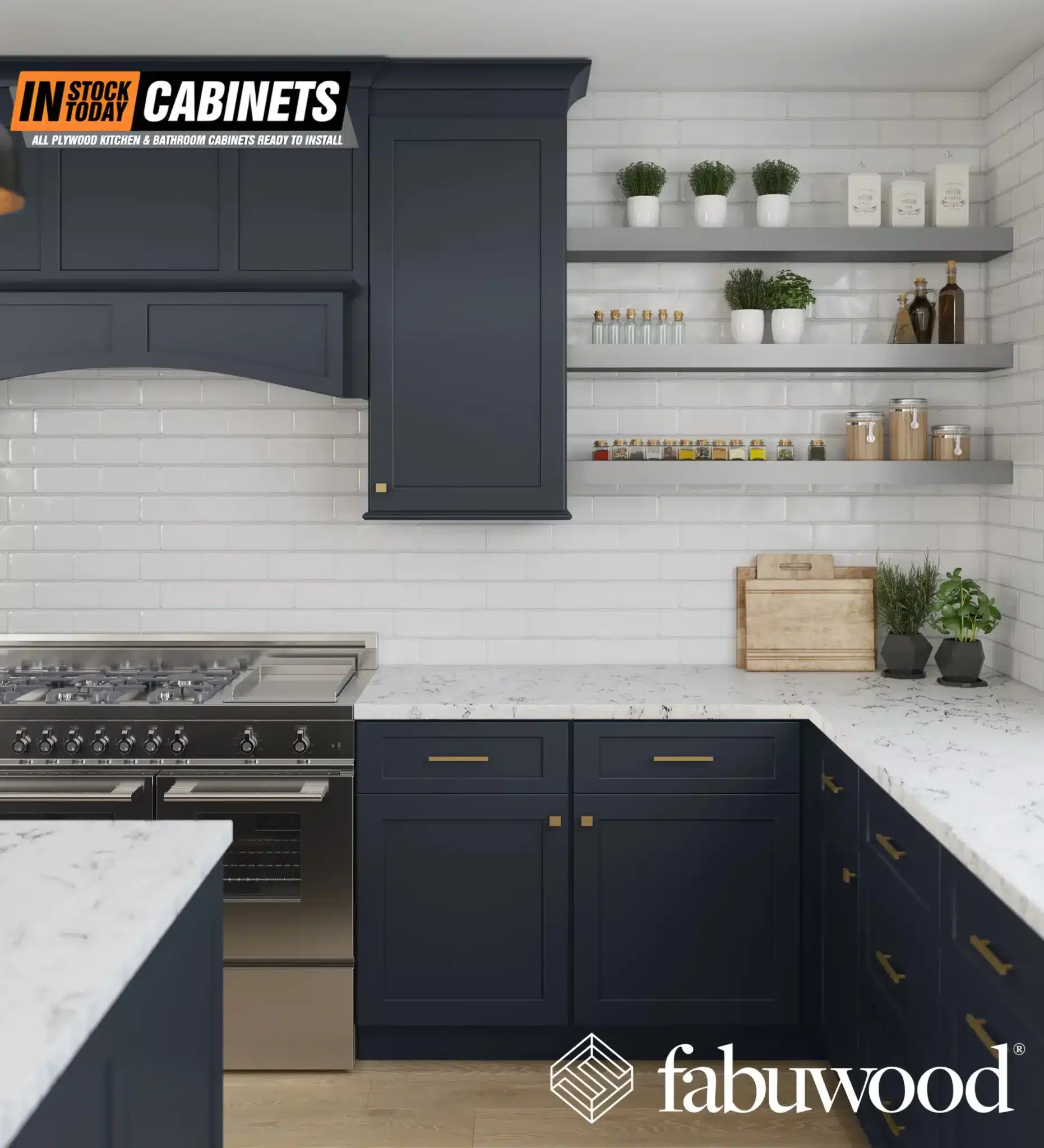
A hairline crack at a rail-to-stile joint isn’t a defective cabinet. It’s a wood cabinet doing what wood does.
Stained cabinet finishes
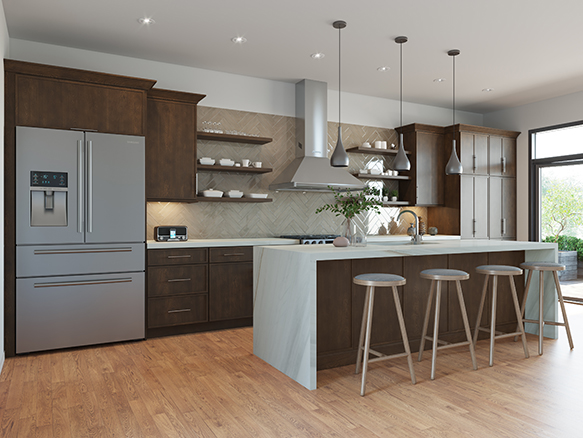
Stain pulls color into the wood instead of laying color on top of it. The grain stays visible. Knots, mineral streaks, and natural color variation show through, which is the whole point. Stain comes in roughly four depth bands: light naturals like Honey or Wheat, medium tones like Walnut or Pecan, dark stains like Espresso or Charcoal, and near-black ebony. Within each band you can apply the stain by spray or by hand-wipe.
Sprayed stain produces a more uniform color across every door, drawer front, and face frame in the kitchen. Hand-wiped stain absorbs unevenly into the wood, settling deeper in some areas and lighter in others. That variability is intentional and usually preferred for traditional, transitional, or rustic kitchens. For modern minimalist work, sprayed is cleaner.
Wood species matters enormously for stain. Oak, cherry, maple, walnut, and hickory all behave differently. Open-grain woods like oak take stain readily and exaggerate it. Tight-grain woods like maple resist stain absorption and can blotch under darker stains, which is why maple is more often paired with light stains or paint. Cherry darkens naturally with light exposure, so a light cherry stain in year one will look medium by year five regardless of what you do.
Stain almost always sits under a clear protective topcoat, usually a varnish or catalyzed lacquer. The stain provides the color, the topcoat provides the wear protection. A bare stained cabinet without topcoat will not survive in a working kitchen.
Glazed cabinet finishes
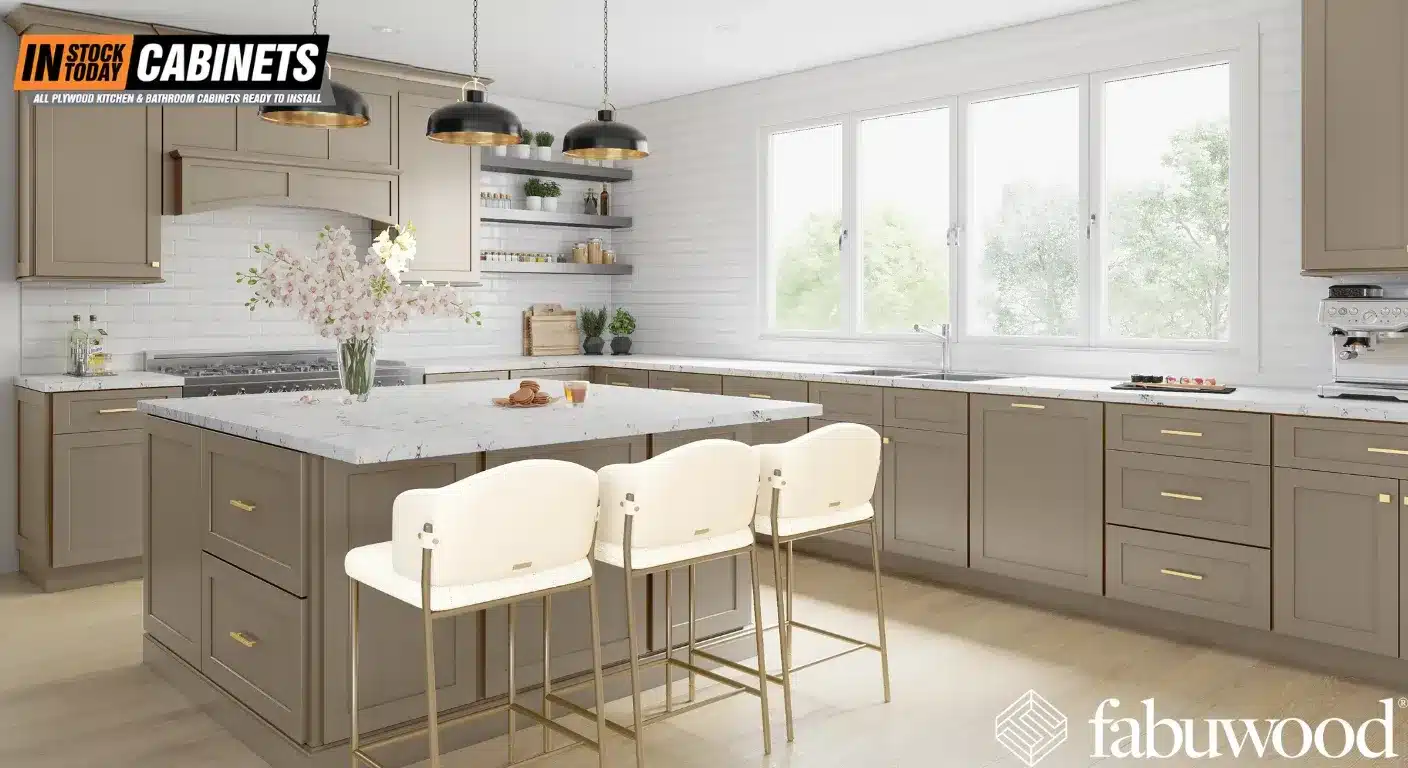
A glaze is a tinted layer applied over a base paint or stain to add depth, age, and shadow to a cabinet door. It’s not the cabinet’s primary color. It’s an accent layer that settles into the recesses, profiles, and routed edges of the door, then gets wiped back on the flat areas. The result reads as antique, hand-finished, and dimensional rather than flat.
There are four glazing techniques used in cabinet manufacturing. Full glaze coats the entire door and gets wiped back uniformly. Brush glaze is applied in directional brushstrokes, leaving visible streaks. Accent glaze is applied only to the profile edges and corners, leaving flat panel areas clean. Pen glaze is the lightest touch, applied only into the deepest crevices for subtle shadowing.
One detail worth knowing before you order: a glazed finish is intentionally uneven by design. As Fabuwood notes in their Allure construction documentation, glazing varies cabinet to cabinet because the wipe-back is a hand process. Some edges and profiles will show heavier hang-up than others. If you want every door to look identical, glaze is the wrong choice. If you want a kitchen that reads as crafted rather than manufactured, glaze is exactly right.
Natural and clear-coat finishes
Natural finishes leave the wood unstained and add only a clear protective coating. The whole point is to see the wood honestly: grain pattern, color variation, knots, and figure. Within the natural category there are three main approaches. Penetrating oil finishes (tung, linseed, hardwax oil) soak into the wood fibers and leave almost no surface film. Wax finishes provide low sheen and a soft hand feel but minimal moisture protection. Water-based clear coats (acrylic, polyurethane) form a thin, hard, transparent film that protects the wood while keeping its color and grain visible.
Natural finishes are the dominant 2026 direction in modern minimalist and organic kitchens, especially with white oak. Designer-spec data shows about 80% of wood-grain cabinets are now finished with low-sheen clear coats rather than glossy ones. The clear coat does the actual work, the wood does the design.
Distressed, rub-through, and antiqued treatments
Distressed finishes deliberately add wear, dents, worm holes, brushed grain effects, and rub-through to make new cabinets look authentically aged. The work happens before final topcoat application, so the distressing is sealed in and protected from further damage. A rub-through treatment is the lightest version: standard paint is mechanically removed from edges and decorative profiles to expose the wood underneath, suggesting decades of use. Heavier distressing adds surface dings, simulated insect damage, and hand-applied glaze antiquing.
Distressed finishes work in farmhouse, French country, rustic, and industrial-vintage kitchens. They have a side benefit worth mentioning: real-life dings and scratches blend in. A pristine modern kitchen broadcasts every chip. A distressed kitchen absorbs them.
Thermofoil cabinets
Thermofoil is a vinyl film that’s heat-pressed and vacuum-formed onto an MDF or particleboard substrate, fully wrapping the door front, edges, and profiles in one continuous unbroken surface. There are no joints, no mitered corners, no rail-to-stile seams to crack. The look ranges from solid colors that mimic painted finishes to printed patterns that mimic wood grain.
The case for thermofoil is simple and pragmatic. It’s affordable, it cleans with a damp cloth, it doesn’t chip or develop hairline cracks the way painted wood does, and the wrapped construction means no caulk lines or trim seams collect kitchen grease. Families with young children, rental property managers, and homeowners on a tight remodel budget are the primary buyers, and the category supports about 1,900 monthly U.S. searches because the value proposition is real.
The case against is heat tolerance. Thermofoil has a temperature ceiling. Cabinets installed directly above a self-cleaning oven, a wall oven on convection, or a high-output range without a proper heat shield can develop bubbling, peeling, or delamination at the foil edges over time. Modern thermofoil products are dramatically more heat-tolerant than the early-generation versions from the 1990s, but the rule still holds: if you’re putting cabinets within 2 inches of a heat source, ask the manufacturer about their thermal rating before you order.
Melamine cabinet finishes
Melamine is a thermally fused decorative paper that’s bonded to particleboard or MDF under heat and pressure, producing a hard, smooth surface that’s exceptionally resistant to moisture, scratches, and most kitchen chemicals. It outranks thermofoil and most laminates on stain resistance, which is why melamine is the universal default for cabinet box interiors across the entire industry, from budget RTA to premium custom.
As a door material, melamine is less common in residential kitchens than in commercial applications, but it has a place in budget kitchens and high-traffic environments. The 1,300 monthly searches for the term are mostly people researching the box-interior application, not exterior doors. Inside the cabinet, melamine is what’s keeping your dishes off raw particleboard.
Laminate (HPL and LPL)
Laminate cabinet doors come in two grades. High-pressure laminate (HPL) is the premium version: multiple kraft paper layers fused together at very high pressure, producing a thick, dimensionally stable, heat-tolerant material that’s used in commercial casework, contract kitchens, and modern frameless residential lines. Low-pressure laminate (LPL) is essentially the same as melamine, used for cabinet interiors and budget exteriors. Modern HPL doors come in solid colors, woodgrain prints, metallic effects, and increasingly in matte anti-fingerprint finishes that compete directly with high-end European lacquer.
Wood veneer finishes
A wood veneer is a thin slice of real hardwood (typically 0.5 mm to 2 mm thick) bonded to a stable substrate like MDF or plywood. The substrate provides dimensional stability and cost control, the veneer face provides authentic wood character. Veneer is the standard construction for most flat-panel slab doors in modern frameless kitchens, including white oak, walnut, and rift-cut oak slabs that are central to the 2026 wood-forward trend. Veneered doors can be stained, clear-coated, or oiled exactly like solid wood. From the front, you can’t tell the difference. The advantage is sustainability: a single hardwood log produces dozens of veneer faces’ worth of cabinetry instead of a handful of solid panels.
Lacquer cabinet finishes
Lacquer is a fast-drying, hard-curing coating that produces some of the smoothest, most uniform surfaces in the cabinet industry. There are three lacquer categories used in cabinet production. Nitrocellulose lacquer is the traditional formulation, easy to repair and refinish but less moisture-resistant than modern alternatives. Pre-catalyzed lacquer adds chemical hardeners during manufacturing for better moisture and chemical resistance. Post-catalyzed (conversion) lacquer is mixed with hardener immediately before application and produces the hardest, most chemical-resistant cabinet finish on the market.
High-gloss lacquered doors are the hallmark of European modern design and frameless kitchens, and they’re what you’ll see on Fabuwood’s Illume series. Modern matte lacquer is the more 2026-relevant story, however. Anti-fingerprint matte lacquers from European specialty coaters now solve the historical complaint about matte finishes (which used to show grease and water marks more than gloss did), and they’re the dominant choice for handleless modern kitchens where the cabinet front is touched constantly.
Varnish, polyurethane, and conversion varnish
These are protective topcoats applied over stain or natural wood. Standard varnish is an oil-based clear coat with good clarity but slow drying time, used mostly in custom and refinishing work. Polyurethane comes in oil-based and water-based formulations, both producing a hard transparent film with excellent moisture resistance. Conversion varnish, the premium category, is a two-part catalyzed coating that cures by chemical reaction rather than evaporation, producing a finish that resists chemicals, heat, and abrasion better than any single-part topcoat. Most premium factory-finished stained cabinets use conversion varnish as the protective layer. If durability matters and you can specify, this is the topcoat to ask for.
Cabinet finish sheen guide: matte to high gloss
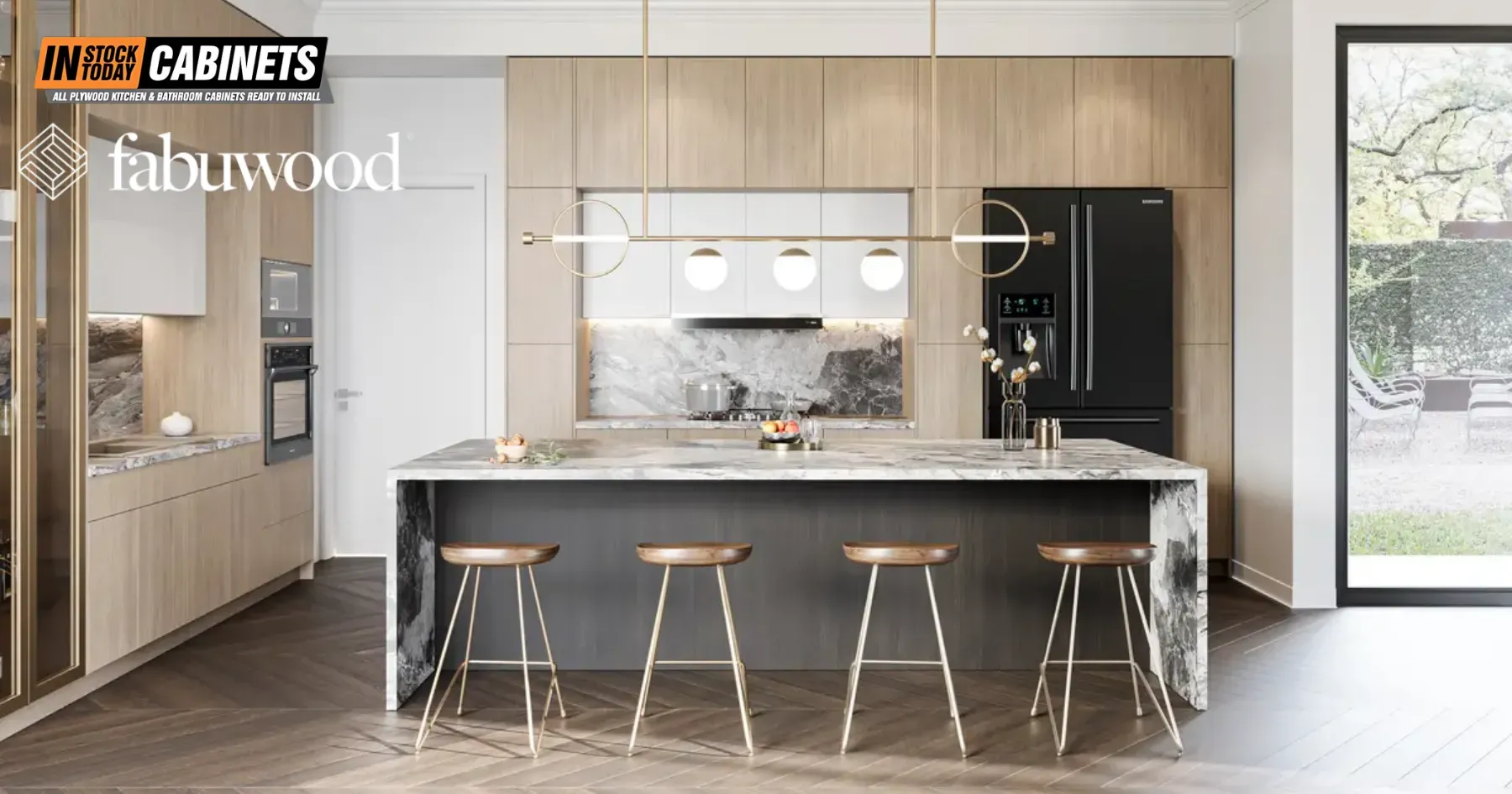
Sheen is how much light a finish reflects, and it’s the single most-debated detail in any kitchen specification meeting. The sheen ladder runs from matte (zero reflection) through eggshell, satin, semi-gloss, and up to high gloss (mirror-like). Same color, same coating chemistry, totally different finish read.
Matte
Matte finishes absorb almost all light and produce a soft, suede-like surface. They diffuse glare from ceiling lights and windows, photograph beautifully, and hide minor surface imperfections. The historical knock against matte was that it showed grease, fingerprints, and water marks more readily than glossier finishes. Modern matte coatings have largely solved that problem with anti-fingerprint nano-coatings, which is why matte is the fastest-growing sheen category in 2026 design.
Eggshell
Eggshell sits one click up from matte. It has a very subtle sheen that’s barely visible head-on but catches light at oblique angles. It cleans easier than matte and reads slightly more refined.
Satin
Satin is the workhorse of painted kitchens and the dominant 2026 sheen. About 65% of new factory-painted cabinets ship in satin. It cleans easily, resists staining, holds color through repeated wiping, and offers a soft glow that flatters most lighting conditions without producing glare.
Semi-gloss
Semi-gloss reflects light clearly and reads more polished and formal. It’s still common in traditional kitchens and is the most stain-resistant sheen on the ladder. Some homeowners specify semi-gloss specifically for the easier cleanup, especially in households that cook frequently with oils and high-splatter foods.
High gloss
High-gloss creates near-mirror reflectivity. It’s the signature finish of European modern frameless kitchens and high-end contemporary designs. It also broadcasts every imperfection: dust, fingerprints, smudges, surface scratches. High-gloss demands more daily maintenance than any other sheen, but in a well-lit modern kitchen, nothing else looks like it.
Wood species and finish pairing

Not every finish works on every wood. The species you start with shapes which treatments will read well and which will fight you. Here’s how the five most-specified cabinet hardwoods behave with the major finish categories.
White oak is the headline species of 2026 (51% of designers in the NKBA report named it the most popular wood). Its open, ring-porous grain takes stain dramatically and looks particularly strong in clear coats and light naturals. Less ideal under solid paint, where the open grain telegraphs through. Cherry has a smooth, closed grain that takes medium and dark stains beautifully but darkens naturally over time regardless of finish. Best with stain or clear coat. Avoid heavy paint, which fights its character.
Maple has a tight, fine grain and a near-uniform color, which makes it the universal donor for painted cabinets. Most factory-painted cabinets in mid and premium tiers are maple frames with MDF panels. Maple can blotch under dark stains, so light stain or paint is the safer pairing. Walnut is a luxury species with deep chocolate-brown tones and refined grain. It’s almost always finished natural with clear coat or hardwax oil to showcase its color. Staining or painting walnut buries what you paid for. Hickory shows dramatic light-and-dark variation within a single board. It takes warm amber stains exceptionally well and works best in rustic, farmhouse, and country kitchens where its natural variation is part of the design.
For a deeper look at species selection, see our guide on construction-grade hardwoods in Shaker cabinets.
Sustainability, VOCs, and certifications
In 2026, sustainability isn’t a marketing layer on top of cabinetry. It’s a baseline expectation, especially for finishes, because the coating is what off-gasses into your home. The certifications worth understanding before you sign a quote are these:
KCMA A161.1
KCMA ESP
GREENGUARD Gold
FSC chain-of-custody
TSCA Title VI is the U.S. federal formaldehyde-emission standard for composite wood products like MDF, particleboard, and plywood. Any reputable cabinet sold in the United States must meet TSCA Title VI. If a product can’t show compliance, walk. KCMA A161.1 is the Kitchen Cabinet Manufacturers Association’s structural durability standard, covering door operation cycles, finish resistance, hinge testing, and drawer-pull cycling. KCMA ESP (Environmental Stewardship Program) covers manufacturing-process sustainability: energy use, waste handling, sourcing.
GREENGUARD certification (especially GREENGUARD Gold) tests finished products for low chemical emissions in indoor air. Cabinets with GREENGUARD Gold are appropriate for sensitive environments like nurseries and schools. FSC (Forest Stewardship Council) chain-of-custody certification confirms that wood used in the cabinet was sourced from responsibly managed forests with documented provenance.
On the coating chemistry side, the meaningful shift in the last decade has been from solvent-based finishes to waterborne acrylics and water-based polyurethanes. Waterborne coatings cut volatile organic compound emissions dramatically without sacrificing durability. Most major cabinet manufacturers (including Fabuwood) have transitioned their interior finish lines to waterborne or low-VOC catalyzed systems. Ask which finish system a cabinet uses if it matters to you, the answer is on the spec sheet.
Cabinet finish maintenance and care
Different finishes need different care. The wrong cleaner can strip a stain in a year or fog a high-gloss lacquer in a month. Here’s the short version per finish type.
Painted cabinets — damp microfiber cloth, a few drops of mild dish soap. Avoid ammonia, bleach, abrasive scrubbers, and citrus solvents. Touch up minor chips with the manufacturer’s matched paint.
Stained and natural-finished cabinets — the most forgiving. Damp microfiber, occasional wood-specific cleaner, and quarterly conditioning with a wood-safe oil. Don’t leave water sitting on the finish.
Glazed cabinets — same as base finish, but resist scrubbing the recessed areas where glaze pools. Aggressive cleaning will lift it.
Thermofoil and laminate — tolerate stronger cleaners than wood, but still avoid abrasives. Damp cloth, mild detergent, dry afterward. Don’t let standing water sit at edges.
High-gloss lacquer — only microfiber and water, or a manufacturer-approved gloss cleaner. Paper towels, glass cleaner, and abrasive sponges leave permanent micro-scratches that catch light and ruin the reflection.
How to choose: matching finish to household
Pricing, color, and showroom samples will only get you so far. The better question is which finish fits how you actually live. Five household profiles to anchor the decision:
Profile 01
Family with young kids
Pick: thermofoil, melamine, or factory-painted satin.
Avoid: high-gloss lacquer, deep glaze recesses.
Profile 02
Heirloom kitchen, 20-year horizon
Pick: factory-finished stained wood with conversion varnish topcoat.
Why: the most durable system in the industry. Wood gains character.
Profile 03
Modern minimalist
Pick: matte painted slab in a saturated color, or natural white oak veneer with low-sheen clear coat.
Why: aligns with the 2026 designer-led shift to wood and matte sheens.
Profile 04
Rental property or flip
Pick: thermofoil or laminate exterior over MDF substrate.
Why: cost-controlled, hides tenant wear better than painted wood.
Profile 05
Traditional or transitional
Pick: painted Shaker doors with a soft brush glaze accent in warm cream or oyster.
Match: Fabuwood Allure with Galaxy or Fusion door styles.
The finish portfolio at IST: Fabuwood plus IST Designer Collection
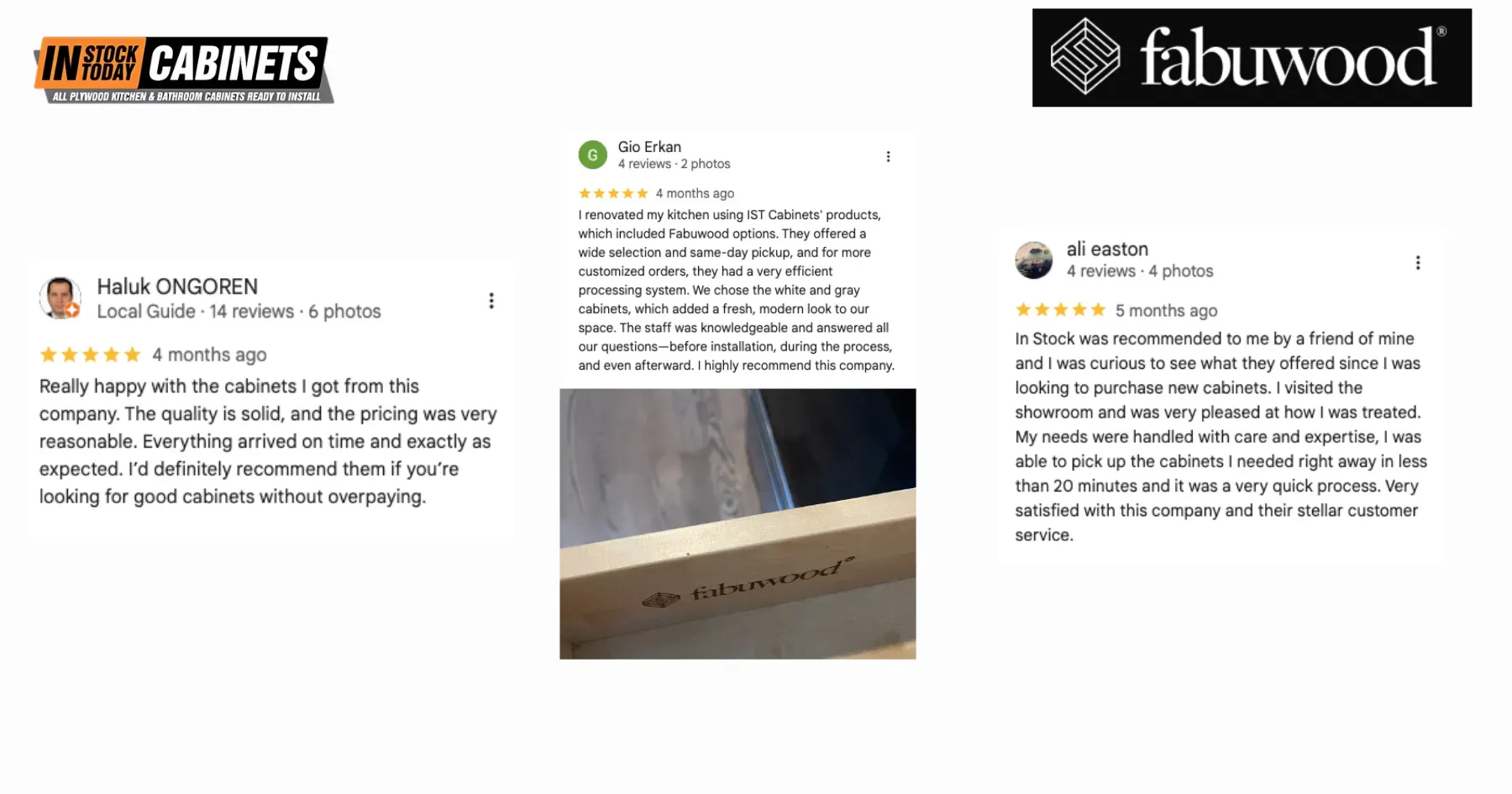
In Stock Today Cabinets stocks every finish category covered above through two main programs: Fabuwood factory-finished cabinetry across multiple series, and our own IST Designer Collection produced in-house at roughly 3,000 cabinets per week.
Fabuwood Allure
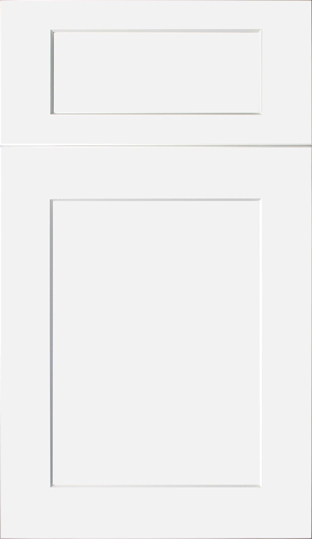
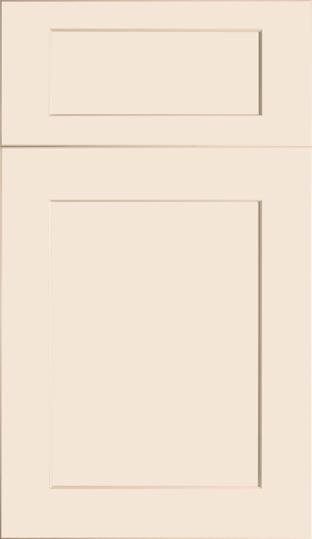
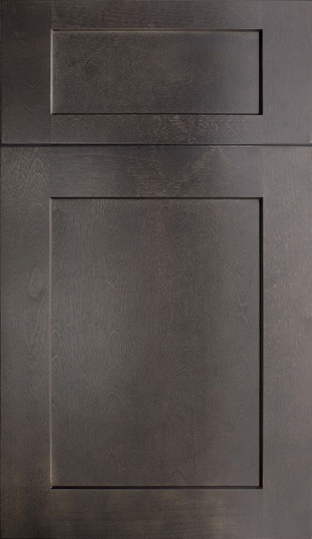
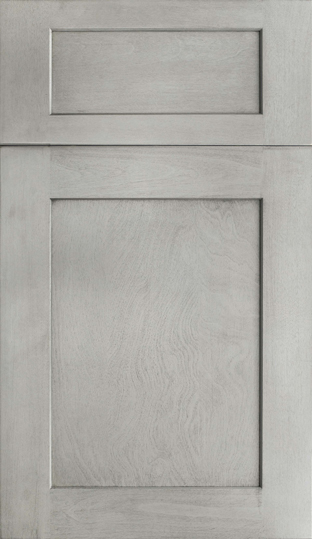
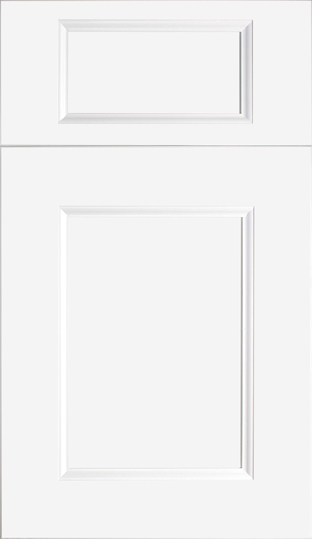
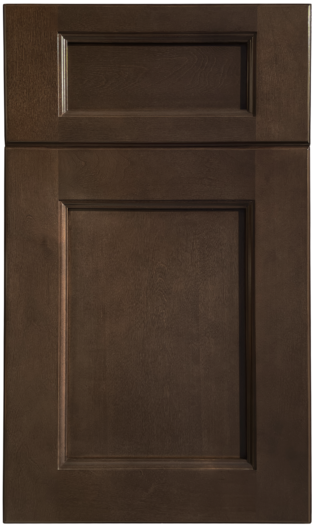
A sample of the Allure finish range. The full line carries 100+ options across six door styles.
The broadest finish range in the line. Six door styles (Galaxy, Luna, Fusion, Onyx, Imperio, and Nexus) and over 100 finish options spanning painted, stained, and glazed treatments. If you want the most variety in one series, this is where to start.
Fabuwood Illume
The frameless modern series. This is where Illume’s high-gloss and satin lacquered fronts live, including the European-inflected designs that pair with handleless modern kitchens.
Fabuwood Quest, Value Premium, Prima, Classic, and Geneva
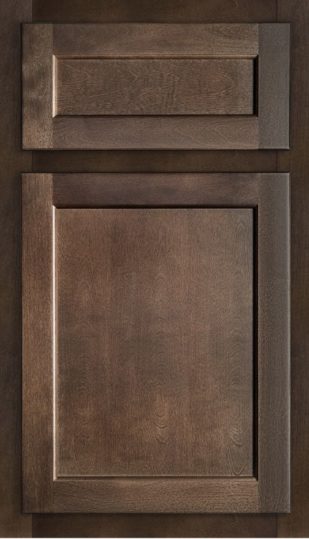
Quest leans toward warm stained finishes (the Metro Java pictured here is a popular dark-stained option), ideal for traditional and transitional kitchens that want visible wood grain rather than paint. Value Premium, Prima, Classic, and Geneva round out the Fabuwood mid-tier, all available in both painted and stained options.
Exclusive to IST
The IST Designer Collection
Our in-house manufactured line, produced at roughly 3,000 cabinets per week. Nineteen exclusive colors not available from any major cabinet brand. Every cabinet ships factory-finished, with typical lead times of 5 to 7 business days.
Cloud White
Denim Blue
Ocean Blue
Hunter Green
Pitch Black
Graphite Black
Pistachio Green
Timber
Dove
Indigo
Kona
Nickel
Blanc
Stone
Oyster
Cobblestone
Horizon
Frost
Kitchen cabinet finishes: frequently asked questions
Ready to choose
See every finish side by side at an IST showroom.
Bring a counter sample, a backsplash chip, and your time. We’ll set up doors next to each other, walk you through the trade-offs, and help you build a finish package you’ll still love in 15 years.
Showrooms in Alexandria VA · Fairfax VA · Columbia MD · Houston TX
Continue reading
2026 Kitchen Cabinet Trends ·
Cabinet Styles Guide ·
Is Fabuwood a Good Cabinet? ·
Common Pitfalls in Shaker Finishing