
The Contractor’s Real Math on Cost, Quality & Installation
A Data-Driven Case Study for Builders Who Run the Numbers Before Picking a Cabinet Line
Seventy-One Percent of Builders Say Labor Is Their Biggest Cost Problem. Their Cabinet Strategy Should Reflect That.
A 2024 NAHB survey found that 71% of residential builders named labor costs as their single greatest challenge. Material prices rose 8–12% that same year. Softwood lumber spiked 23% year-over-year in early 2025. And the Bureau of Labor Statistics projects a 3% decline in carpenter employment through 2029.
So the RTA vs pre-assembled cabinet decision is no longer a question about quality. CNC manufacturing has closed that gap. It’s a business strategy question—one that directly affects your profit margins, your project timelines, your liability exposure, and your ability to scale.
Most online comparisons of RTA vs. pre-assembled cabinets are written for homeowners deciding between IKEA and a big-box store. They repeat the same five points: RTA is cheaper, flat-packs ship easier, assembly takes 20–45 minutes, pre-assembled saves time, and cabinet quality varies by brand. All true. All useless to a contractor managing three concurrent kitchen remodels and a 40-unit apartment buildout.
We built this case study for you. It includes the profit formulas, liability analysis, multi-unit logistics, and warranty fine print that nobody else publishes—because we sell both RTA and pre-assembled lines and have no reason to push one over the other.
10 Key Takeaways From This Guide
The $128 Breakeven Rule: If your fully loaded crew rate is below $128/hour, RTA generates more profit per kitchen. Above that, pre-assembled is the better financial move.
$377 Net Savings Per Kitchen: After factoring in assembly labor, shipping, damage risk, and consumables — not just sticker price — RTA saves $377 per 10×10 kitchen at a $75/hr crew rate.
$7,540 on a 20-Kitchen Project: RTA material and logistics savings compound fast at scale. Twenty kitchens at $377 each adds $7,540 to your project profit from cabinet selection alone.
The Liability Gap Nobody Talks About: When you assemble RTA cabinets, you absorb the manufacturer’s assembly liability. Most RTA warranties void on “improper assembly” — and your standard CGL policy may not cover it either.
Quality Is About Specs, Not Format: A plywood RTA cabinet with pocket-screw joinery and Blum hardware (200,000-cycle tested hinges) matches or beats a particleboard factory-assembled unit at twice the price.
71% of Builders Cite Labor as Their Top Cost Challenge: RTA lets you shift assembly to lower-cost crew hours or off-site shop time, freeing skilled carpenters for installation and finish work.
3–4× More Kitchens Per Truck: Flat-pack RTA puts 150–200 kitchens on a 53-foot trailer versus 50–60 pre-assembled — cutting freight costs and carbon emissions per unit delivered.
Mix Formats, Don’t Pick Sides: Use RTA for standard base and wall cabinets. Use pre-assembled for lazy susans, blind corners, and specialty pieces where factory QC prevents costly assembly errors.
“Lifetime Warranty” Usually Doesn’t Cover Labor: Most cabinet warranties exclude removal, installation, and shipping costs — the expensive parts of a warranty claim. Some exclude rental and commercial use entirely.
5–7 Days vs. 8–12 Weeks: IST Cabinets ships stock RTA and Fabuwood pre-assembled within a week, with same-day pickup at five locations — while semi-custom lines still quote two to three months.
The Real Cost Comparison: Beyond the Sticker Price
Every cabinet blog on the internet starts with a price table. So will we—but ours includes the numbers contractors actually need: total installed kitchen cabinet cost, not just the per-linear-foot material price.
Material Cost per Linear Foot (2025–2026 Data)
| Cabinet Type | Cost / Linear Foot | 10×10 Kitchen (Materials Only) |
|---|---|---|
| Economy RTA (particleboard) | $100 – $150 | $1,200 – $2,500 |
| High-End RTA (plywood) | $200 – $350 | $2,800 – $5,000 |
| Stock Pre-Assembled | $150 – $400 | $3,500 – $6,500 |
| Semi-Custom Assembled | $350 – $800 | $8,000 – $15,000 |
| Custom Assembled | $700 – $1,200+ | $25,000+ |
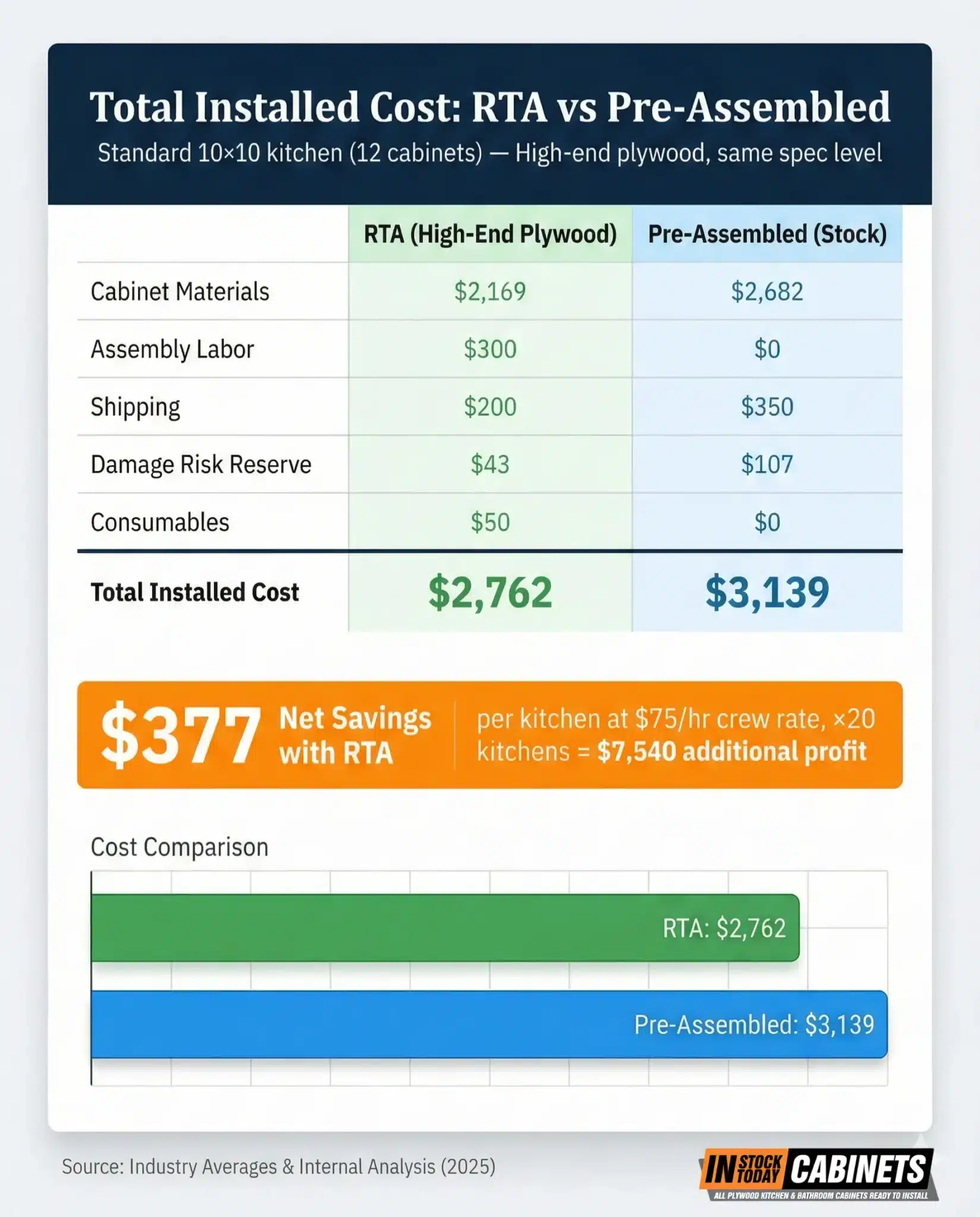
An apples-to-apples comparison tells the story fast: the same cabinet in a 10×10 kitchen layout costs roughly $2,169 as RTA versus $2,682 pre-assembled—a 24% premium, or about $513 per kitchen. Across a 20-unit apartment project, that’s $10,260 in material savings before you factor in labor.
But that’s only half the equation.
The Breakeven Labor Rate Formula (What No Competitor Publishes)
Here’s the calculation that actually matters for your business: at what hourly crew rate does assembling RTA cabinets stop being profitable?
| The Formula: Breakeven Rate = Material Savings Per Kitchen ÷ Assembly Hours Per Kitchen |
Using industry-corroborated data: a 12-cabinet kitchen saves approximately $513 in materials with RTA. An experienced crew assembles that kitchen in about 4 hours (10–15 minutes per base, 7–10 minutes per wall cabinet).
$513 ÷ 4 hours = $128.25 per hour.
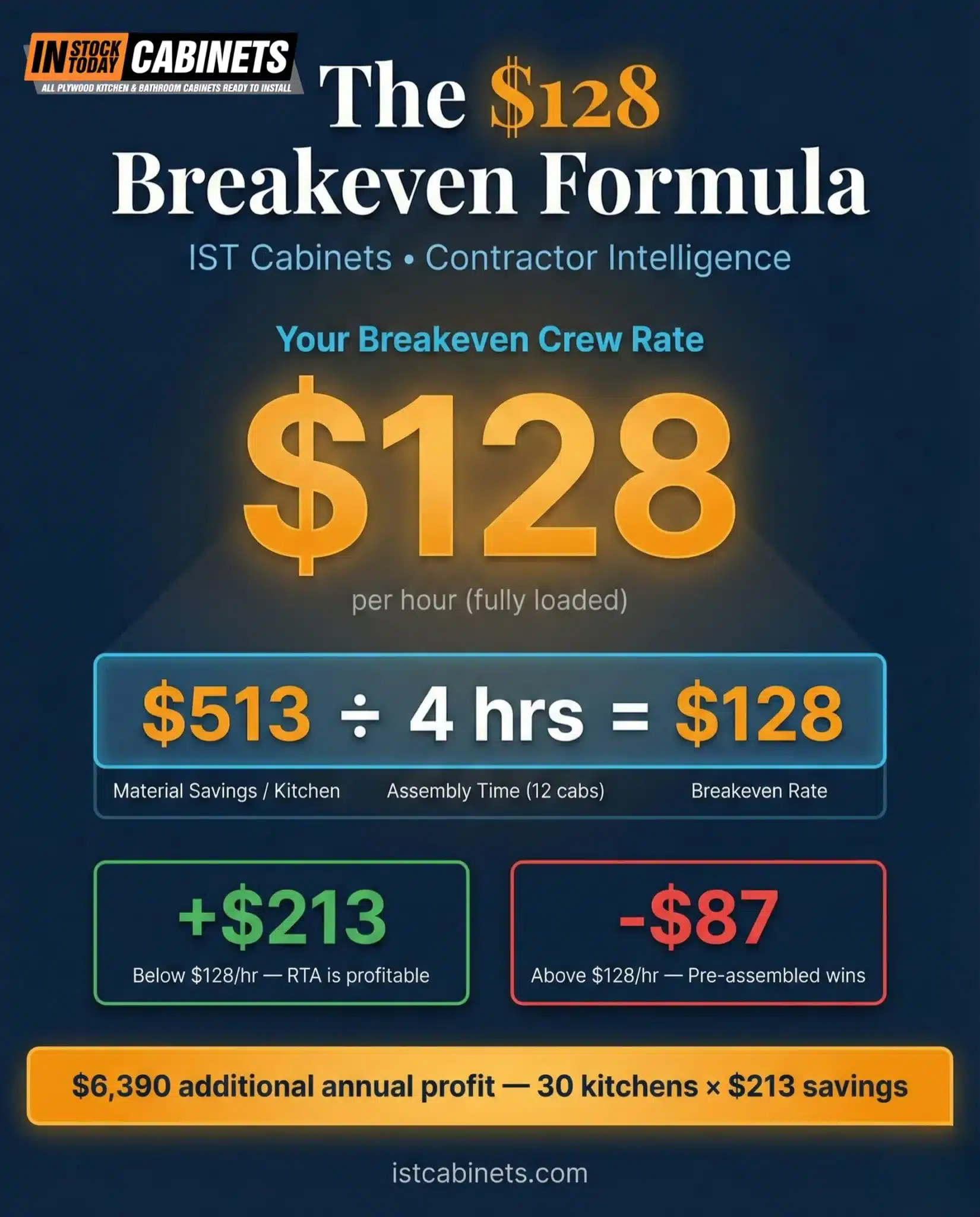
| If your fully loaded crew rate is below $128/hour, RTA generates more profit per kitchen. Above $128/hour, pre-assembled is the better financial decision. |
A mid-market contractor billing at $75/hour spends $300 in assembly labor per kitchen, netting $213 in savings. Do that across 30 kitchens in a year, and you’re looking at $6,390 in additional profit—from cabinet selection alone.
What about a high-end remodeler billing at $150/hour? Assembly costs $600 per kitchen, which exceeds the $513 savings by $87. Pre-assembled is the clear play.
Total Installed Cost: A Side-by-Side Breakdown
| Cost Component | RTA (High-End Plywood) | Pre-Assembled (Stock Plywood) |
|---|---|---|
| Cabinet Materials | $2,169 | $2,682 |
| Assembly Labor (4 hrs × $75/hr) | $300 | $0 (factory-included) |
| Shipping (flat-pack vs bulky) | $200 est. | $350 est. |
| Damage Risk Reserve (2% vs 4%) | $43 | $107 |
| Consumables (glue, nails, disposal) | $50 | $0 |
| Total Contractor Cost | $2,762 | $3,139 |
| Net Savings with RTA | $377 per kitchen | — |
Based on same-line comparison (Ice White Shaker, Kitchen Cabinet Kings) with professional assembly at $75/hr.
Don’t forget the hidden ledger. RTA requires consumables: PVA wood glue, brad nails, and packaging disposal. A full kitchen generates 36–48 boxes of cardboard and styrofoam. Budget $30–50 for disposal, and factor in the 1.5–2 hours your crew spends unboxing, sorting, and managing waste.
Cabinet Quality in 2026: The Gap That Closed (and the One That Didn’t)
Five years ago, the knock on RTA was that it’s particleboard junk held together with cam-locks. That hasn’t been accurate since CNC routers started cutting panels to within 0.1mm accuracy regardless of where the cabinet gets assembled. The same Blum Bluemotion hinge performs identically whether it’s installed in a factory in New Jersey or on a job site in Dallas.
But there’s a cabinet quality gap nobody talks about: the one between joinery systems.
Joinery: Where Quality Actually Lives
| Joinery Type | Found In | Strength Assessment | Long-Term Risk |
|---|---|---|---|
| Cam-lock & dowel | Economy RTA | Mechanical only; no chemical bond | Loosening under vibration; no re-tightening possible |
| Pocket screw + PVA glue | Professional RTA | Chemical + mechanical; rivals mortise-and-tenon | Near-zero when glued and clamped properly |
| Dovetail drawer box | Premium RTA & assembled | Interlocking wedge resists pull-apart | Industry gold standard; identical across formats |
| Factory hot-melt adhesive | Stock pre-assembled | Fast industrial bond | Consistent but not stronger than pocket screw + PVA |
Peer-reviewed research on furniture durability found that the most common failure mode in kitchen cabinetry is fastener pull-out from chipboard substrates—hinge plates loosening, drawer runner screws losing grip, cam-locks working free over thousands of open-close cycles.
Solving this isn’t about choosing assembled over RTA. It’s about choosing plywood over particleboard and pocket-screw-with-glue over cam-lock. A contractor who assembles a plywood RTA cabinet using PVA glue, clamps, and finish nails will produce a cabinet structurally equal to—or stronger than—a factory-built unit using hot-melt adhesive.
| Pro Tip From Contractor Forums: “Throw away all the homeowner fasteners they give you and glue them together the way they should be.” — Verified contractor, ContractorTalk.com |
Hardware: The True Quality Equalizer
Hardware endurance testing tells you more about a cabinet’s real-world lifespan than anything else:
- Blum hinges: tested at 200,000 open/close cycles under ISO-certified conditions.
- Blum MOVENTO/TANDEM runners: rated for 100,000 open/close cycles.
- Hettich Quadro runners: independently tested at 80,000 cycles per DIN EN standards.
These numbers hold whether the hardware ships inside a flat-pack or a pre-built box. If a cabinet line skimps on hardware—generic soft-close hinges with no published endurance data—that’s the red flag, not whether you assembled the box yourself.
IST Cabinets specifies Blum Bluemotion hardware across both its in-house RTA Shaker line and its Fabuwood pre-assembled lines. Same hardware, same endurance, same result.
Finish: Where Pre-Assembled Retains a Slight Edge
Both formats arrive pre-finished from the factory with industrial coatings tested to KCMA A161.1 standards (resistance to vinegar, lemon juice, coffee, alcohol, and hot/cold cycling). Site-painting RTA cabinets is mostly a thing of the past.
Where pre-assembled semi-custom lines still lead is finish variety. A semi-custom program might offer 20+ standard colors plus Sherwin Williams custom-match. Most RTA lines focus on the top 10 trending finishes. For contractors whose clients demand specific paint colors, semi-custom pre-assembled remains the path of least resistance.
The Liability Question Nobody Asks (Until a Cabinet Falls Off the Wall)
If you read only one section of this article, make it this one. Not one competing blog post—out of the 15+ we analyzed—addresses liability and insurance implications of RTA vs. pre-assembled cabinet installation. That silence should concern you.
How the Warranty Chain Shifts with RTA
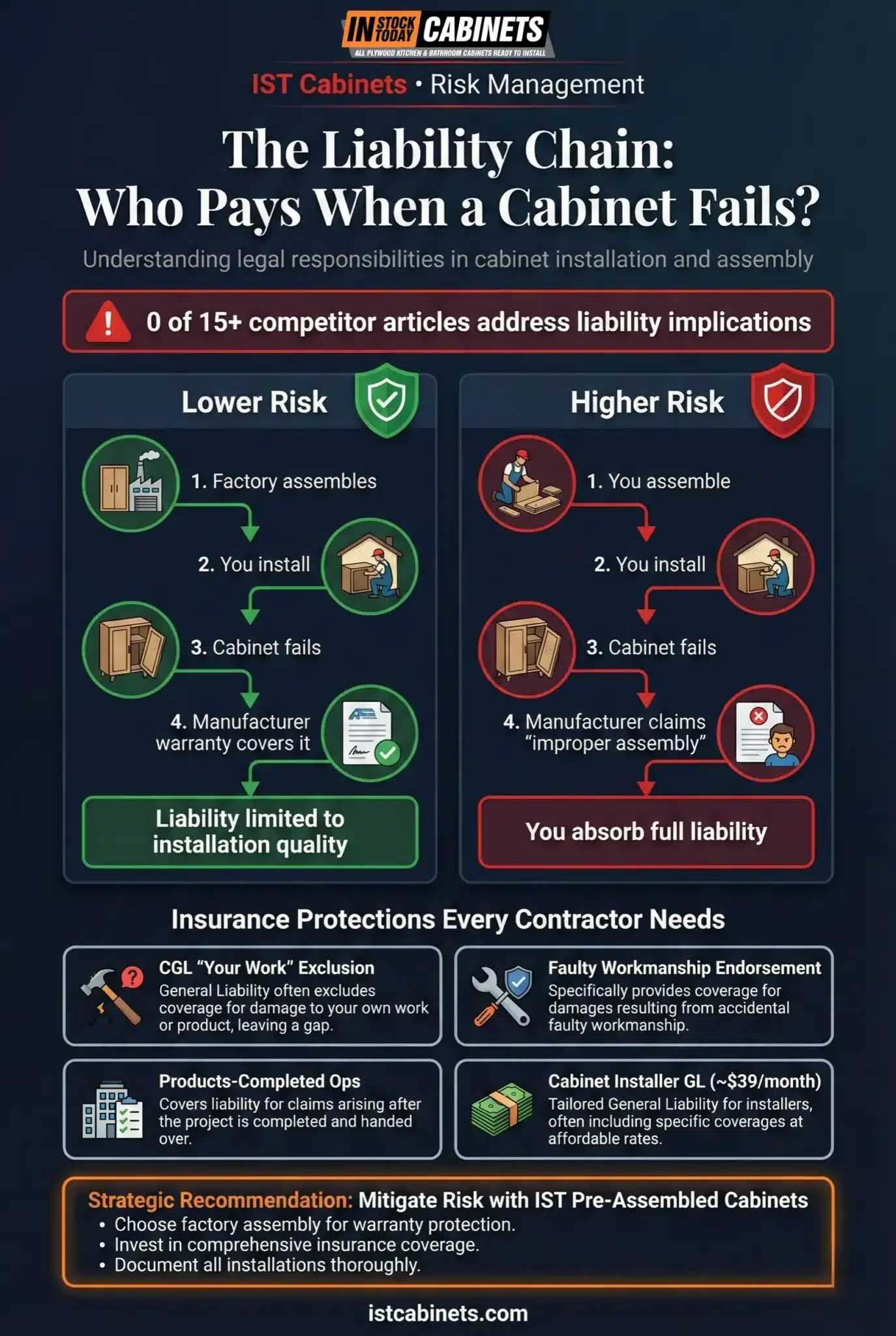
When you install a factory-assembled cabinet and it fails, warranty liability sits with the manufacturer. Your role was installation—hanging it level, securing it to studs—and that’s a clearly defined scope.
When you assemble an RTA cabinet and install it, you’ve absorbed the manufacturer’s assembly liability. Most RTA warranties contain language like: “Any Ready To Assemble Cabinet that has been opened, assembled, or modified in any way cannot be returned.” Structural failure claims can be denied on grounds of “improper assembly”—with the manufacturer defining what “proper” means.
Picture the scenario: a wall cabinet you assembled and installed falls three months later. The manufacturer points to assembly error. Your general liability policy becomes the last line of defense.
Insurance Implications You Should Know
- The “Your Work” Exclusion: Most CGL (Commercial General Liability) policies exclude damage resulting from completed work performed by the insured contractor. If a cabinet you assembled and installed fails, your standard policy may not cover it.
- Faulty Workmanship Endorsement: Available as a rider, typically adding modest cost to your policy, but you need to have it before the claim.
- Products-Completed Operations Coverage: Recommended for any contractor regularly installing cabinets, regardless of format.
- Cabinet installer GL baseline: Starts at approximately $39/month per industry insurance brokers.
| Risk Management Strategy: Use pre-assembled cabinets on higher-end residential projects where liability exposure is greatest and client expectations for warranty clarity are highest. Use RTA on budget-sensitive and multi-unit projects where the cost savings justify the shifted liability, and where you control quality through repeatable assembly processes. |
Warranty Fine Print: What “Lifetime” Actually Covers
| Warranty Factor | Typical RTA Warranty | Typical Pre-Assembled Warranty |
|---|---|---|
| Term Length | 1–5 years (some offer limited lifetime) | 5 years to limited lifetime |
| Labor Coverage | Rarely covered | Some brands cover under conditions |
| Transferability | Usually non-transferable | Varies; often limited to original purchaser |
| Humidity/Moisture Exclusion | Yes—commonly invoked for claim denials | Yes—same exclusion applies |
| Shipping Damage Window | Must document on delivery day | Must document on delivery day |
| Assembly Error Exclusion | Yes—major risk for contractors | N/A (factory assembled) |
Watch for hidden exclusions. CNC Cabinetry’s warranty, as one example, explicitly excludes landlords, leasing companies, and commercial purchasers—a clause that directly affects contractors working on rental and investment properties. Always read the full warranty before specifying a line for a project.
Installation: What Matters on the Job Site
Assembly Time Standards for Professional Crews
| Cabinet Type | Assembly Time (Experienced Crew) | Notes |
|---|---|---|
| Wall cabinet (standard) | 7–10 minutes | Simple box; fastest assembly unit |
| Base cabinet (standard) | 10–15 minutes | Drawer assembly adds time |
| Base cabinet with drawers | 20–30 minutes | Dovetail drawers may come pre-assembled |
| Lazy susan / corner unit | 30–45 minutes | Consider buying these pre-assembled |
| Full 10×10 kitchen (~12 units) | 4–6 hours total | Production-line method: all boxes first, then hardware |
The Production-Line Method vs. One-at-a-Time
Experienced crews don’t assemble one complete cabinet at a time. They run a production line: unbox and sort all panels by type (sides, backs, bottoms), assemble all boxes in sequence, then attach all face frames, then install all hardware. This approach cuts assembly time by roughly 30% compared to building each cabinet start-to-finish.
One step most articles skip: squareness checking. Before the glue sets, measure diagonals on every box. An out-of-square cabinet means crooked doors and binding drawers—problems that compound when you’re installing 12 cabinets in a run and the error cascades down the wall.
Shop Assembly vs. Site Assembly
Contractors with warehouse or shop space have a third option: assemble RTA cabinets off-site in a controlled environment, then deliver them assembled to the job site. This captures the material cost savings of RTA while eliminating job site assembly constraints—weather, space, trade scheduling—and gives you quality control comparable to factory output.
For multi-unit projects, this approach works especially well. One crew handles assembly in the shop while another crew handles installation at the site, running both operations in parallel.
Urban and Tight-Access Projects
For high-rise renovations in dense metro areas, RTA isn’t just an option—it’s often the only viable one. A fully assembled 96-inch pantry cabinet will not fit in a standard residential elevator. A flat-packed version goes up in pieces and gets assembled inside the unit. Same applies to narrow stairwells, tight hallways, and buildings with no freight elevator access.
Multi-Unit & Fleet Projects: Where the Math Gets Compelling
Scale changes everything. Cost per unit, logistics advantages, and operational strategies for a 50-unit apartment complex are fundamentally different from a single-kitchen remodel. Yet almost no cabinet industry content addresses this segment with specifics.
Scale Economics of RTA
- Storage density: Flat-pack RTA reduces storage footprint by approximately 75%. An entire kitchen’s worth of RTA cabinetry fits in a single-car garage bay. Pre-assembled fills three to four bays.
- Volume pricing: Wholesale discounts of 10–20% typically kick in on orders exceeding $5,000–$10,000. Truckload orders unlock an additional 5–15% savings beyond standard pro pricing.
- Freight efficiency: A 53-foot semi-trailer holds approximately 50–60 pre-assembled kitchens. That same truck holds 150–200 RTA kitchens. Per-unit freight cost drops substantially at scale.
- Phased delivery: Compact flat-packs can be staged across construction phases without consuming entire floors of storage space in an active building.
Standardization Across Your Portfolio
For contractors managing rental portfolios or multi-family builds, standardizing on a single RTA system across all units creates compounding operational advantages: crews learn one assembly process and get faster with each unit, ordering becomes predictable, inventory management simplifies, and future tenant-damage repairs require only ordering a replacement door or drawer front—not hunting for a discontinued line.
| At Scale: 20 kitchens × $377 net savings per kitchen (at $75/hr crew rate) = $7,540 in additional project profit from cabinet selection alone. |
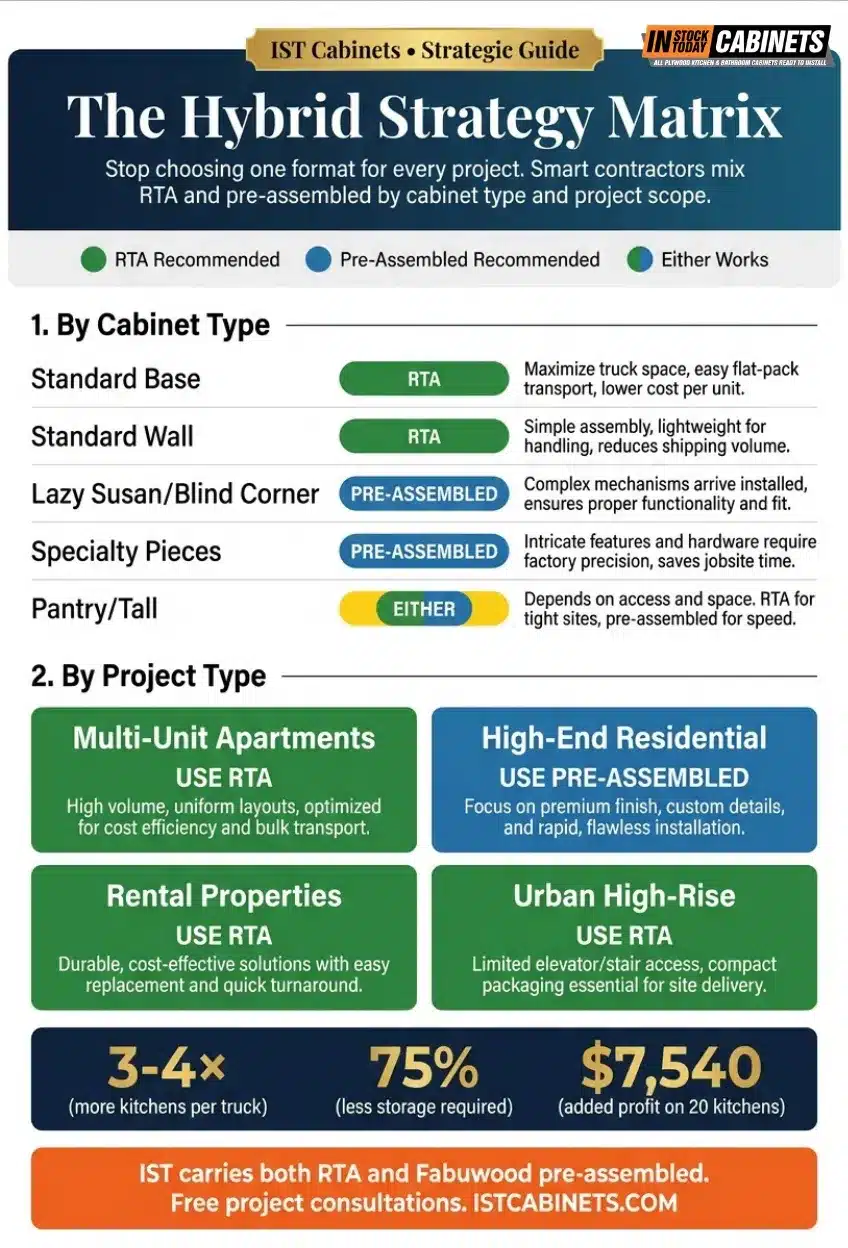
When to Mix Formats: The Hybrid Strategy
IST Cabinets is uniquely positioned to make this recommendation because we distribute both RTA and Fabuwood pre-assembled lines. No single format is optimal for every cabinet in every project. Smart contractors mix strategically:
| Cabinet Type | Recommended Format | Why |
|---|---|---|
| Standard base cabinets | RTA | High volume, straightforward assembly, maximum savings |
| Standard wall cabinets | RTA | Lightest, fastest assembly, easiest to install when empty |
| Lazy susan / blind corner | Pre-assembled | Complex geometry; assembly errors are costly |
| Specialty pieces (wine racks, appliance garages) | Pre-assembled | Tight tolerances; factory QC saves time |
| High-end residential showcase kitchens | Pre-assembled | Client perception and warranty clarity matter most |
| Multi-unit / apartment builds | RTA | Scale savings compound; standardization benefits |
| Rental properties | RTA (plywood) | Best ROI; damaged doors swap easily; resists tenant abuse |
| Urban high-rise renovations | RTA | Often the only format that fits the elevator and hallways |
Sustainability and Compliance: What Actually Matters
Green certifications in cabinetry follow a clear hierarchy. Understanding which ones are meaningful—and which are table stakes—helps contractors communicate credibly with environmentally conscious clients and meet green building requirements.
- TSCA Title VI / CARB2 compliance: Federal law, not a differentiator. All composite wood products sold in the U.S. must meet these formaldehyde emission standards. Any manufacturer advertising this as a special feature is telling you they follow the law.
- KCMA A161.1 certification: The industry’s performance benchmark. Includes a 600-lb weight test for wall cabinets, drawer cycle testing, and finish resistance (vinegar, lemon juice, coffee, alcohol). Many premium RTA lines carry this certification.
- GREENGUARD Gold: Third-party low-VOC emission certification positioned for sensitive indoor environments. A meaningful differentiator when bidding on health-focused builds.
- KCMA ESP (Environmental Stewardship Program): Covers renewable energy use and carbon accounting in manufacturing. Relevant for LEED projects.
- FSC chain-of-custody: Verifies sustainably sourced wood through the supply chain. The highest standard for responsible forestry.
RTA has one inherent sustainability advantage worth quantifying: freight efficiency. Flat-pack shipping puts 3–4× more kitchens on each truck, directly reducing carbon emissions per unit delivered. For a 20-kitchen project, that means roughly 1 truck of RTA versus 3–4 trucks of pre-assembled—fewer miles driven, less fuel burned, and a sustainability story you can put in your bid when competing for green-certified contracts.
Your Decision Framework: A Contractor’s Buyer Checklist
Before specifying any cabinet line for a project, run through these questions. Print this page and bring it to your next vendor meeting.
The Spec Checklist (Demand Answers to All 10)
- Box material and thickness? Plywood (1/2” or 5/8” minimum) or particleboard? What grade?
- Back panel thickness? Thin backs (1/4”) can flex; 1/2” is stronger.
- Shelf thickness and material? 3/4” plywood shelves hold weight; MDF shelves can sag over time.
- Drawer box material and joinery? Dovetail solid wood is the standard. Stapled particleboard is a warning sign.
- Hinge and slide brand? Named brands (Blum, Hettich) with published endurance data, or unbranded generics?
- Finish type and test certifications? KCMA A161.1 certified? UV-cured or lacquer?
- Warranty scope? What’s the term? Does it cover labor? Is it transferable? What humidity/moisture exclusions exist?
- Assembly error exclusions? (RTA only) Does the warranty survive your assembly?
- Damage claim process and window? How many days to report? What documentation is required?
- Lead time and delivery model? Stock vs. made-to-order? Tailgate vs. inside delivery?
Why IST Cabinets Built This Guide (and Why We’re Different)
Most cabinet companies sell one format and write content that pushes you toward it. We carry both, so we have no angle to play.
- In-house RTA line: Shaker White, Shaker Grey, and Shaker Blue—all-plywood construction with Blum Bluemotion hardware and dovetail drawers. The same specs that run 2× higher from premium assembled brands.
- Fabuwood pre-assembled lines: Allure (premium framed), Quest (mid-range), Value Premium (budget), and the Illume series (frameless European-style with 44 finish options). Mortise-and-tenon door frames, all-plywood, Blum throughout.
- 5–7 day delivery: While semi-custom lines quote 8–12 weeks, our stock model gets cabinets to your site within a week.
- 5 locations: Alexandria VA, Fairfax VA, Columbia MD, Bear DE, and South Houston TX. Same-day pickup available.
- Contractor support: IST Loyalty Rewards Program, free 3D design services, and dealer display kits ($2,500 value for $950).
We built this guide because no one else was giving contractors the actual data to make this decision. If you want to talk through the right mix for your next project, our design team offers free consultations—no commitment, no pressure, just numbers.
Frequently Asked Questions RTA vs Pre-Assembled Cabinets
Are RTA cabinets lower quality than pre-assembled cabinets?
Not inherently. Quality depends on materials, joinery, and hardware—not on where the box gets assembled. A plywood RTA cabinet with pocket-screw joinery and Blum hardware can match or exceed a particleboard factory-assembled unit costing 30–50% more. Look for minimum 1/2” plywood boxes, dovetail drawer construction, and named-brand hinges with published endurance ratings (200,000+ cycles).
How long does it take a professional crew to assemble RTA cabinets for a full kitchen?
An experienced crew can assemble a standard 10×10 kitchen (approximately 12 cabinets) in 4–6 hours using the production-line method—assembling all boxes first, then attaching all face frames, then installing all hardware. Individual wall cabinets average 7–15 minutes; base units with drawers run 15–30 minutes. First-time crews should budget closer to 8–12 hours.
At what point do RTA cabinets stop being cheaper than pre-assembled?
When your fully loaded crew rate exceeds approximately $128 per hour. That’s the breakeven point where assembly labor costs consume the material savings. A contractor billing $75/hour nets about $213 per kitchen in savings with RTA. A contractor billing $150/hour loses about $87 per kitchen compared to buying pre-assembled. Run the math for your own rate before committing.
Who is liable if an RTA cabinet I assembled fails after installation?
You are—and this is the question most comparisons skip entirely. When you assemble RTA cabinets for a client, you absorb the assembly liability that would otherwise sit with the manufacturer. Most RTA warranties exclude claims for “improper assembly,” and the manufacturer decides what qualifies. Your general liability insurance becomes the backstop, and your standard CGL policy may include a “Your Work” exclusion. Consider a Faulty Workmanship endorsement and Products-Completed Operations coverage if you install RTA regularly.
Can I mix RTA and pre-assembled cabinets in the same project?
Yes, and that’s often the smartest approach. Use RTA for standard base and wall cabinets where assembly is straightforward and per-unit savings add up. Use pre-assembled for complex specialty pieces (lazy susans, blind corners, wine racks) where factory quality control prevents costly assembly errors. Just ensure both lines use compatible sizing, finish matching, and hardware specifications.
Are RTA cabinets practical for multi-family apartment projects?
They’re often the preferred choice. Flat-pack shipping puts 150–200 kitchens on a 53-foot trailer versus 50–60 pre-assembled, cutting per-unit freight costs dramatically. Storage footprint drops by 75%, which matters when staging deliveries across construction phases. Standardizing one RTA system also means your crews get faster with every unit, you can predict per-unit costs precisely, and future tenant-damage repairs require only ordering a replacement part rather than matching a discontinued line.
What tools do I actually need to assemble RTA cabinets professionally?
Beyond the basics (cordless drill with adjustable clutch, rubber mallet, tape measure, carpenter’s square), professional-quality results require bar clamps to hold joints while glue sets, a brad nailer for pinning backs, right-angle clamps, and PVA wood glue. Skip the included cam-lock hardware on budget lines—use pocket screws and glue for a permanent structural bond.
How much shipping damage should I expect with RTA vs. pre-assembled?
Industry average transit damage rates run 3–5% for cabinet shipments overall. Well-packaged RTA flat-packs tend to come in below 2%, because dense, compact boxes resist drop damage better than hollow assembled cabinets. Recovery also differs: a damaged RTA door arrives as a replacement part via standard shipping within days. A crushed pre-assembled cabinet requires full unit replacement via freight, potentially delaying your project by weeks. Regardless of format, photograph everything as it comes off the truck—before signing delivery paperwork.
What does “lifetime warranty” actually cover on cabinets?
Less than most contractors assume. “Lifetime” typically means the lifetime of the original purchaser for as long as they own the home—not the lifetime of the cabinet. Most warranties exclude removal and installation labor costs (often the most expensive part of a warranty claim), damage attributed to humidity or environmental conditions, normal wear and tear, and sometimes commercial or rental use entirely. Read the exclusions, not just the term length.
Should I assemble RTA cabinets on the job site or in my shop?
If you have shop or warehouse space, assembling off-site is almost always better. You control temperature and humidity (important for glue curing), you have table space and tool access, you can run a proper production line, and you keep the job site clear for other trades. Deliver the assembled cabinets to the site and your installation process looks identical to pre-assembled. Many contractors who calculate RTA as unprofitable are only considering site assembly—shop assembly changes the math entirely.
How do RTA cabinets perform in rental properties?
Plywood-box RTA is widely considered the strongest ROI play for rentals. Plywood resists water damage and tenant abuse better than particleboard. Damaged doors or drawer fronts swap out individually without replacing entire cabinets. Standardizing a single RTA system across a rental portfolio simplifies maintenance ordering. And upfront savings compound across multiple units. One caution: some manufacturer warranties explicitly exclude commercial purchasers and leasing companies—verify coverage before you commit.
What’s the difference between KCMA certification, CARB2, and GREENGUARD Gold?
Three different things measuring three different concerns. CARB2/TSCA Title VI is federal law requiring low formaldehyde emissions in composite wood—all legal products meet this, so it’s not a differentiator. KCMA A161.1 is a voluntary performance standard covering structural strength (600-lb wall cabinet test), drawer cycle durability, and finish chemical resistance—this is the one that matters most for day-to-day cabinet performance. GREENGUARD Gold is a third-party indoor air quality certification for low VOC emissions—relevant if you’re building for clients with air quality sensitivities or pursuing green building certifications.
How fast can IST Cabinets deliver?
Stock kitchen cabinets ship within 5–7 business days, with same-day pickup available at our five showroom/warehouse locations in Alexandria VA, Fairfax VA, Columbia MD, Bear DE, and South Houston TX. Compare that to 8–12 week lead times for semi-custom lines and even longer for custom orders. For contractors managing tight remodel schedules or tenant turnovers, that speed difference can be worth more than any per-unit savings.
Ready to Run the Numbers on Your Next Project?
Every project has a different optimal cabinet strategy. A 12-unit apartment in Houston and a $250K whole-home remodel in Alexandria need different approaches—and we’re equipped to support both.
IST Cabinets offers free 3D design consultations where we’ll help you determine the right mix of RTA and pre-assembled for your specific project, timeline, and budget. No commitment, no sales pitch—just an honest assessment from a team that sells both formats and has no reason to push one over the other.
Contact IST Cabinets: Visit istcabinets.com or call any of our five showroom locations for a free project consultation.
© 2026 In Stock Today Cabinets LLC. All rights reserved. Data sourced from NAHB, NKBA, KCMA, BLS, Zonda/Remodeling Magazine Cost vs. Value Report, industry pricing surveys, and original research.