
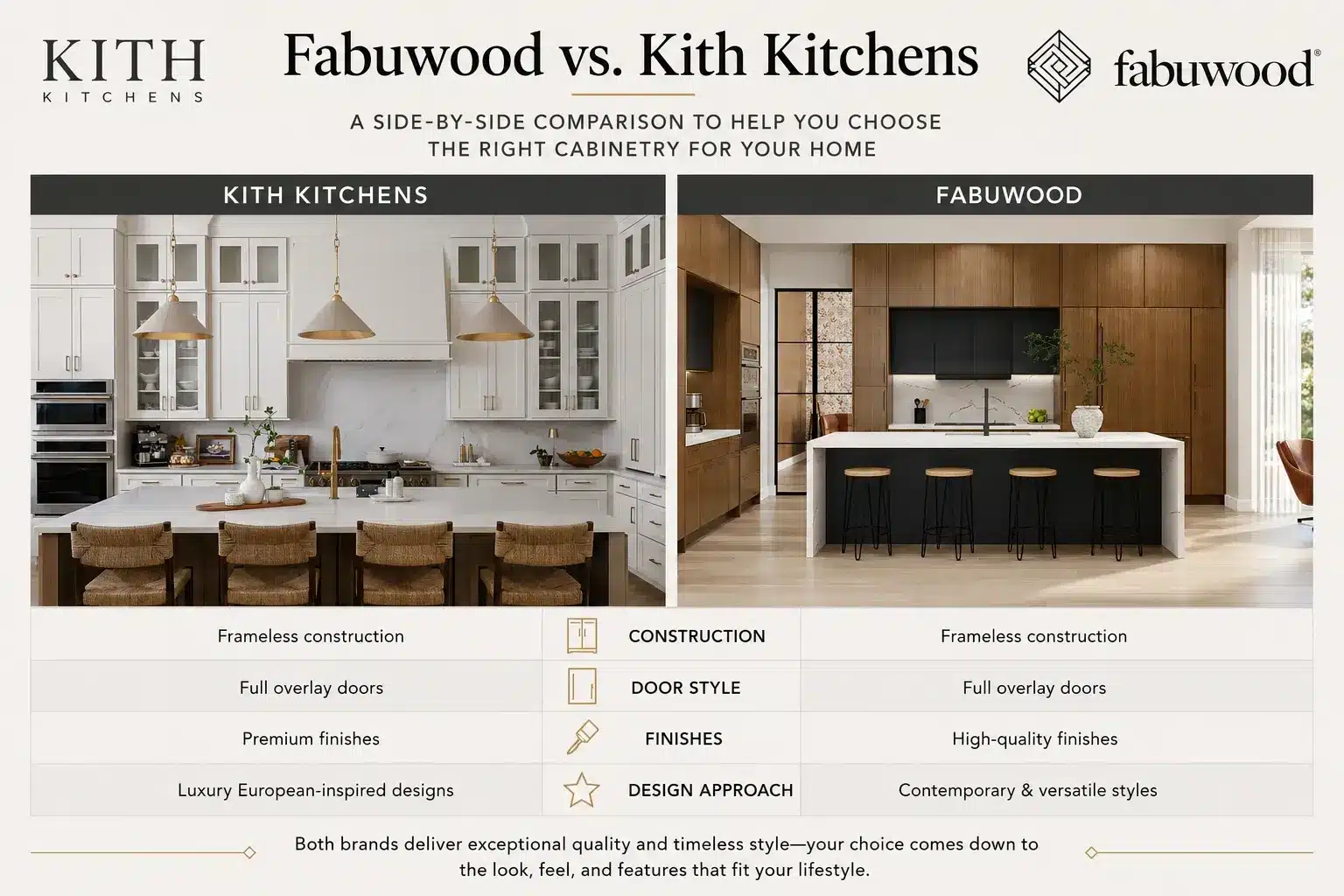
Most “Fabuwood vs. Kith” articles you’ll find online read like spec sheets. They list materials, repeat warranty terms, and end with some version of “they’re both great, choose what fits your style.” That’s not useful if you’re past the shortlist stage and trying to decide between two specific brands for an actual project.
This comparison is different. It’s written by people who sell Fabuwood every day, who’ve handled Kith installations in dealer channels, and who’ve seen how both brands perform after the homeowner moves back in.
The goal is to tell you where each brand wins, where each one falls short, and which buyer profile each one was built to serve. No “it depends on your taste.” Specific answers, with the reasoning behind them. One thing has changed since most of the comparison content on the web was written. Both brands now operate full ecosystems with luxury arms, not single product lines. That changes how you should think about the comparison, so we’ll cover that too.
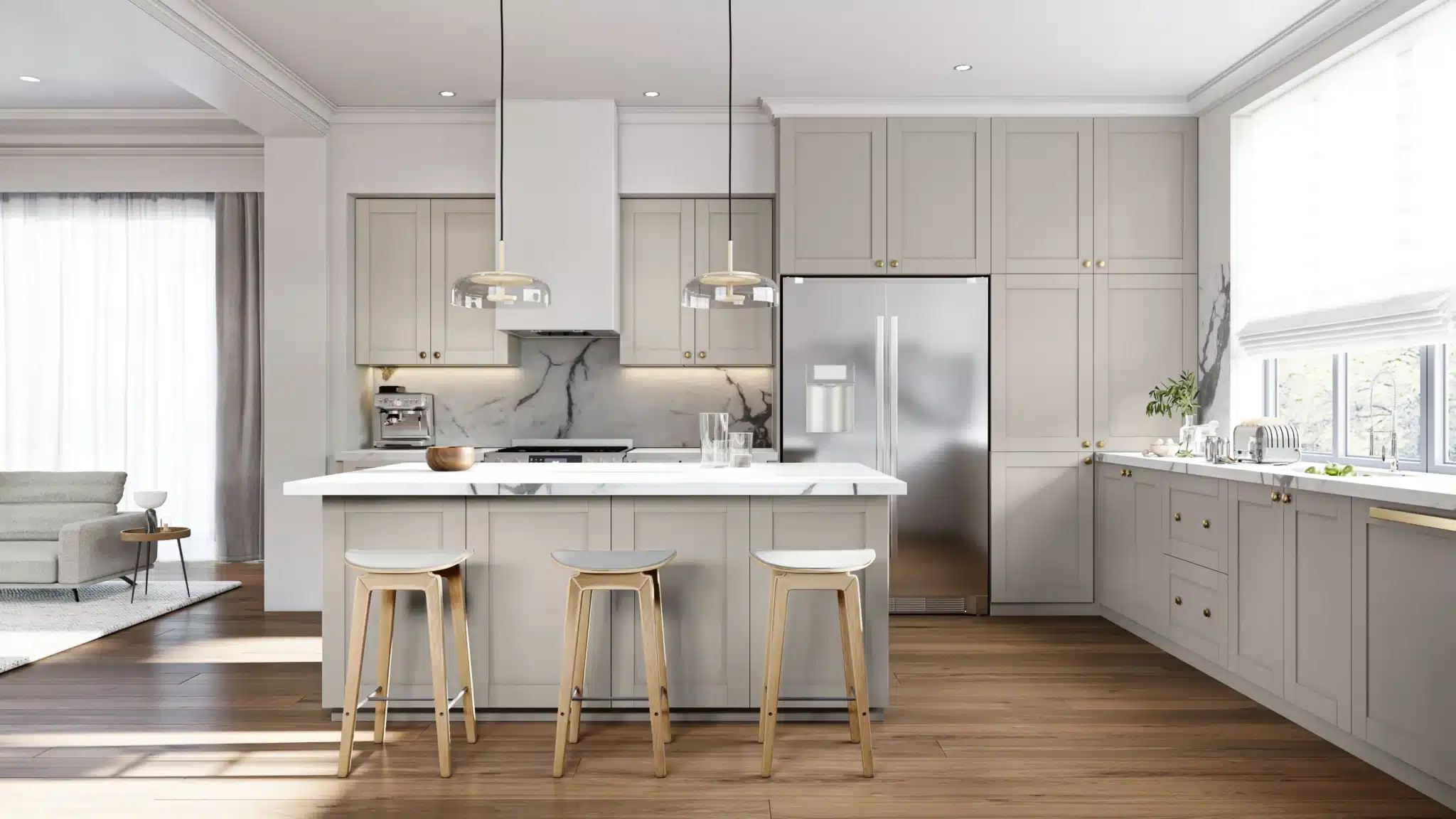
The Two Brands at a Glance
Fabuwood is a semi-custom manufacturer headquartered in a one-million-square-foot facility in Newark, NJ. The company assembles cabinets domestically using a network of global component suppliers, which is what lets it ship stocked configurations in roughly five business days. In January 2025, Fabuwood opened a second manufacturing facility in Tijuana plus a Southern California distribution center to cut transcontinental freight times.
In September 2024, the company acquired Plain & Fancy Custom Cabinetry, a 56-year-old Pennsylvania luxury custom maker. Fabuwood has won the Kitchen & Bath Business Readers’ Choice Award in the cabinetry category five times in seven years (2019, 2021, 2023, 2024, 2025). Kith Kitchens is a family-founded, private equity-owned manufacturer based in Haleyville, Alabama. Founded in 1998 as a components company, Kith now operates entirely on domestic production with CNC-driven manufacturing and traditional mortise-and-tenon door construction. In late 2020, Kith acquired Mouser Custom Cabinetry of Elizabethtown, Kentucky, an ultra-premium framed and frameless cabinet maker founded in 1955. Kith sells through authorized dealers and distributors only (no direct-to-consumer, no big-box retail).
Quick Comparison
| Attribute | Fabuwood | Kith Kitchens |
|---|---|---|
| Founded | 2008 | 1998 |
| Manufacturing | Newark, NJ + Tijuana, Mexico (West Coast); globally sourced components, assembled in USA | Haleyville, AL (100% American-made); Elizabethtown, KY for Mouser luxury line |
| Product Lines | Allure (framed), Illume (frameless), Ovela (all-plywood frameless), Quest, Value Premium, Valencia; Plain & Fancy custom arm | KithOne (value), Eudora (frameless), Kith (semi-custom), Mouser (ultra-premium) |
| Standard Lead Time | ~5 business days for stocked configurations | 3 to 6 weeks (built to order) |
| Distribution | Authorized dealer network (including some major retailers) | Authorized dealers and regional distributors only (no big-box) |
| Warranty | Limited Lifetime on Allure, Illume, Ovela, Quest, Value Premium, Valencia (purchases on or after Oct 1, 2024) | Lifetime Warranty on core lines, for original purchaser |
| Hardware | Blum standard across all framed lines | Blum standard across all lines |
What Changed in 2024 and 2025: The Ecosystem Story
If you read a Fabuwood vs. Kith comparison written in 2022 or 2023, you got a clean narrative: Kith was the customization-heavy American-made option, Fabuwood was the fast, budget-friendly semi-custom option. That framing is now outdated. Fabuwood’s acquisition of Plain & Fancy gives it a true custom cabinetry arm with hand-applied finishes and species options the Allure series never offered. The November 2025 launch of Ovela introduces an all-plywood frameless line to compete directly with Kith’s Eudora. The West Coast facility cuts the cross-country shipping disadvantage that previously favored Kith for builders west of the Rockies. And the Limited Lifetime Warranty, expanded in October 2024 to cover purchases on or after that date, closes a gap that Kith used to win on alone. Kith’s portfolio is similarly broad. KithOne serves the budget tier at a flat ~$260 per linear foot, all door styles and finishes priced identically. Eudora handles frameless. Standard Kith covers semi-custom. Mouser, the Kentucky-based luxury brand Kith acquired in 2020, serves the ultra-premium segment with framed and frameless options in alder, cherry, hickory, maple, oak, and walnut. The takeaway: pick the line, not just the brand. A Quest series Fabuwood and a standard Kith deck are not in the same comparison. An Allure Galaxy and a KithOne Newport are. An Ovela frameless and a Eudora frameless are. The line-against-line match is where the meaningful differences show up.
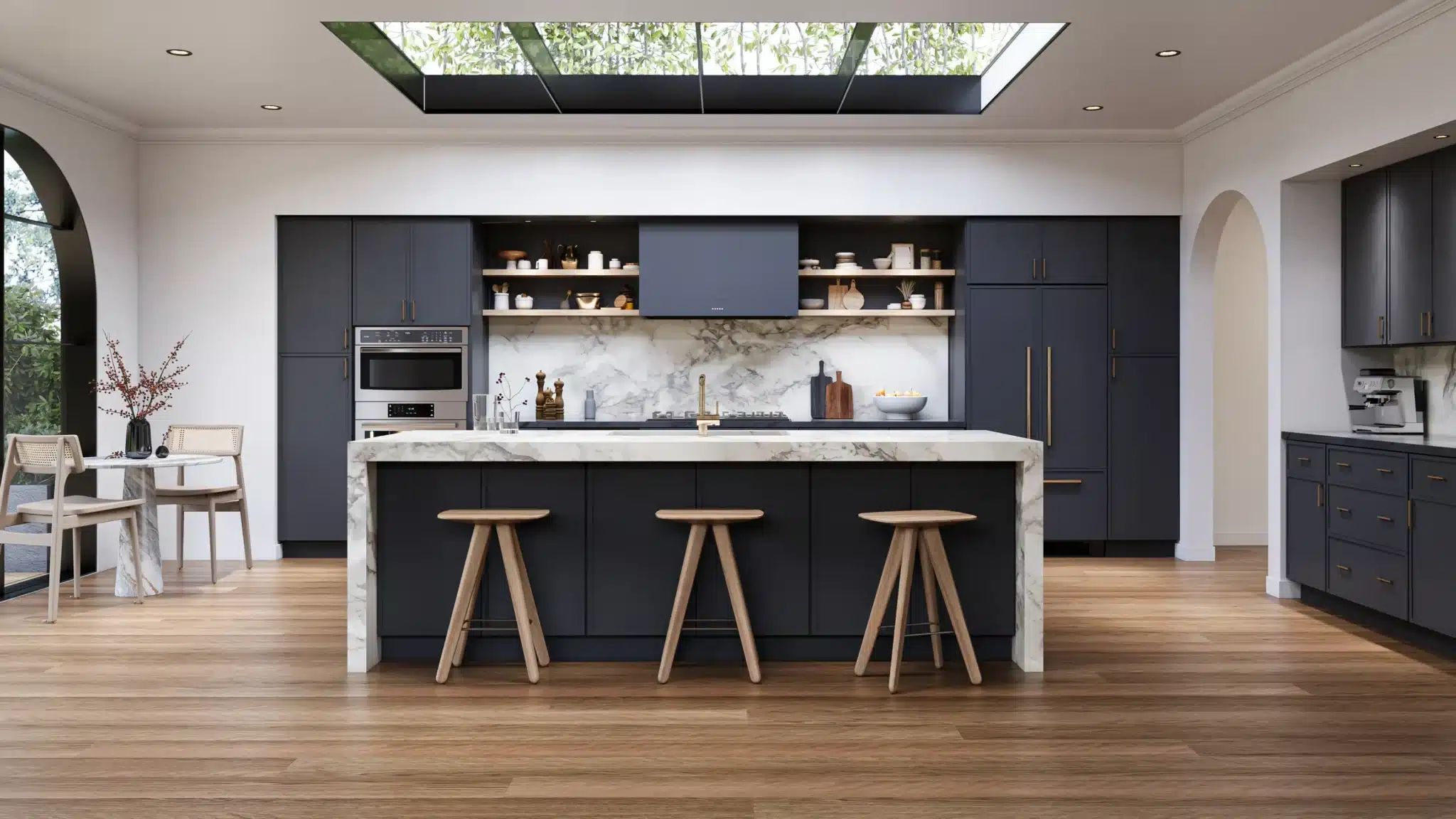
Construction Quality, Honestly
Both brands operate well above builder-grade. The question is where they put their structural emphasis and where each one cuts cost.
Cabinet Box Construction
Fabuwood’s flagship Allure series uses 1/2″ plywood throughout the box with a one-piece 1/2″ plywood back. The single-piece back is structurally significant: it resists racking under heavy stone countertops and provides a secure mounting surface across the full cabinet width without requiring supplementary hanging rails. The KCMA certification on the line covers six-hundred-pound wall load testing. Kith’s standard line uses furniture-grade plywood for the box: 1/2″ plywood sides, 1/2″ tops and bottoms, 1/2″ stretchers and hanging rails, and a 1/4″ plywood back. The thinner back panel relies on the stretchers to bear the wall load, which is a different engineering choice but not a worse one.
Where Kith pulls ahead is the fastening method: case assembly uses confirmat screws that create deep mechanical locks within the plywood layers, rather than the industrial staples used in some Fabuwood configurations. KithOne, the value-tier line, comes standard with furniture board boxes. Plywood is available as the “Deluxe Plywood” upgrade tier. This is an important distinction. If you’re cross-shopping Fabuwood Allure against a base-spec KithOne, Fabuwood’s box construction is stronger by default. If you’re cross-shopping against KithOne Deluxe Plywood, they’re comparable.
Drawer and Door Construction
Both brands use solid wood dovetail drawer boxes with Blum full-extension soft-close runners. Fabuwood specifies 5/8″ solid birch for the drawer box. Kith specifies solid hardwood with UV-cured topcoats on the interior. In a side-by-side drawer test, you’d struggle to find a meaningful performance difference. Doors are where the brands diverge. Fabuwood’s framed Allure series uses solid wood stiles and rails with a 3/8″ MDF center panel and mortise-and-tenon joinery.
The MDF center provides dimensional stability and resists seasonal movement that solid wood panels can show. Kith’s standard line uses true solid hardwood throughout the door for select profiles, joined with mortise-and-tenon. Kith offers maple, oak, cherry, and hickory as species; Fabuwood substitutes birch in its “maple-look” finishes because its supply chain doesn’t carry true hard maple.
Hardware
Both brands ship Blum hardware as standard across their main lines. Blum Compact Clip hinges with Blumotion soft-close are standard on Allure; full-extension Blum runners are standard on both. Hinge cycle ratings, weight ratings, and adjustment range are essentially identical because the hardware comes from the same manufacturer. The Blum hardware warranty applies independent of the cabinet brand.
The Short Version
Fabuwood’s construction floor is higher than KithOne’s standard. Kith’s ceiling, when you spec into standard Kith or Mouser, is higher than Fabuwood’s Allure series. Compare the same tier, not the same brand.
The Five Scenarios Where the Right Answer Flips
Generic recommendations aren’t useful. Here are five concrete project profiles where the right brand changes, and the reasoning behind each call.
Scenario 1: You’re on a Contractor’s Clock
You’re remodeling your only kitchen, you’re living through the project, and your contractor needs cabinets in hand before he can frame the island or set the countertop template. Or you’re a flipper holding the property at carrying cost and every week of delay costs you real money. Pick Fabuwood. Stocked Allure configurations leave the warehouse in about five business days. Kith’s standard build window is three weeks minimum on KithOne, longer on custom orders.
The 2025 West Coast facility means coastal builders no longer wait an extra week for cross-country freight. Fabuwood is the only brand at this price point that can keep up with a tightly-scheduled project. Caveat: custom colors and non-stock SKUs push Fabuwood’s lead time out to six or eight weeks. If your project depends on a Sherwin-Williams custom match, you lose the speed advantage. Plan accordingly.
Scenario 2: You Have a Finish Vision Fabuwood Doesn’t Carry
You want a hand-wiped glaze on a heirloom-aged maple door. You want true vintage brushed treatment, not a factory wash. You want the door to look like it came out of a 1920s pantry, not a 2024 catalog. Pick Kith. Standard Kith offers 21 paint colors on maple, dozens of wood-specific stains, and proprietary glazing, vintage, brushed, and heirloom treatments applied by hand. Custom Sherwin-Williams color matching is built into the standard quote process.
Fabuwood’s curated palette (Frost, Dove, Nickel, Indigo, Timber, Cobblestone, Kona, and a small set of others) is engineered for high turnover, not for finish breadth. The Plain & Fancy luxury arm extends Fabuwood’s range, but for now most dealer showrooms stock the semi-custom catalog.
Scenario 3: All-Plywood Construction Is Your Baseline
You’ve decided you won’t accept furniture board in any part of the box. Plywood top, bottom, sides, back, and shelves, or you walk. Pick Fabuwood Allure or Ovela. Both lines ship all-plywood construction as standard with the 1/2″ one-piece back. KithOne, the most price-competitive Kith line, charges a “Deluxe Plywood” upgrade fee to match this spec. If you’re paying retail, the upgrade gap means Fabuwood ends up materially less expensive for an equivalent build.
The new Ovela line, launched in November 2025, gives Fabuwood a true all-plywood frameless option that previously didn’t exist at this price point. If you’re already speccing into standard Kith (not KithOne), plywood is standard, and this scenario is a tie on construction.
Scenario 4: You Want True Solid Maple or Oak
You’re matching cabinets to existing solid-wood millwork. Or you want stain-grade doors with visible grain, not a painted finish that hides the substrate. Or you specifically don’t want MDF center panels on your doors. Pick Kith. Standard Kith and Mouser doors can be specified in true solid maple, oak, cherry, hickory, or walnut. Fabuwood’s “maple-look” finishes (Timber, the recently-added Mocha stain) are applied to birch, not true maple, because the company doesn’t import true maple components. For a buyer who wants the actual wood, not a wood look, Kith is the only choice between the two.
Scenario 5: You’re Speccing Multiple Units
You’re a builder with twelve identical kitchens in a townhome development. Or a multifamily project manager handling 80 rental units. Or a flipper running three properties in parallel and you need predictable cost per linear foot. This one splits, and the answer depends on what you need most.
Pick Fabuwood Quest or Value Premium if your priority is stocked SKUs and rapid replenishment. Fabuwood’s Value Premium line, focused on the Hallmark Frost shaker, was built specifically for volume projects. Quest covers a few more finishes (Frost, Java, Mist). The Limited Lifetime Warranty was extended to both lines in October 2024.
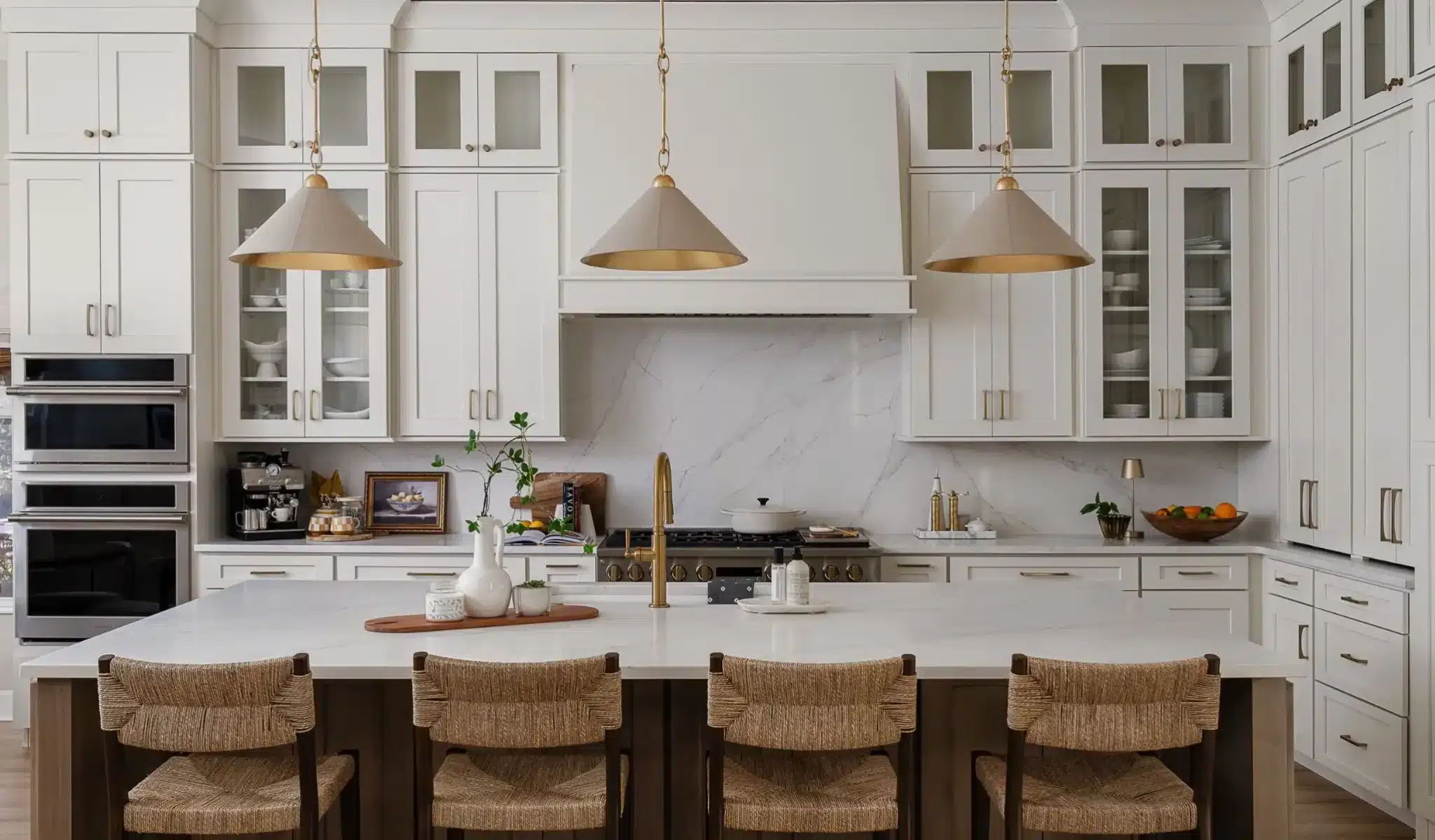
Pick KithOne if your priority is administrative simplicity and budget predictability. KithOne’s flat-rate model (around $260 per linear foot, all door styles and finishes priced identically) eliminates the spec friction that volume projects usually run into. You can change the kitchen design across thirty units without recalculating every quote.
Real-World Pain Points: What Owners Actually Report
Spec sheets and brochures only tell you so much. What both brands look like after a few years in service is the more honest measure. Here’s what comes up repeatedly in Reddit threads, Houzz reviews, Better Business Bureau filings, and Yelp posts for each brand.
Fabuwood: Where Owners Complain
The most common complaint, by a clear margin, is paint chipping and finish fragility on the painted (not stained) lines. Owners report chipping, cracking, or peeling within twelve to eighteen months on painted shaker doors. The issue clusters around white finishes specifically (Frost is the most-cited). Industry professionals note this isn’t unique to Fabuwood; any factory-painted white cabinet at this price tier is susceptible to chipping if the paint film is thin. But the volume of complaints on Fabuwood is notable. Delivery damage is the second recurrent issue.
Multiple contractor accounts describe reordering replacement parts two or three times because each replacement also arrived damaged. The warranty claim process compounds the friction: Fabuwood requires photographic evidence at delivery, sometimes requires damaged goods to be shipped back to New Jersey before authorizing a replacement, and can take weeks to resolve. Dealers who advocate proactively for their customers tend to get faster resolutions than homeowners filing direct.
Kith: Where Owners Complain
The recurring criticism of Kith centers on the gap between premium pricing and execution. Contractor accounts on Reddit describe Kith shipping wrong cabinets, slow replacement processes, and inconsistent stain matching across batches. One frequently-cited account describes a $18,000 Kith order arriving with seven of nineteen cabinets damaged, with replacements failing internal QA and pushing the project from weeks into months of delay. Long lead times on custom orders are the second pattern. A Houzz reviewer describes a sixteen-week wait on cabinets originally quoted at twelve weeks. Specialty stains and Sherwin-Williams custom matches are the most common culprits. Owners also report paint chipping and seam disintegration on Kith fronts after three years, with the manufacturer attributing the failures to “moisture” or normal wear.
What to Take From This
Neither brand is defect-free. Fabuwood’s defect pattern matches what you’d expect at production scale: high volume means occasional finish fragility and recurring delivery damage, both well-documented. Kith’s defect pattern reflects its custom build process. More steps mean more chances for spec errors, and hand-applied finishes vary across batches. Choosing a strong local dealer is the single biggest factor in how your post-installation experience plays out, regardless of which brand you pick.
Pricing: What Real Quotes Look Like
Brand-level pricing is misleading because both brands span value to premium. Line-level pricing is more useful.
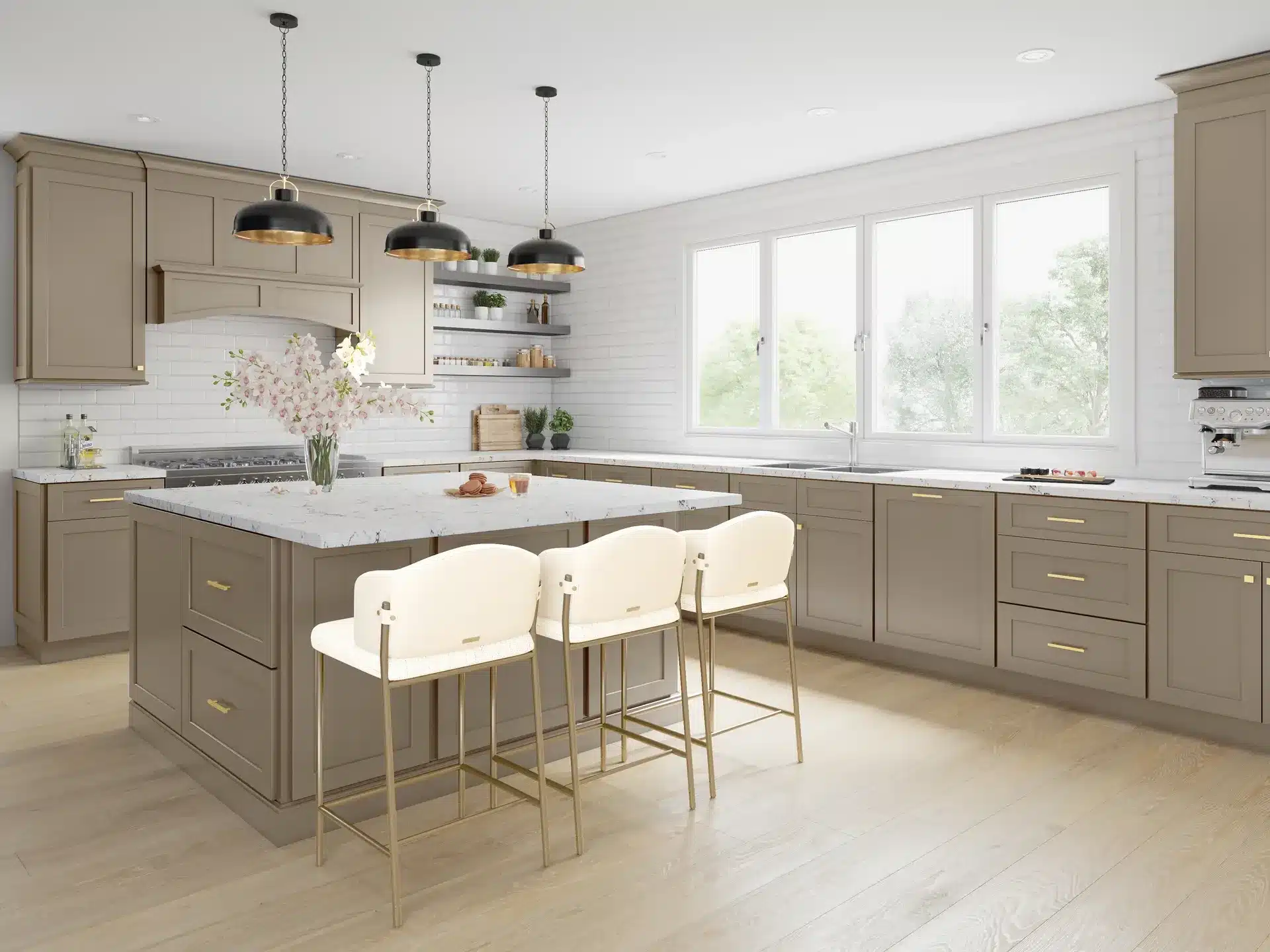
Fabuwood Allure kitchens typically install in the range of $300 to $500 per linear foot, depending on accessories and design complexity. A 20-foot Allure kitchen (cabinets only, mid-range layout) commonly comes in around $6,000 to $10,000. A more elaborate Galaxy Frost installation with island, full storage accessories, and integrated appliance paneling can reach the $15,000 to $22,000 range based on publicly reported homeowner quotes. The Fabuwood Quest and Value Premium lines come in below this band; Plain & Fancy custom work comes in well above.
Kith Kitchens pricing has more spread. KithOne starts around $260 per linear foot with the flat-rate model. Standard Kith and Eudora climb from there based on finish, species, and customization, but the brand doesn’t publish standard rates because pricing is dealer-driven. One commonly-cited dealer comparison put a 35-linear-foot galley at $8,000 for Kith (cabinets only) against $3,600 for Fabuwood. The gap narrows or inverts as you spec into Fabuwood’s custom colors and Kith’s basic options. Mouser ultra-premium pricing is fully bespoke. Both brands sell through dealers, which means dealer markup is part of the comparison. A well-run local dealer can flatten brand-level pricing differences considerably. A poorly-run one can amplify them.
Where Each Brand Falls Short
Honest comparison requires naming the trade-offs.
Fabuwood Limitations
No true solid maple or oak in the semi-custom catalog (birch substitution). Finish library is curated rather than open, which limits the buyer with a specific color vision. Custom Sherwin-Williams matching adds six to eight weeks. Painted finishes (especially white) have a documented chip-rate issue. The warranty claim process is slow and paperwork-heavy. Inset doors are not offered in the standard catalog.
Kith Limitations
KithOne’s standard box construction (furniture board, not plywood) is a real step down from Fabuwood’s standard. Three-week minimum lead time disqualifies the brand for tight-schedule projects. Quality control consistency varies by dealer, with multiple reported instances of wrong cabinets shipped, finish variability across batches, and slow resolution timelines. Custom orders have a track record of slipping past their quoted lead times. Direct consumer reach is limited because Kith doesn’t sell through big-box retail.
So Which One Is Right for You?
The decision flips on what you value most. Choose Fabuwood if: timeline pressure is real, you want all-plywood construction without paying an upgrade, your finish vision lives within a curated palette (which is most people), you’re working with an experienced dealer who can handle the warranty process, or you’re managing a portfolio of properties where speed and predictable supply matter more than custom finish depth. Choose Kith if: finish flexibility is your top priority, you want true solid hardwood species (not substitutes), your project can absorb three weeks or more for production, you’re working with a strong local Kith dealer who can flag QC issues before they reach the job site, or you’re at a price tier where Standard Kith or Mouser is the comparison set, not KithOne. For most kitchen remodels at the semi-custom price point, with a defined timeline and a finish palette that lives in the mainstream, Fabuwood delivers more square footage of quality cabinet per dollar. For projects where design differentiation, specialty finishes, or true hardwood species are non-negotiable, Kith earns the premium.
Where IST Cabinets Fits
Since both brands sell through dealers only, the dealer you work with is the whole experience. The warranty process, the design consultation, the field measurement, the installation network, the finish samples in the showroom, the post-installation support if something fails after move-in. All of that is dealer-driven, not manufacturer-driven.
IST Cabinets is an authorized Fabuwood dealer with full-line stocking across the Allure, Illume, Quest, Valencia, and Ovela series, plus access to Fabuwood’s vanity collection and the new Plain & Fancy custom arm. Our showrooms in Alexandria VA, Fairfax VA, Columbia MD, Houston TX and Delaware carry physical displays of the most-specified door styles and finishes, so you can see a Galaxy Frost or a Cobblestone shaker in person before committing.
We don’t carry Kith, and we won’t pretend otherwise. If after reading this you decide Kith is the better fit for your project, you’ll find their dealer network easily. If Fabuwood is on your shortlist, we’d be a useful place to compare options. Walk in, bring your kitchen dimensions, and we’ll put a real quote in front of you with a real lead time. No deposit required for a design consultation.
Frequently Asked Questions for Fabuwood vs. Kith Cabinets
Why do Fabuwood painted cabinets chip or peel?
The most-reported issue with Fabuwood is paint chipping, cracking, or peeling on the painted lines, particularly white finishes like Frost. Reports cluster within twelve to eighteen months of installation. The most common cause is the paint film thickness on factory-applied finishes, an industry-wide pattern at this price tier and not unique to Fabuwood. Stained finishes don’t show the same issue. To minimize risk, consider a stained Allure finish (Timber, Cobblestone, Kona) over a painted one, ask your dealer about thicker custom-finish options, and inspect every door at delivery before the install crew leaves.
What should I do if my Fabuwood cabinets arrive damaged?
Fabuwood requires photographic evidence of damage at the time of delivery for any warranty claim. The manufacturer can ask for damaged components to be shipped back to the New Jersey facility before authorizing a replacement, which adds weeks to resolution. Practical steps: photograph every cabinet during unloading, file the damage claim through your dealer rather than direct to Fabuwood since dealer advocacy moves claims faster, and keep all packaging until the replacement ships. Custom-color replacements take longer than stocked finishes.
Are Kith cabinets worth the price given the quality control concerns?
Kith’s documented QC issues include wrong cabinets shipped, finish variability across batches, and slow resolution timelines on custom orders. These complaints are real but not universal. The single biggest variable is the dealer. Strong Kith dealers catch spec errors before they reach the job site; weaker ones pass them through. Before committing, ask your dealer how they handle factory order errors, whether they inspect deliveries before scheduling installation, and what their typical resolution timeline is on damaged-shipment claims. Kith’s lifetime warranty covers material defects, but turnaround speed is dealer-driven.
Why do Kith custom orders sometimes take longer than quoted?
Kith builds every cabinet to order. Standard lead time is three weeks for KithOne and three to six weeks for the main Kith line, but custom specifications push that out further. Specialty stains, Sherwin-Williams custom color matches, and hand-applied glazing or vintage finishes are the most common causes of overruns. Some owners report sixteen-week waits on orders originally quoted at twelve weeks. If your project has a hard deadline, ask your Kith dealer for the realistic lead time including your specific finish, not the catalog estimate.
How do I avoid quality problems with either Fabuwood or Kith?
Three things matter more than the brand choice itself. First, pick a strong local dealer with a track record of advocating for clients on warranty claims. Second, inspect every cabinet at delivery and document any damage before the truck leaves the property. Third, if you’re choosing painted finishes, ask your dealer about finish film thickness and whether the specific line has documented chip-rate concerns. Both brands ship the vast majority of orders without issue, but your post-installation experience depends as much on the dealer as on the manufacturer.
What is the lead time difference between Fabuwood and Kith?
Fabuwood ships stocked Allure, Quest, and Ovela configurations in about five business days. Custom colors and non-stock SKUs extend that to six to eight weeks. Kith builds to order with a three-week minimum on KithOne and three to six weeks on the main Kith line. Custom Kith orders with specialty finishes can run twelve to sixteen weeks or longer. For a tight-schedule project, Fabuwood is the more predictable option.
Do Fabuwood and Kith cabinets come with a warranty?
Both brands offer a lifetime warranty to the original purchaser. Fabuwood’s Limited Lifetime Warranty covers the Allure, Illume, Ovela, Quest, Value Premium, and Valencia series for purchases on or after October 1, 2024. Earlier purchases fall under the prior five-year limited warranty. Kith’s lifetime warranty covers defects in materials and workmanship on the cabinet box, doors, finishes, and Blum hardware across all core lines. Both warranties are non-transferable. Neither covers seasonal wood movement, normal wear, or moisture damage.
Are Fabuwood cabinets high end?
Fabuwood sits in the upper-middle of the market, not the high end. The brand is semi-custom, positioned between stock cabinets and full-custom cabinetry. The Allure series competes well on construction at its price point, with all-plywood boxes and Blum hardware as standard, but it isn’t a luxury line. For a true high-end Fabuwood product, the company’s 2024 acquisition of Plain & Fancy Custom Cabinetry serves the premium custom segment. Most buyers comparing Fabuwood to Kith are shopping the semi-custom tier, where Fabuwood is a strong value rather than a luxury statement.
Is Fabuwood junk?
No. Fabuwood is KCMA-certified and has won the Kitchen & Bath Business Readers’ Choice Award in the cabinetry category five times. The Allure series uses half-inch plywood boxes with a one-piece plywood back and solid wood dovetail drawers, which is solid construction for the price. The most common complaint is paint chipping on white painted finishes within the first year or two, plus occasional delivery damage. Those are real and worth planning around, but they are finish and logistics issues, not signs of a structurally poor cabinet. Choosing a stained finish and inspecting at delivery sidesteps most of the recurring problems.
Why is Fabuwood so popular?
Speed is the headline reason. Fabuwood ships stocked configurations in about five business days, the fastest turnaround at its tier, which lets contractors and homeowners keep projects on schedule. Beyond that, the brand offers all-plywood construction and Blum hardware as standard rather than as upgrades, a wide range of styles from classic to contemporary, and strong dealer marketing support. The combination of fast lead times, predictable quality, and a price that undercuts much of the semi-custom field has made it one of the most-specified cabinet brands in the country.
Are Kith kitchen cabinets good quality?
Generally yes. Kith’s main lines are KCMA-certified with plywood box construction, solid hardwood dovetail drawers, true solid hardwood door options, and Blum hardware. The construction is sound and the finish range is deep, including hand-applied glazes and custom color matching. The two caveats: the value-tier KithOne line uses furniture board as its standard box (plywood is an upgrade), and quality-control consistency varies by dealer, with documented reports of wrong cabinets shipped and finish variability across batches. As with Fabuwood, the dealer you choose has a large effect on the final quality of your experience.
What is the most popular cabinet color in 2026?
Light-stained wood is the leading cabinet finish for 2026, ahead of off-white and white. Trend data from KBIS displays put light wood at the top of monochrome cabinet choices, off-white second, and green as the most popular non-neutral color. The broad shift is away from cool gray and stark white toward warmer, more natural tones. For a Fabuwood buyer, this maps to stained finishes like Galaxy Timber; for Kith, to the natural wood and green options in the standard line.
What kitchen cabinet color is outdated in 2026?
Cool gray cabinetry, ultra-gloss finishes, and stark all-white kitchens paired with chrome are the looks appearing less often in 2026 design. White itself is not out, but the all-white-everything kitchen is giving way to warmer whites and layered neutrals. If you want a finish that reads current and ages well, warm off-whites, light stained woods, and earthy greens are safer choices than cool gray.
What color countertops are in for 2026?
Countertops are warming up in 2026, moving away from cool gray toward creamy ivories, soft mushroom beiges, and sandy taupes. At the same time, bold, expressive natural stone and high-end quartz with dramatic veining are being used as focal points rather than quiet backgrounds. Soft white quartz with marble-inspired veining remains one of the most requested looks. These warmer surfaces pair naturally with the light wood and warm-neutral cabinet finishes trending the same year.
What is Joanna Gaines’ favorite kitchen color?
Joanna Gaines frequently favors green, especially Magnolia Green from her own Magnolia Home paint line, a bright nature-inspired shade she pairs with off-white. She has repeatedly described liking a sophisticated green against a creamy white like Shiplap for the depth and visual interest the combination gives a kitchen. Her broader preference leans toward earthy, nature-inspired colors that feel timeless rather than trend-driven.
What is the most popular kitchen cabinet right now?
The volume leader remains a Shaker-style door in a light-stained wood or warm off-white finish, which suits both traditional and transitional kitchens. Flat or slab-front doors are rising in popularity for modern and minimalist designs, but the Shaker profile still dominates overall sales. Both Fabuwood and Kith offer Shaker doors as their core style, which is part of why the comparison between them comes down to construction, finish range, and lead time rather than door shape.