
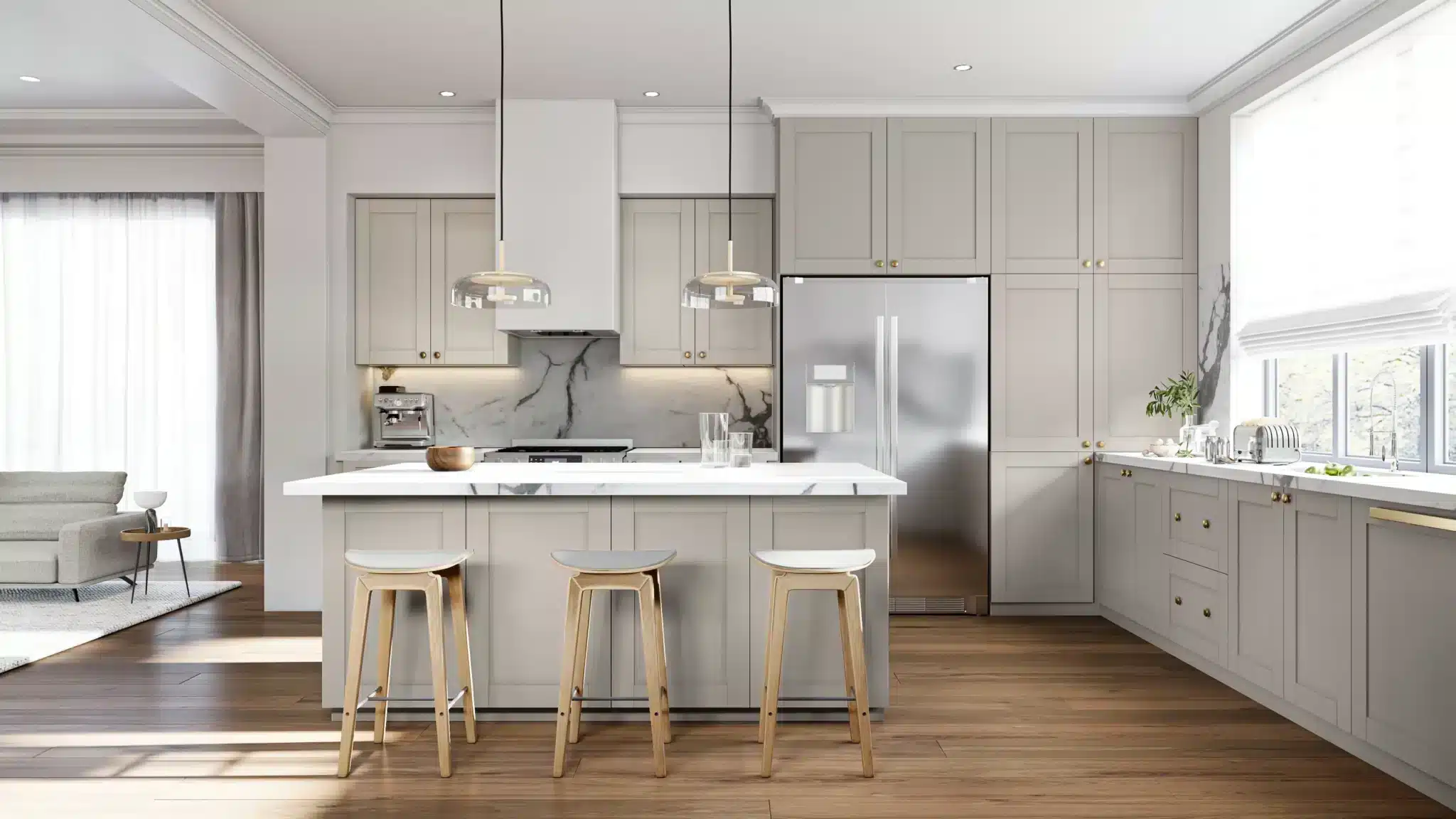
This is part of our Fabuwood comparison series, where we put Fabuwood next to other popular cabinet brands and judge them on build quality, not marketing. We sell and install Fabuwood every day, so we know it cold. But the goal here is a fair, spec-by-spec look at how Fabuwood and Shiloh Cabinetry are actually built so you can decide for yourself.
These two brands don’t compete head-to-head as cleanly as some of the matchups in this series. Fabuwood is a fast, value-driven semi-custom line. Shiloh is a true American-made, build-to-order semi-custom and custom line that sits a clear tier higher in both price and customization. A real homeowner in New Jersey recently posted both quotes for the same kitchen: roughly $25,000 for Fabuwood, $42,000 for Shiloh. That gap tells you most of what you need to know about where each brand lives. The rest of this comparison tells you whether that gap is worth it for your project.
The short answer
If your priority is speed, all-plywood box construction at a value price, a frameless modern option, and a limited lifetime warranty, Fabuwood wins. If your priority is true inset doors, real solid hardwood in nine wood species, hand-applied and distressed finishes, and a level of customization Fabuwood’s semi-custom catalog can’t touch, Shiloh wins, and you’ll pay for it. Shiloh is the better-built, more customizable cabinet in absolute terms. Fabuwood is the better value and the only one of the two that can hit a tight construction schedule. Pick the priority, not the logo.
The two brands at a glance
Fabuwood is a semi-custom manufacturer founded in 2008, headquartered in a one-million-square-foot facility in Newark, NJ. It assembles cabinets domestically from globally sourced components, which is what lets it ship stocked configurations in roughly five business days. In January 2025 it opened a second plant in Tijuana plus a Southern California distribution center; in September 2024 it acquired the 56-year-old luxury custom maker Plain & Fancy. Fabuwood has won the Kitchen & Bath Business Readers’ Choice Award in cabinetry five times in seven years.
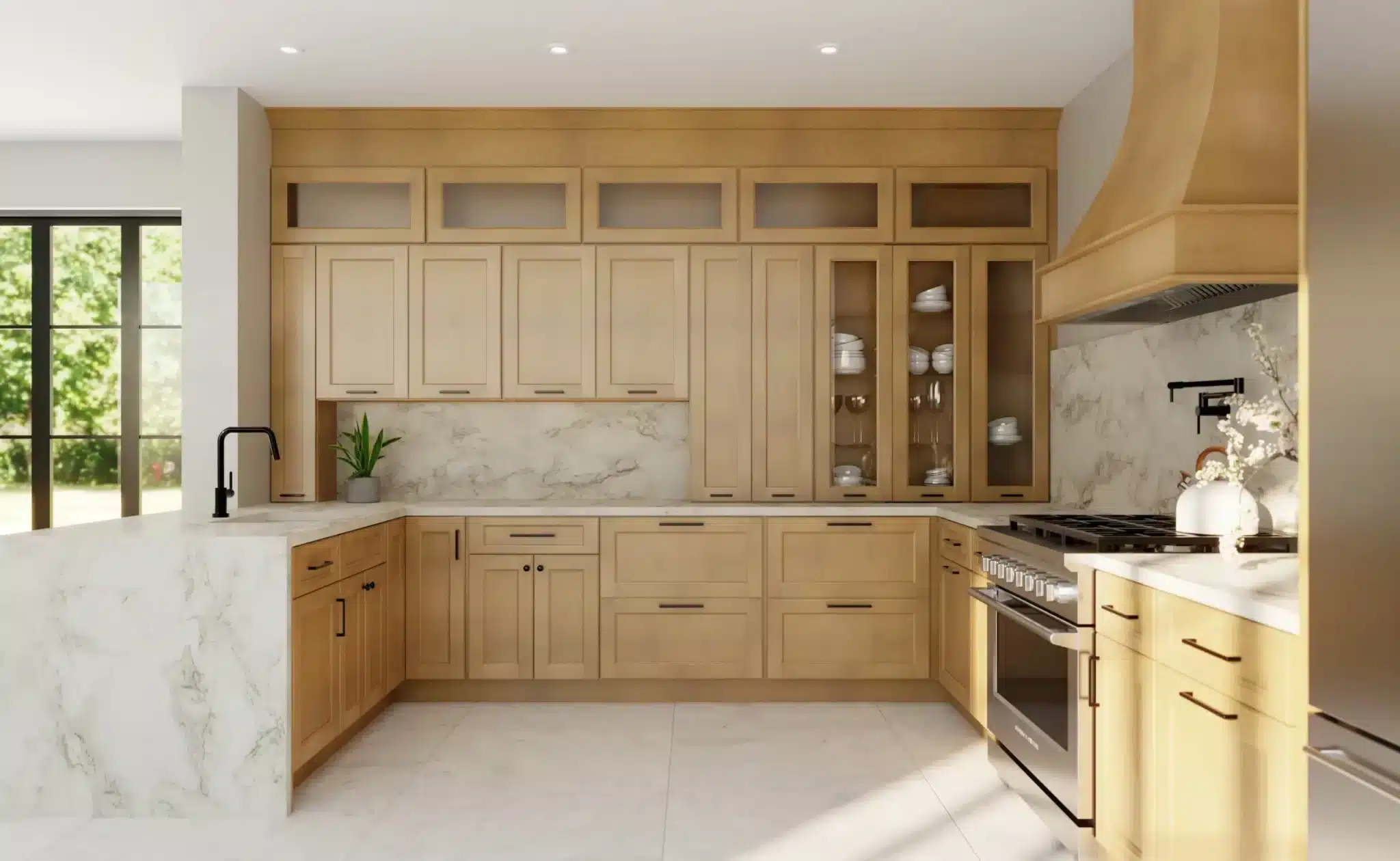
Shiloh Cabinetry is built in Dudley, Missouri by W.W. Wood Products, Inc., a family-owned American manufacturer. Every Shiloh cabinet is framed construction, built to order, with the doors made in-house. The line runs deep on customization: 50-plus door styles, nine wood species, 25 standard Sherwin-Williams paint colors plus unlimited custom matches, nine overlay and inset configurations including true flush inset, and specialty hand-distressed finishes. Shiloh runs its own testing lab and carries a 10-year limited warranty.
| Attribute | Fabuwood | Shiloh Cabinetry |
|---|---|---|
| Founded / Maker | 2008; Fabuwood | W.W. Wood Products (family-owned) |
| Built in | Newark, NJ + Tijuana, MX; assembled in USA from global components | Dudley, Missouri; American-made |
| Construction type | Framed (Allure) + frameless (Illume, Ovela) | Framed only; 9 overlay/inset configs incl. true inset |
| Door styles | ~12 door-style families | 50+ door styles |
| Wood species | Birch (“maple-look”); no true maple/oak in semi-custom catalog | 9 species: maple, alder, walnut, cherry, red oak, hickory, poplar, white oak (rift & quarter-sawn) |
| Finishes | Curated named tiers; Sherwin-Williams + Benjamin Moore | 25 standard SW + unlimited custom; Olde World & Aged distressed |
| Lead time | ~5 business days on stocked configs | Build-to-order, typically several weeks (rush program available) |
| Hardware | Blum standard across main lines | Blum TANDEM + BLUMOTION & Blum CLIP top hinges, standard |
| Warranty | Limited Lifetime (named series, purchases on/after Oct 1, 2024) | 10-Year Limited |
| Certifications | KCMA, CARB2, TSCA Title VI, ICC-ES, AWI Premium (Q12) | KCMA, Environmental Stewardship Program, FSC; in-house lab |
| Sample price (NJ, same kitchen) | ~$25,000 | ~$42,000 |
Specs reflect current manufacturer and dealer spec sheets and can vary by line. Prices are sample real-world quotes, not offers.
Box construction and materials
Start with the box, because it carries the countertop and holds the hardware for the life of the kitchen.
Fabuwood’s flagship Allure series uses 1/2-inch plywood throughout the box with a one-piece 1/2-inch plywood back. That single-piece back is a real structural advantage: it resists racking under heavy stone and gives a secure full-width mounting surface without relying on supplementary hanging rails. The line is KCMA-certified to the 600-pound wall-load test. Fabuwood’s Ovela frameless line is also all-plywood; its Illume frameless line uses engineered furniture board boxes, so if you want plywood in a frameless Fabuwood cabinet, Ovela is the correct pick.
Shiloh builds a framed box with 1/2-inch plywood sides, 3/8-inch plywood top and bottom (on wall cabinets), 3/4-inch plywood adjustable shelving with solid metal clips, and finished ends in matching 1/4-inch hardwood veneer (or MDF on painted cabinets). Instead of a thick one-piece back, Shiloh anchors the box with a solid wood hanging rail and solid wood corner blocks in the base cabinets, plus 1-1/2-inch wide solid wood face frames. That’s a different engineering philosophy: Fabuwood leans on a heavy plywood back panel, Shiloh leans on solid-wood framing members and corner blocks. Both are sound. Shiloh’s solid-wood frame gives superior screw-holding for hardware and trim; Fabuwood’s one-piece back is the stronger single panel.
The honest read on the box: on the most popular framed kitchens, the two are closer than the price gap suggests. Shiloh’s thicker 3/4-inch shelving and solid corner blocks edge it ahead on structure; Fabuwood’s 1/2-inch one-piece back edges it ahead on the back panel. Neither uses particleboard in the box on its plywood lines.
Drawers and joinery
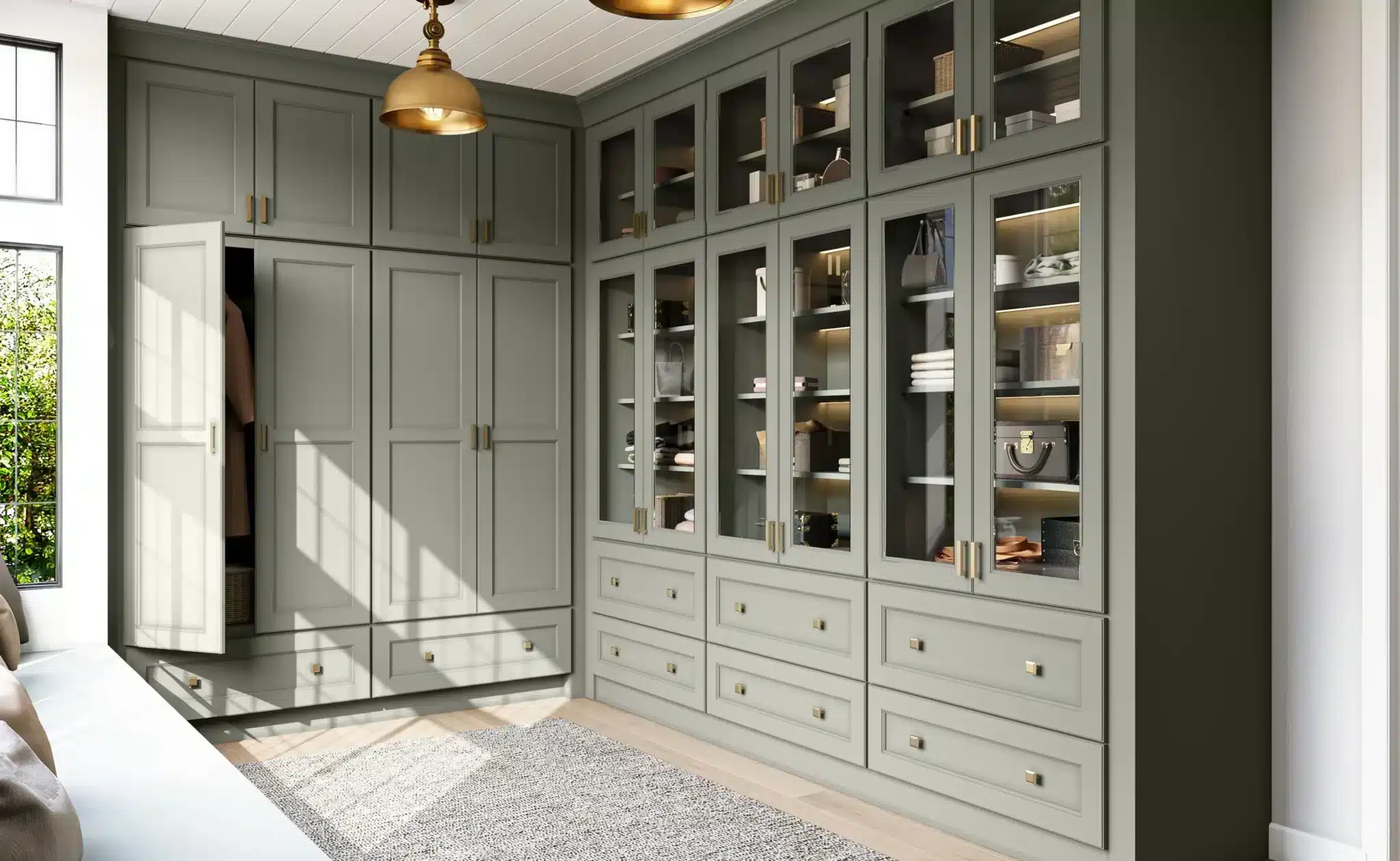
Both brands use the joint you want: solid-wood dovetail drawer boxes. Dovetails interlock the front and sides so the drawer face doesn’t pull loose after years of slamming, which is the failure point on cheaper stapled or doweled boxes.
Fabuwood specs 5/8-inch solid birch dovetail boxes on Allure and Ovela (and a Blum metal Merivobox on Illume). Shiloh specs 5/8-inch hardwood dovetail as standard, with a 3/4-inch hardwood dovetail upgrade available. On glides, Fabuwood runs Blum full-extension soft-close as standard. Shiloh runs Blum TANDEM edge 7/8-inch extension with integrated BLUMOTION as standard, with full-extension Blum TANDEM available as an option. Practically, Fabuwood’s standard glide gives full extension out of the box; Shiloh’s standard is 7/8-inch extension and you upgrade to full. Both are genuine Blum, both soft-close, both built to last. Shiloh’s optional 3/4-inch drawer box is heavier than anything in Fabuwood’s standard catalog.
Doors, finishes, and color: Shiloh’s clearest win
This is where the brands separate the most, and where Shiloh earns its premium.
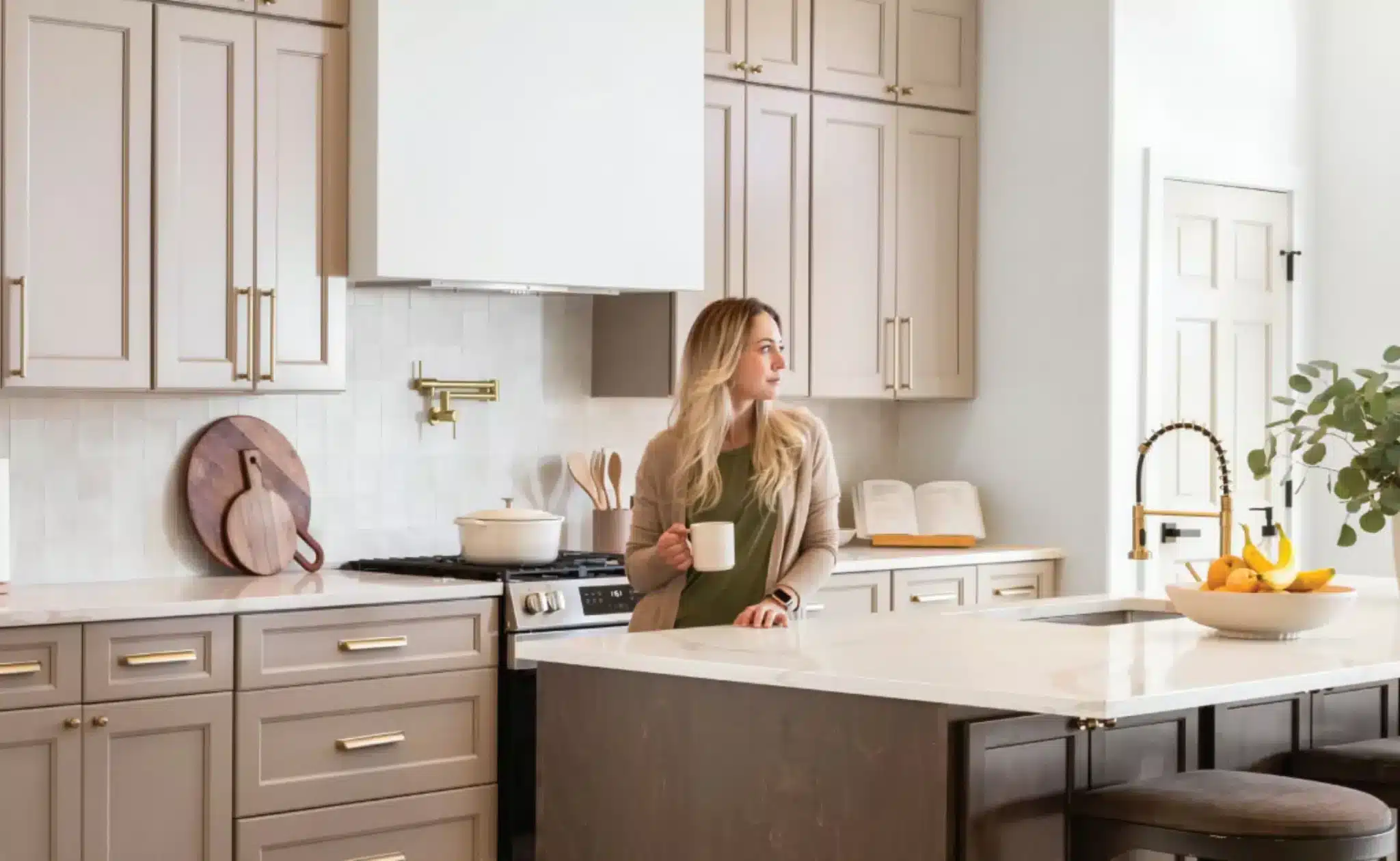
Fabuwood’s doors are well made for the price: solid wood stiles and rails with a 3/8-inch MDF center panel and mortise-and-tenon joinery on Allure. The MDF center is deliberate. It resists the seasonal movement that can crack a painted solid-wood panel at the joints. But Fabuwood’s catalog is curated, not open. Its “maple-look” finishes are applied to birch, not true hard maple, because its supply chain doesn’t carry true maple. The palette (Frost, Dove, Nickel, Indigo, Timber, Cobblestone, Kona, Mocha and a few others) is engineered for high turnover, and inset doors are not offered in the standard catalog.
Shiloh builds every raised-panel door in-house and offers true solid hardwood doors (except painted styles and the Metropolitan door, which are MDF for a smoother paint result). You get nine wood species: maple, alder, walnut, cherry, red oak, hickory, American poplar, select poplar, and white oak including rift-cut and quarter-sawn, each with its own deep stain library. On paint, 25 standard Sherwin-Williams colors plus unlimited custom Sherwin-Williams matches, finished with a catalyzed conversion varnish topcoat. Then come the finishes Fabuwood simply doesn’t offer: Olde World hand-distressed (rock dents, crackle, gouging, worm-holing, brushed highlights) and Aged techniques, plus Café and Slate highlight options.
If you want a specific shade, real grain in real wood species, or a hand-applied character finish, Shiloh is in a different league. If you want a clean, repeatable, mainstream finish that ships fast, Fabuwood’s curated palette covers most buyers.
Framing, inset, and customization
This is the second place Shiloh pulls clearly ahead, and the one place Fabuwood answers back.
Shiloh offers nine framed configurations: standard overlay, full overlay, and a full inset family including 3/8-inch inset, beaded inset, square beaded inset, flush inset, modern flush inset, modern beaded inset, and modern square beaded inset. True flush inset is a high-craft look that Fabuwood’s standard catalog does not offer at all. Shiloh also runs as a full semi-custom-to-custom program: dimensional modifications, 40-plus decorative wood hoods built by its own craftsmen, and a furniture-vanity program.
Fabuwood’s counter is frameless. Shiloh is framed only. There is no true frameless Shiloh line, so a full-access European slab look isn’t on the menu. Fabuwood offers two frameless lines (Ovela all-plywood, Illume engineered board). So the customization question splits cleanly: for inset and traditional craft, Shiloh; for frameless modern, Fabuwood.
Certifications and quality standards
Both brands are KCMA-certified and both document environmental compliance. Fabuwood holds KCMA, CARB2, TSCA Title VI, ICC-ES, and AWI Premium Grade, packaged into a 12-benchmark program it calls Q12. Shiloh holds KCMA, Environmental Stewardship Program, and FSC certification, and runs its own in-house testing lab. For most kitchens this won’t change how the cabinets perform, but both brands give you documented standards to hand a builder or inspector.
Warranty
Here Fabuwood has the edge on paper. Fabuwood’s Limited Lifetime Warranty covers the Allure, Illume, Ovela, Quest, Value Premium, and Valencia series for purchases on or after October 1, 2024, for as long as the original buyer owns the home. Shiloh carries a 10-Year Limited Warranty. Ten years is a serious, confident warranty for a build-to-order line, but it isn’t lifetime. Both are non-transferable and neither covers seasonal wood movement, normal wear, or moisture damage. If warranty length is your deciding factor, Fabuwood wins it.
Pricing: what real quotes look like
Brand-level pricing is misleading because both span a range, but the gap between them is real and consistent.
Fabuwood Allure kitchens typically install in the $300 to $500 per linear foot range. A 10×10 package runs roughly $4,440 (Value Premium) to $5,748 (Allure Luna or Fusion) in sample dealer listings. A full mid-range Allure kitchen commonly lands around $6,000 to $10,000 in cabinets; an elaborate Galaxy Frost build with island and accessories can reach $15,000 to $22,000.
Shiloh sits a clear tier higher because it’s a build-to-order, true-hardwood, customizable line. Public data points: a Houzz user reported a Shiloh estimate of just under $25,000; the New Jersey homeowner cited above quoted ~$42,000 for Shiloh against ~$25,000 for Fabuwood on the same project. In a separate comparison, owners described Shiloh as clearly worth a roughly $6,000 upcharge over KraftMaid. Shiloh doesn’t publish flat rates because pricing is dealer- and configuration-driven, and inset, custom color, and specialty finishes all add to it.
The honest way to judge value is line against line with the same door style and finish. On that basis, Fabuwood delivers more cabinet per dollar; Shiloh delivers more cabinet, period, at a meaningfully higher price.
Real-world pain points: what owners actually report
Spec sheets only tell you so much. Here’s the recurring pattern from Reddit, Houzz, and Facebook renovation groups.
Fabuwood: where owners complain
Paint chipping / peeling on painted lines, white (Frost) especially, within 12–18 months. Common at this price tier, but the volume of reports is notable.
Delivery damage. Contractor accounts of reordering replacement parts more than once.
Warranty friction. Photos required at delivery, sometimes a return-to-factory step before a replacement ships.
Shiloh: where owners complain
Lead-time overruns. One Houzz owner quoted three months waited seven. A Facebook post described cabinets unfinished after 15 months.
Finish & fit errors on custom work: wrong paint, drawers that didn’t fit properly.
Against that, a Reddit cabinetry thread calls Shiloh “an excellent cabinet” with great finishes, construction, and a rush-shipment program.
What to take from this: Neither brand is defect-free, and the defects track the production model. Fabuwood’s are finish fragility and shipping damage at volume scale. Shiloh’s are lead-time slips and spec errors on custom builds. In both cases, the dealer is the single biggest factor in how your post-install experience goes.
Five scenarios where the right answer flips
| Your scenario | Pick | Why |
|---|---|---|
| On a contractor’s clock (living through the reno, or holding a flip) | Fabuwood | ~5-day stock lead time; Shiloh is build-to-order and can slip past quote |
| You want true inset doors (flush inset) | Shiloh | Full inset family; Fabuwood has no inset in its standard catalog |
| You want real solid maple, oak, walnut, or cherry | Shiloh | 9 true species; Fabuwood substitutes birch in “maple-look” finishes |
| All-plywood at a value price, or a frameless modern look | Fabuwood | Allure/Ovela all-plywood standard; Shiloh is framed only |
| A specific hand-applied or distressed finish | Shiloh | Olde World/Aged + unlimited custom color; not what Fabuwood’s palette is built for |
What we see from the showroom floor
We’ve sold and installed Fabuwood since 2014, across our showrooms in Virginia, Maryland, Texas, Illinois, and Delaware. We don’t stock Shiloh, but we see its quotes constantly, because customers bring one in and ask us to compare.
The pattern is consistent. When a customer is choosing between Fabuwood and Shiloh, they’re usually choosing between two different projects, not two versions of the same one. The Fabuwood buyer wants a strong, fast, all-plywood kitchen at a predictable price and a finish that lives in the mainstream. The Shiloh buyer has a specific vision: inset doors, a particular stained species, a hand-applied finish, and a budget that can absorb a premium and a wait. Both are right for the buyer they fit. Where we add value is being honest about which one you actually are before you spend the money.
“Marco was great at helping me pick exactly what I needed. Working with him was hassle-free. The prices are very fair and the selection spans many colors and styles.”
— Jason M., Google review
A spec sheet won’t catch a measurement that’s off or an appliance that won’t clear a drawer once it’s open. An experienced designer does, and that’s the part of a kitchen you can’t download.
The quality verdict
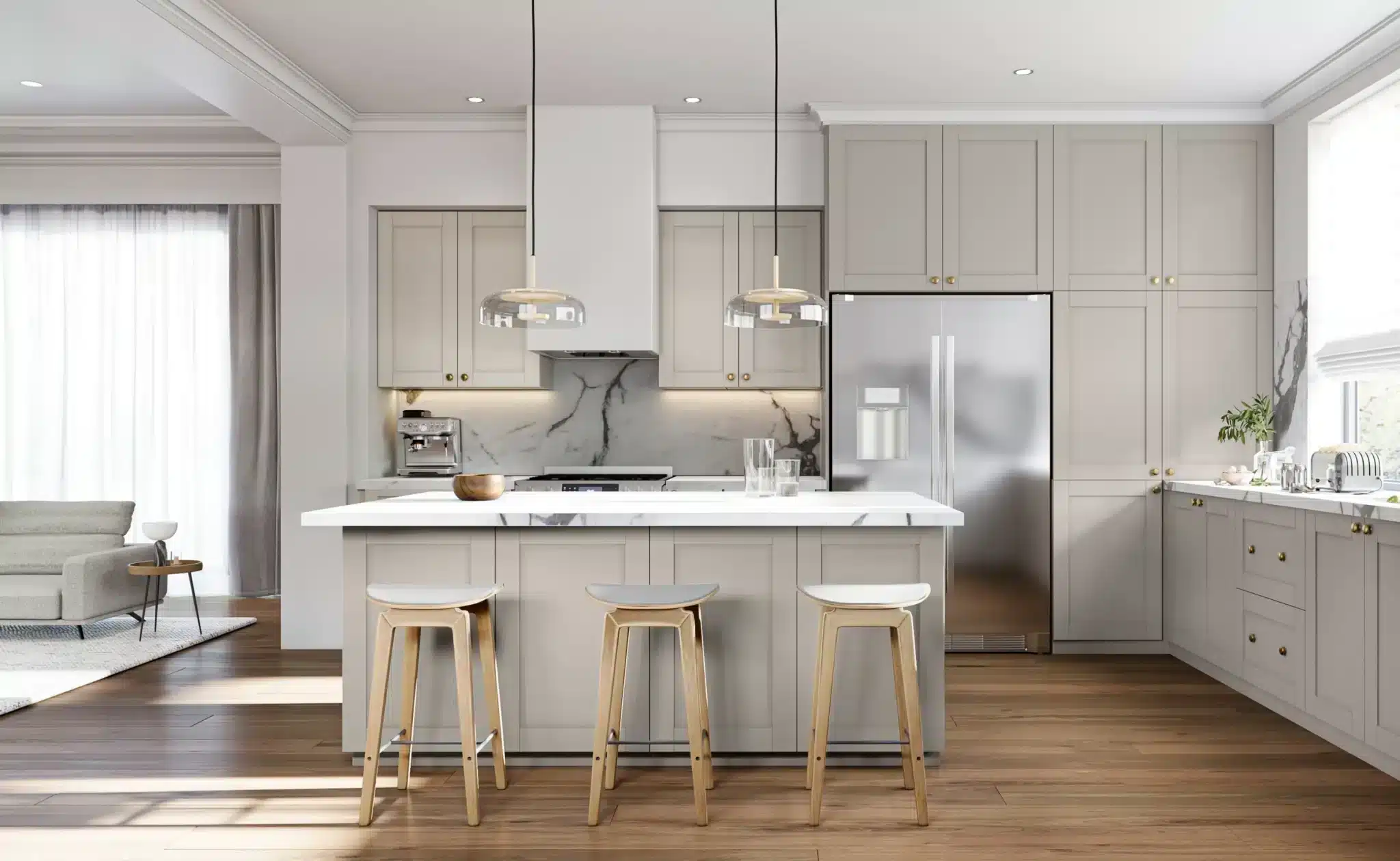
On absolute build quality and customization, Shiloh is the higher cabinet. It has true solid-hardwood doors in nine species, in-house door building, true inset, hand-distressed finishes, solid-wood framing and corner blocks, and an in-house test lab. It’s an American-made semi-custom-to-custom line, and the price reflects it. Fabuwood wins on the things that matter to most kitchen projects at the semi-custom price point: ~5-day lead time, all-plywood boxes and Blum hardware as standard, a one-piece plywood back, a frameless option, a limited lifetime warranty, and a price that can be half of a comparable Shiloh quote.
Choose Fabuwood if…
Timeline pressure is real, you want all-plywood construction without an upgrade fee, you want a frameless modern option, your finish vision lives in a mainstream palette, or you’re managing multiple properties where speed and predictable supply matter most.
Choose Shiloh if…
You want true inset doors, real solid hardwood in a specific species, hand-applied or distressed finishes, and customization Fabuwood’s catalog can’t reach, and your budget and schedule can absorb the premium and the build-to-order wait.
Where IST Cabinets fits
Both brands sell through dealers, so the dealer you work with is the whole experience: the design consultation, the field measurement, the finish samples, and the warranty advocacy if something fails after move-in.
IST Cabinets is an authorized Fabuwood dealer with full-line stocking across the Allure, Illume, Quest, Valencia, and Ovela series, plus Fabuwood’s vanity collection and the new Plain & Fancy custom arm. Our showrooms carry physical displays of the most-specified door styles and finishes, so you can see a Galaxy Frost or a Cobblestone shaker in person before you commit.
We don’t carry Shiloh, and we won’t pretend otherwise. If after reading this you decide Shiloh is the better fit, you’ll find their dealer network easily. If Fabuwood is on your shortlist, walk in with your kitchen dimensions and we’ll put a real quote and a real lead time in front of you. No deposit required for a design consultation.
See Fabuwood quality up close
Feel the door weight, the drawer action, and the finish in person. Bring your measurements for a free design and quote.
Alexandria VA · Fairfax VA · Columbia MD · Houston TX · Delaware
Frequently asked questions: Fabuwood vs. Shiloh
Is Shiloh better than Fabuwood?
In absolute build quality and customization, yes. Shiloh offers true solid-hardwood doors in nine species, in-house door construction, true inset, hand-distressed finishes, and solid-wood framing, and it’s priced as the higher product. But “better” depends on the project. For a fast, value-priced, all-plywood kitchen in a mainstream finish, Fabuwood delivers more cabinet per dollar and ships in days. Shiloh is the better cabinet; Fabuwood is the better value and the faster option.
Why is Shiloh so much more expensive than Fabuwood?
Shiloh is a build-to-order American-made line with real solid-hardwood doors, nine wood species, true inset construction, hand-applied finishes, and unlimited custom color matching. Fabuwood is a high-volume semi-custom line that assembles stocked configurations for fast shipping. On the same New Jersey kitchen, owners have reported roughly $25,000 for Fabuwood against $42,000 for Shiloh. You’re paying for customization, hardwood, and craft, not just a logo.
Does Fabuwood or Shiloh have a better warranty?
Fabuwood has the longer warranty on paper: a Limited Lifetime Warranty on its named series for purchases on or after October 1, 2024, for the original owner. Shiloh carries a 10-Year Limited Warranty. Both are non-transferable and neither covers seasonal wood movement, normal wear, or moisture. If warranty length is your deciding factor, Fabuwood wins it.
Which brand ships faster?
Fabuwood, decisively. Stocked Allure, Quest, and Ovela configurations leave the warehouse in about five business days. Shiloh is built to order; standard lead time runs several weeks and owner reports show custom orders stretching to three to seven months in some cases. Shiloh offers a rush-shipment program, but for a tight construction schedule Fabuwood is the safer choice.
Does Shiloh offer inset cabinets and does Fabuwood?
Shiloh offers a full inset family: 3/8-inch inset, beaded inset, square beaded inset, flush inset, and modern inset versions, across nine framed configurations. Fabuwood does not offer inset doors in its standard catalog. If true inset is your look, Shiloh is the pick between these two.
Are Fabuwood cabinets real wood?
Fabuwood uses real wood where it counts: solid wood door frames, 5/8-inch solid birch dovetail drawer boxes, and plywood boxes on Allure and Ovela. But its painted doors use a 3/8-inch MDF center panel (standard practice to resist cracking), and its “maple-look” finishes are applied to birch rather than true hard maple. Shiloh offers true solid-hardwood doors in nine species. Both are real-wood cabinets; Shiloh offers more true solid hardwood.
Is Fabuwood a good cabinet for the price?
Yes. Fabuwood is KCMA-certified, uses 1/2-inch plywood boxes with a one-piece plywood back and solid-wood dovetail drawers, and includes Blum hardware as standard rather than as an upgrade. The most common complaint is paint chipping on white painted finishes in the first year or two, plus occasional delivery damage, which are finish and logistics issues, not structural ones. Choosing a stained finish and inspecting every door at delivery sidesteps most of the recurring problems.
Is Shiloh worth the money?
For the right buyer, yes. Shiloh’s solid-hardwood doors, true inset options, nine wood species, hand-distressed finishes, and in-house quality testing are premium, and owners who want that level of craft generally feel the upcharge is justified. The risk to plan around is lead time: build-to-order schedules can slip, and a strong dealer who manages the order is the biggest protection against it.
What is the most popular cabinet style in 2026?
A Shaker-style door in a warm off-white or light-stained wood remains the volume leader, suiting both traditional and transitional kitchens, while flat and slab fronts are rising for modern designs. Both Fabuwood and Shiloh offer Shaker as a core style, which is why the comparison comes down to construction, finish range, inset availability, and lead time rather than door shape.
What cabinet finish is trending for 2026?
Warm, natural tones are leading: light-stained woods, warm off-whites, and earthy greens, with cool gray and stark all-white kitchens fading. Shiloh’s 2025–2026 trend colors include Shoji White, Quietude, and Rookwood Shutter Green; Fabuwood maps to this shift through stained finishes like Timber and Mocha. Whichever brand you choose, warmer and more natural reads as current and ages better than cool gray.