
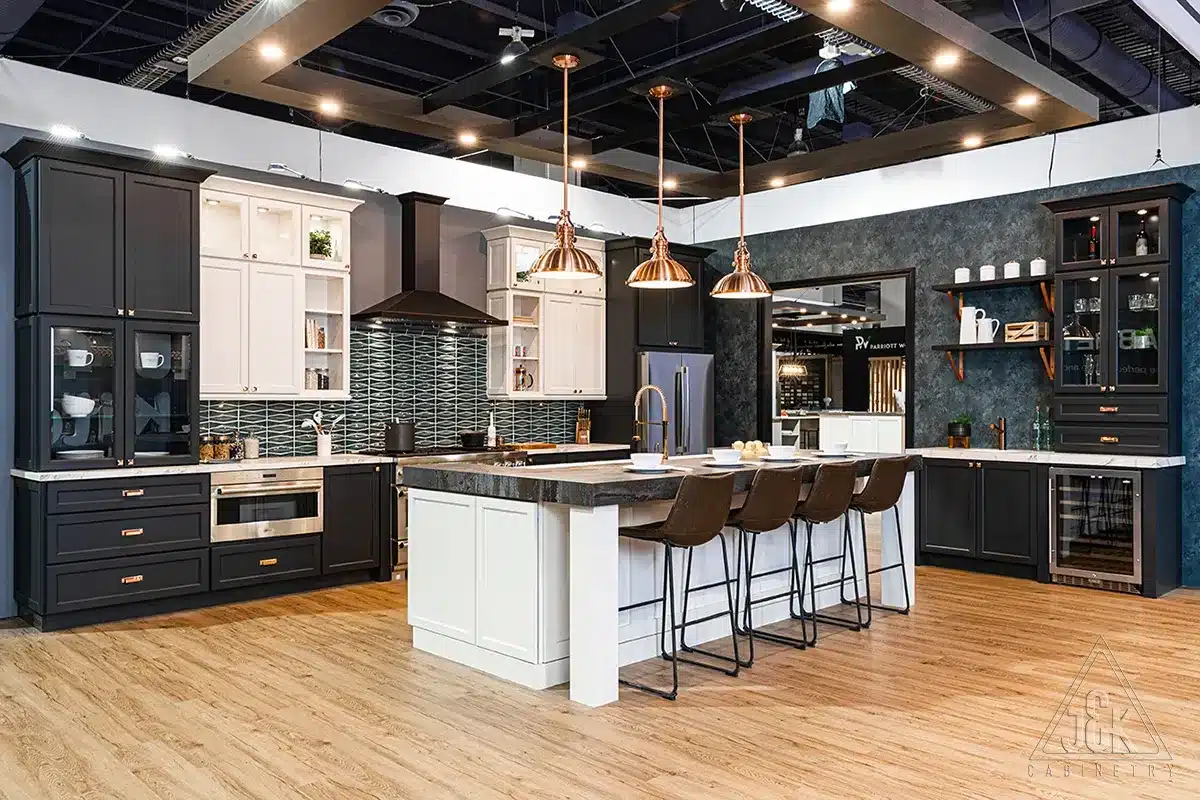
Fabuwood Comparison Series
We sell and install Fabuwood every day, so read this knowing where we stand. What follows is not a sales pitch wearing a comparison’s clothes. After years of laying out kitchens, checking deliveries off the truck, and taking the calls that come a few months after install, we have a clear read on where these two brands actually differ and where one is the smarter buy than the other. J&K is a real competitor. For some projects it is the right call, and this guide will tell you when.
This is part of our Fabuwood comparison series, where we put Fabuwood next to the brands homeowners and contractors actually weigh it against. Both land on almost every short list in the affordable all-wood bracket. Both use plywood boxes and solid-wood dovetail drawers, both skip particleboard on their better lines, and both are imported. They separate on four things that decide how a kitchen ages: how it arrives, the hardware, the warranty, and the price.
The short answer
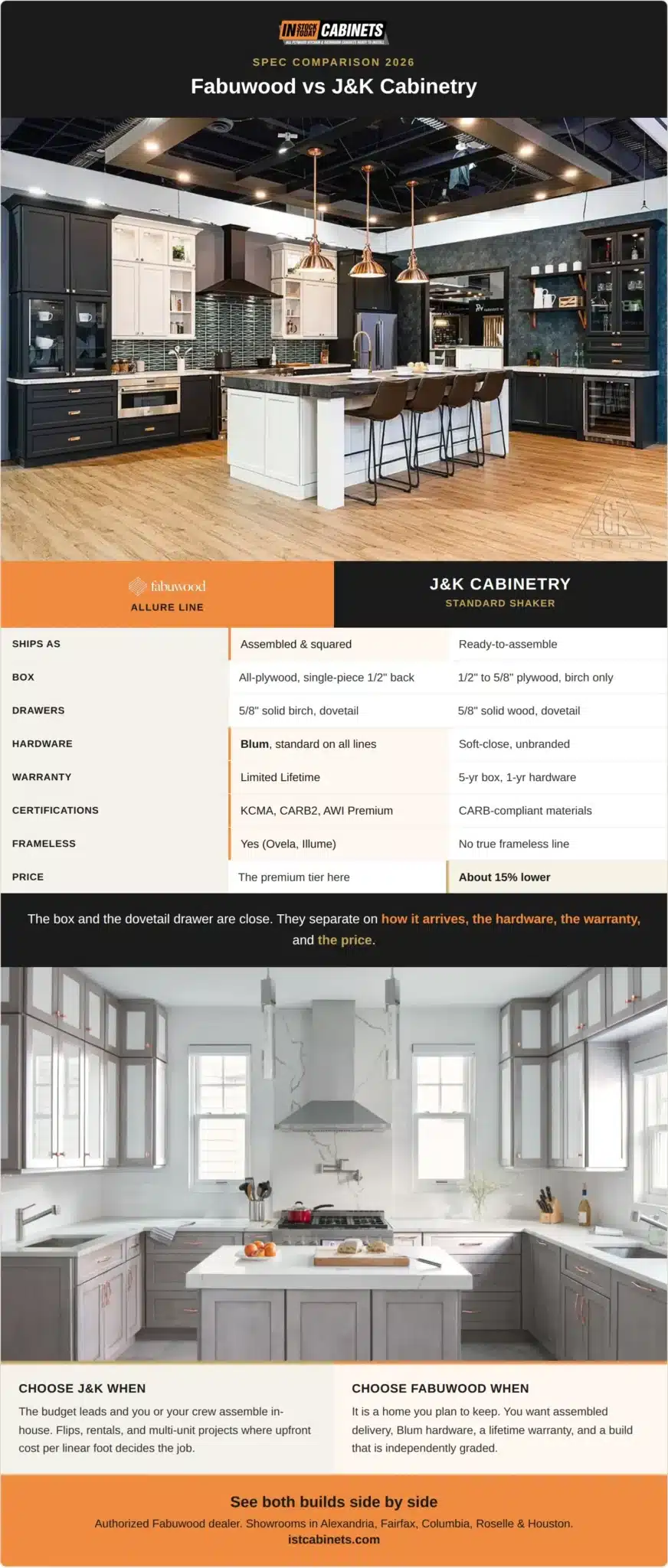
J&K is the lower-priced brand, usually around 15 percent cheaper, and it ships ready-to-assemble, which stretches a budget further if you or your installer will build the boxes. Fabuwood costs more, and the premium buys the parts that decide how a kitchen holds up: branded Blum hardware on every main line, a published single-piece half-inch plywood back, AWI Premium Grade qualification on Allure, a Limited Lifetime Warranty instead of a five-year box term with only one year on the hardware, and cabinets that arrive already assembled and squared through IST.
Choose J&K for a flip, a rental, or a strict budget where you or your crew assemble in-house and upfront cost leads. Choose Fabuwood for a primary home you plan to keep, where the hardware, the warranty, assembled delivery, and resale carry the decision.
At a glance
| Spec | Fabuwood (Allure) | J&K Cabinetry |
|---|---|---|
| Ships as | Assembled and squared | Ready-to-assemble (RTA) |
| Box | All-plywood, single-piece 1/2″ back | 1/2″ to 5/8″ plywood, birch and plywood only |
| Drawers | 5/8″ solid birch, dovetail | 5/8″ solid wood, dovetail |
| Hardware | Blum (Julius Blum GmbH), standard on all main lines | 6-way soft-close metal, unbranded |
| Warranty | Limited Lifetime (2-year on painted finish) | 5-year box, 1-year hardware |
| Third-party grade | KCMA, CARB2, TSCA VI, AWI Premium (Allure) | CARB-compliant materials |
| Frameless option | Yes (Ovela plywood, Illume engineered board) | No true frameless line |
| Price | Higher (the premium tier here) | About 15% lower |
Specs reflect current published spec sheets and can vary by series. Prices are directional, not quotes.
Where they are built the same
Start here, because it is most of the cabinet. Both brands build with plywood boxes, not particleboard, on their standard lines. J&K states its cases are birch and plywood only, with no MDF, HDF, or particleboard, and Fabuwood’s Allure box is all-plywood as well. Both use five-eighths-inch solid-wood drawer boxes joined with dovetails, which is the joint you want. Dovetails interlock the front and sides so the drawer face does not work loose after years of slamming, the failure point on cheaper stapled or doweled boxes.
Both also finish their interiors, both meet the federal formaldehyde limits that matter for indoor air, and both offer a wide catalog of painted and stained doors in the shaker and slab looks most 2026 kitchens are built around. If all you compared were a base cabinet box and a drawer, you would have a hard time telling a standard J&K from a Fabuwood Allure across the room. That is the honest starting point. The differences are real, but they live in the details that do not show up in a showroom glance.
Where they separate
1. How the cabinet arrives: assembled vs RTA
This is the difference most buyers feel first, and it is the one online spec sheets skip. J&K is a ready-to-assemble line. The cabinet ships flat, and you or your installer build each box on site with the included hardware. Assembled well, an RTA kitchen performs fine, and the flat-pack format is part of why J&K keeps its price down and its shipping fast. Through IST, Fabuwood arrives already built and squared, so nothing depends on how carefully the boxes went together in someone’s garage.
For a homeowner, assembled delivery removes a real variable. Every joint was set on a factory line under quality control, not on a Saturday with a rubber mallet. For a contractor who assembles in-house and has the labor to do it, RTA can be the cheaper path and the flexibility is a feature, not a flaw. We break the tradeoff down in full in our RTA vs pre-assembled guide, but the short version is simple: RTA saves money and shifts the quality of the build onto whoever assembles it.
2. The hardware, which wears out first
If one factor decides how a kitchen feels in year ten, it is the hardware, because hinges and glides wear out long before a plywood box does. This is the clearest gap between the two. Fabuwood runs Blum across its main collections as standard, the six-way adjustable clip-on hinge and Blum soft-close runners, included on every main line rather than reserved for a top tier. Blum, officially Julius Blum GmbH of Austria, rates its hardware for roughly 200,000 open-and-close cycles and carries its own separate manufacturer warranty.
J&K uses a six-way adjustable soft-close metal hinge and a concealed undermount soft-close glide. These are solid, current-generation parts, and on day one they operate much like anyone else’s soft-close. The difference is that they are unbranded. Ten years from now, matching a worn Blum hinge is a catalog lookup. Matching a generic glide from a wholesale line can mean guesswork. When you are buying the part that fails first, a named, serviceable brand is worth something.
3. The warranty, especially on that hardware
The warranties look close until you read the hardware line. Fabuwood expanded its cabinet coverage to a Limited Lifetime Warranty for purchases on or after October 2024, with a separate two-year term on painted finishes, which is standard across the industry because paint over a moving wood joint eventually shows a hairline at the miter. J&K warrants its cabinets for five years, but the hinges and the entire drawer glide system are warranted for only one year.
Read those together with the point above and they compound. The component most likely to need replacing is the one J&K covers for the shortest time, and it is unbranded. That is not a reason to avoid J&K. It is a reason to know what you are buying and to price a set of replacement glides into a ten-year view if you go that route.
4. The back panel and the base
Fabuwood publishes a single-piece half-inch plywood back on its main lines. A full one-piece back can be screwed into wall studs at any point across its width, carries shear strength in every direction, and resists racking, the slow twist that pulls a cabinet out of square when a heavy quartz or granite top is set on the base run. J&K publishes a half-inch to five-eighths-inch plywood box but does not call out a full single-piece back thickness in its standard-features sheet the way Fabuwood does. That does not mean the back is thin. It means the spec is not published, so if a fully loaded base run matters to you, ask your J&K dealer to confirm the back construction in writing before you order.
5. Third-party validation
Both brands meet CARB Phase 2 and the federal TSCA Title VI formaldehyde limits, which is the floor, not a bragging right. Above that floor, Fabuwood carries KCMA certification and earned AWI Premium Grade on the Allure line in 2023, both independently tested standards, plus its own Q12 checklist, which is proprietary branding rather than a third-party stamp. J&K leans on CARB-compliant materials and its own quality-standards sheet. If independent grading is part of how you judge a cabinet, Fabuwood has more of it on paper.
6. The price, where J&K wins
For the same layout, J&K typically runs around fifteen percent under a comparable Fabuwood kitchen, and the RTA format can widen that gap further if you supply the assembly labor. That is a genuine advantage. On a tight renovation budget, on a rental, or on a flip where you are optimizing dollars per linear foot, the lower entry price is the honest reason to pick J&K, and we would tell you so on the showroom floor.
A note on where they are made
Neither brand is made in the USA in the way that phrase is often assumed. Both are imported. Fabuwood assembles, quality-checks, and ships from a one-million-square-foot facility in Newark, New Jersey, using globally sourced components. J&K, by its own FAQ, manufactures abroad and assembles in the United States. The honest distinction is that Fabuwood stands behind an assembled product domestically, while J&K ships a flat-pack you or your dealer complete. Ask either dealer to confirm current country of manufacture in writing if it matters to your project.
Pick the line, not just the brand
Both brands run several tiers, and a fair comparison matches like against like. Set a J&K standard shaker against a Fabuwood Allure and the box and drawer are close, with Fabuwood separating on the Blum hardware and the warranty. Drop to J&K’s economy E-series, where the door frame is solid wood but the center panels step down to quarter-inch plywood, and you should compare it against Fabuwood’s value tier rather than Allure, because you are now in a lighter build on both sides.
Frameless is where the match breaks. J&K does not offer a true frameless European line, so a modern slab look comes from full-overlay doors on a framed box. Fabuwood offers two frameless paths: Ovela, which keeps a plywood box, and Illume, which uses engineered furniture board. If you want a frameless kitchen with a plywood case, that is a Fabuwood Ovela conversation with no direct J&K equivalent. Our Fabuwood frameless guide walks through when frameless is worth it and when a framed box is the better buy.
Who each brand is really for
Reach for J&K when
The budget leads and you or your crew will assemble the boxes. Flips, rentals, and multi-unit projects where dollars per linear foot decide the job. You want a large all-wood catalog at a wholesale price and you are comfortable coordinating replacement hardware down the line yourself.
Reach for Fabuwood when
It is a home you plan to live in and keep. You want the cabinet to arrive assembled, the hardware to be Blum and serviceable a decade out, and the warranty to run for the life of the kitchen rather than one year on the parts that wear. You care that the build is independently graded, and you want a dealer who will design it and stand behind it locally.
Frequently Asked Questions For Fabuwood vs J&K Cabinetry
Is Fabuwood better quality than J&K Cabinetry?
On the box and the dovetail drawer they are close, since both use plywood cases and five-eighths-inch solid-wood dovetail drawers. Fabuwood pulls ahead on the parts that decide how a kitchen ages: branded Blum hardware standard on every main line, a Limited Lifetime warranty against J&K’s one-year hardware term, assembled delivery instead of ready-to-assemble, and independent AWI Premium Grade on Allure. J&K competes on a lower price, usually around fifteen percent less.
What are Fabuwood and J&K cabinets made of?
Both are all-wood builds, not particleboard, on their standard lines. J&K states its cases are birch and plywood only, with no MDF, HDF, or particleboard. Fabuwood’s Allure box is all-plywood with a single-piece half-inch plywood back. Both use three-quarter-inch solid-wood doors and five-eighths-inch solid-wood dovetail drawers. The main build difference is the hardware: Fabuwood runs Blum on every main line, while J&K uses an unbranded six-way soft-close hinge and glide.
Does J&K use Blum hardware?
No. J&K uses a six-way adjustable soft-close metal hinge and a concealed undermount soft-close glide, but the hardware is unbranded. Fabuwood includes Blum, made by Julius Blum GmbH of Austria, as standard on every main line. Blum hardware is rated for roughly 200,000 cycles and is easy to source and match years later.
Are J&K cabinets RTA or assembled?
J&K is a ready-to-assemble line. Cabinets ship flat and are built on site by you or your installer. Fabuwood, through IST, arrives already assembled and squared. Assembled delivery removes the variable of how carefully the boxes went together, which matters most on a home you plan to keep.
Where are Fabuwood and J&K cabinets made?
Both are imported, not domestically manufactured. Fabuwood assembles, quality-checks, and ships from a one-million-square-foot facility in Newark, New Jersey, using globally sourced components, and opened a second facility in Tijuana in early 2025. J&K, by its own FAQ, manufactures abroad and assembles in the United States. Country of manufacture can shift over time, so ask your dealer to confirm the current origin in writing if it matters to your project.
What is J&K’s warranty compared to Fabuwood’s?
J&K warrants its cabinets for five years, but the hinges and the drawer glide system are covered for only one year. Fabuwood carries a Limited Lifetime Warranty on cabinets purchased on or after October 2024, with a separate two-year term on painted finishes. The gap is widest on the hardware, which is the part most likely to need replacing.
Does J&K offer frameless cabinets like Fabuwood?
Not as a true frameless line. J&K achieves a modern slab look with full-overlay doors on a framed box. Fabuwood offers two frameless paths: Ovela, which keeps a plywood box, and Illume, which uses engineered furniture board. If you want a frameless kitchen with a plywood case, Fabuwood Ovela is the closest match, with no direct J&K equivalent.
Is J&K cheaper than Fabuwood?
Yes. For the same layout, J&K usually runs about fifteen percent under a comparable Fabuwood kitchen. Because J&K ships ready-to-assemble, the gap can widen further if you or your installer supply the assembly labor rather than paying for assembled cabinets.
Is J&K Cabinetry junk, or is it good quality?
Neither. The “junk” label online usually traces back to the price, not the construction. J&K builds plywood boxes with solid-wood dovetail drawers, the same core you find in pricier lines, so the box itself is sound. The risk is that J&K ships ready-to-assemble, so the final quality depends on who builds and installs it. A careful dealer and installer make J&K a solid budget kitchen. A rushed one can undo a good cabinet.
Do Fabuwood or J&K painted cabinets chip or peel?
Both can, and it clusters on white painted lines in the first year or two. Factory paint over a moving wood joint eventually shows a hairline, which most makers class as normal rather than a defect. It is an industry pattern at this price tier, not unique to either brand. If a flawless painted surface matters to you, a stained finish is the safer pick, and inspect every door at delivery before the crew leaves.
I run tight job schedules. How fast can I get cabinets, and does my crew have to assemble them?
Fabuwood stocked configurations ship in roughly five business days through IST, and they arrive assembled and squared, so your crew is not spending billable hours building boxes on site. You can also pick up from our showrooms in Alexandria, Fairfax, Columbia, Roselle, or Houston. J&K ships ready-to-assemble, meaning flat-pack boxes your team builds, so if you go that route, budget the assembly labor into the schedule. For a contractor protecting a timeline, assembled Fabuwood removes the biggest variable.
What happens if cabinets arrive damaged in the middle of a job?
You do not chase it alone. As your authorized dealer, IST receives and inspects the order and files any damage claim on your behalf, which moves faster than a homeowner or contractor filing directly with a wholesale manufacturer. Inspect and photograph every cabinet at delivery, flag anything before install, and keep the packaging until replacements ship. Most damage is shipping-related rather than a manufacturing defect, so catching it at the truck keeps a job on schedule.
Can IST handle multi-unit, spec, or replacement orders?
Yes. Both brands offer semi-custom modifications and odd sizes for real-world layouts, and Fabuwood’s warranty is assignable, so a builder or developer can pass coverage to the initial homeowner as a selling point. Because Fabuwood standardizes on Blum, matching a hinge or glide for a replacement years later is a simple catalog lookup rather than a hunt. Bring your unit count and takeoff and we will spec it for repeatability across the project.
What happens to my warranty if my dealer goes out of business?
This is the part buyers miss. Both brands sell wholesale only, so you never hold the warranty directly. Every claim runs through your dealer, who files it with the manufacturer. If that dealer disappears or the relationship sours, claims can stall. It is the main reason to buy from a stable, established authorized dealer who will still be around in ten years to stand behind the kitchen.
See both builds side by side before you decide
IST Cabinets is an authorized Fabuwood dealer with showrooms in Alexandria, Fairfax, Columbia and Houston. Bring your layout and a countertop sample. We will lay out the tradeoffs honestly, including when a lower-priced line is the right answer for your project.