
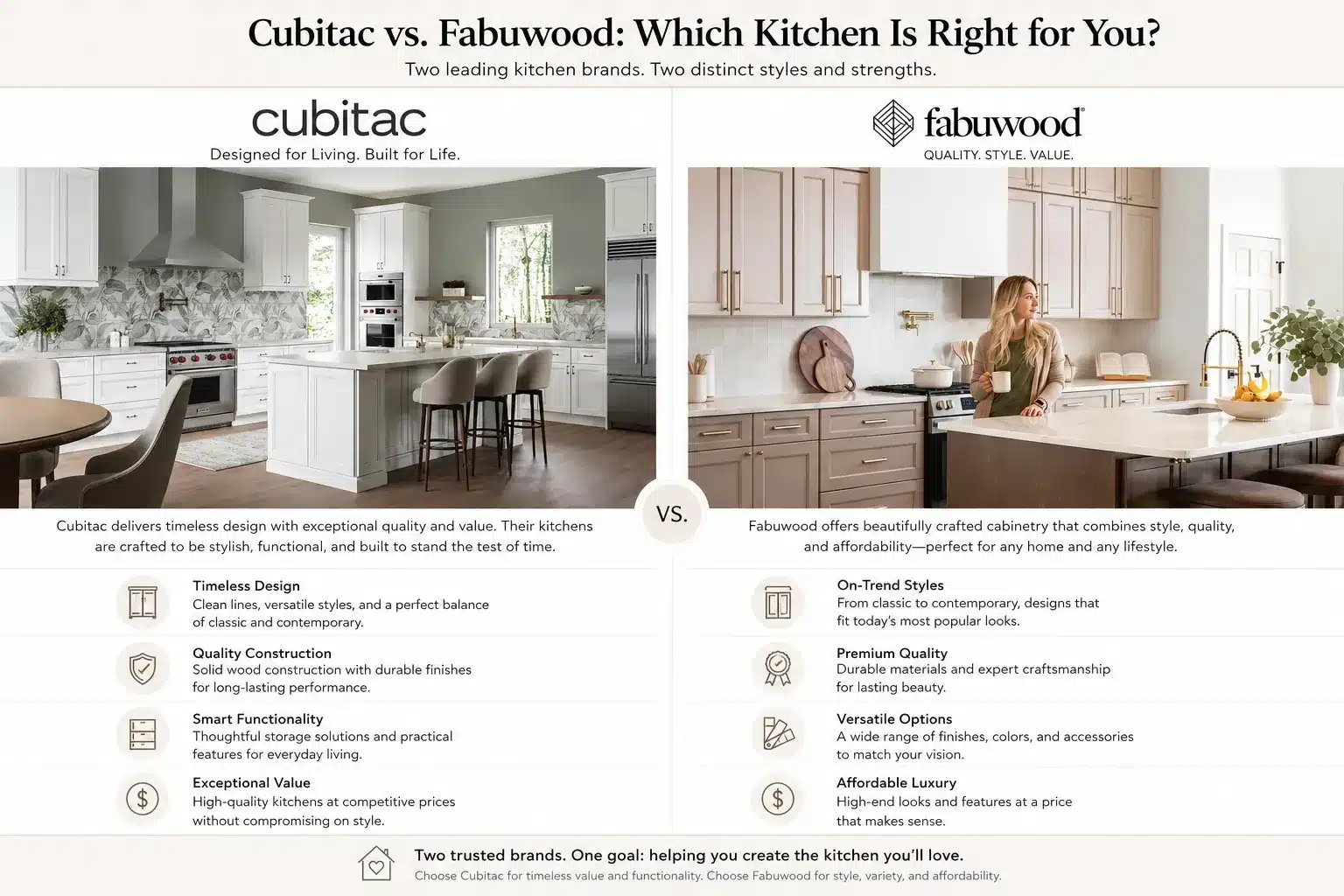
This is part of our Fabuwood comparison series, where we put Fabuwood next to other popular cabinet brands and judge them on build quality. We sell and install Fabuwood every day, so we know it well, but the goal here is a fair, spec-by-spec look at how Fabuwood and Cubitac are actually built so you can decide for yourself. Both are affordable all-wood lines that compete in the same bracket. Here is where they match and where they separate.
The short answer
On the fundamentals, these two are closer than their price tags suggest. Both use plywood boxes and solid-wood dovetail drawers, and both avoid particleboard on their better lines. Fabuwood pulls ahead on three quality fronts: Blum hardware on every main line instead of only the top tier, a frameless plywood option, and documented certifications and warranty across the catalog. Cubitac matches the core build and competes on custom color range and the lowest entry price. If you are grading consistency across the whole lineup, Fabuwood is the more predictable build.
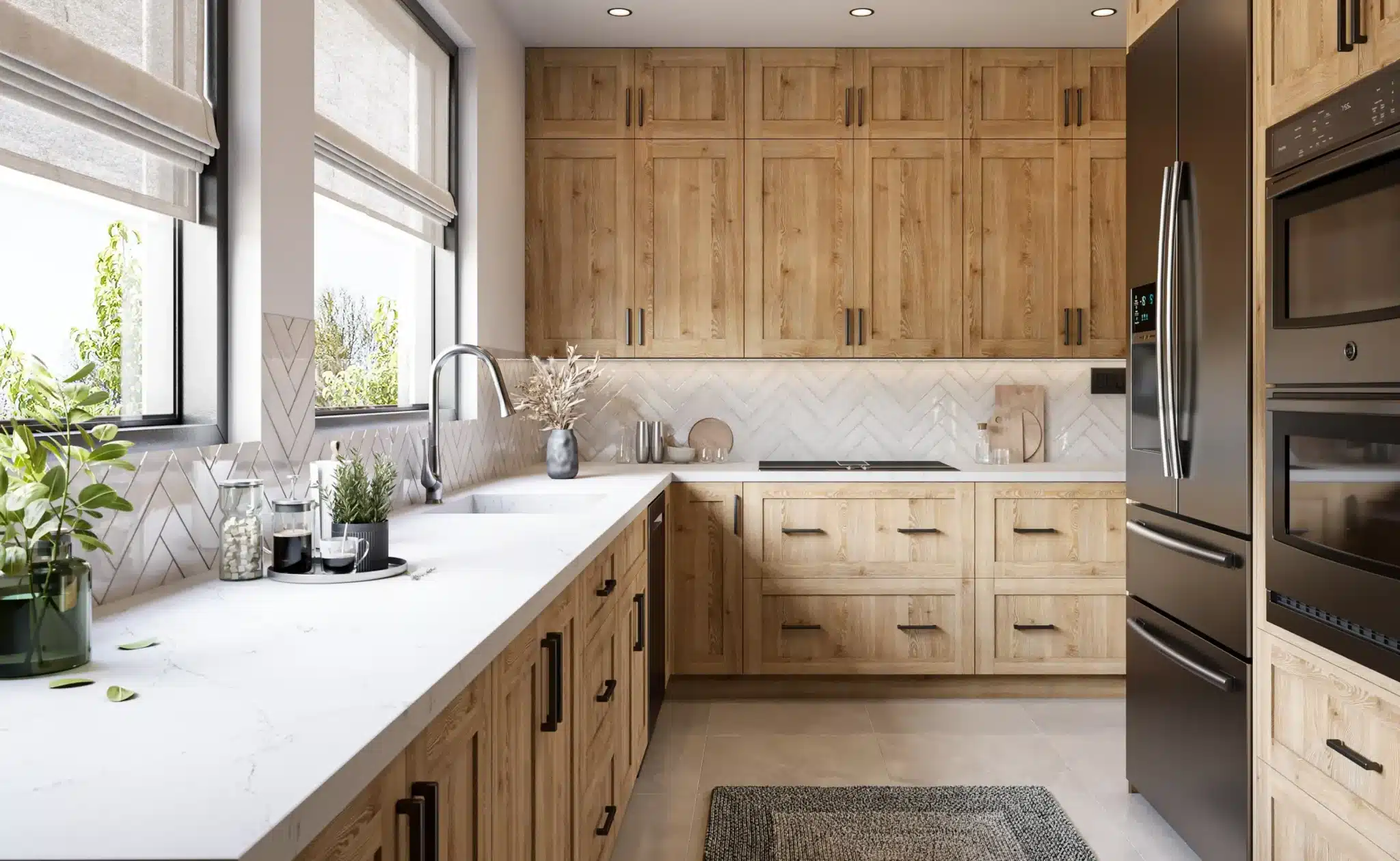
Fabuwood vs Cubitac at a glance
| Quality factor | Fabuwood | Cubitac |
|---|---|---|
| Cabinet box | Plywood on Allure and Ovela; engineered furniture board on Illume | 1/2-inch veneered plywood sides and backs; 3/4-inch plywood shelves |
| Drawer boxes | Solid wood dovetail (Allure, Ovela); Blum metal Merivobox (Illume) | 5/8-inch solid wood, dovetail |
| Soft-close hardware | Blum standard across the main lines | Blum on Imperial only; Basic, Prestige and Presto use unbranded soft-close |
| Construction type | Framed (Allure) and frameless (Illume, Ovela) | Full-overlay face frame across all series. No true frameless line |
| Series | Allure, Illume, Ovela, Value Premium, Quest (12 door-style families) | Imperial, Prestige, Basic, Presto (about 18 styles) |
| Color range | Structured finish tiers; Sherwin-Williams and Benjamin Moore coatings | Many styles advertise 5,000-plus custom colors |
| Certifications | KCMA, CARB2, TSCA Title VI, ICC-ES, AWI Premium Grade (Q12 program) | CARB2, KCMA |
| Warranty | Limited lifetime on named series, with a current, detailed document | Advertises limited lifetime; detailed public form is an older 5-year doc |
| Sample 10×10 package | About $4,440 (Value Premium) to $5,748 (Allure Luna or Fusion) | About $3,553 (Presto Bolt) to $6,847 (Imperial Madison) |
| Customization | Semi-custom size modifications, depth and height changes, plus an accessory program | Strongest on color and finish choice; less dimensional modification |
Box and drawer specs reflect current dealer-published spec sheets and can vary by series. Package prices are sample dealer listings, not quotes.
Box construction and materials
Start with the box, because it carries the countertop and holds the hardware for the life of the kitchen. Current dealer spec sheets show Cubitac building with 1/2-inch veneered plywood sides and backs, 3/4-inch plywood shelves, and no particleboard in the box. That is a solid build for the price and better than many shoppers expect from a value line. Fabuwood’s framed Allure series runs comparable 1/2-inch plywood box parts, so on the most popular framed kitchens, the two are close to even on the box itself.
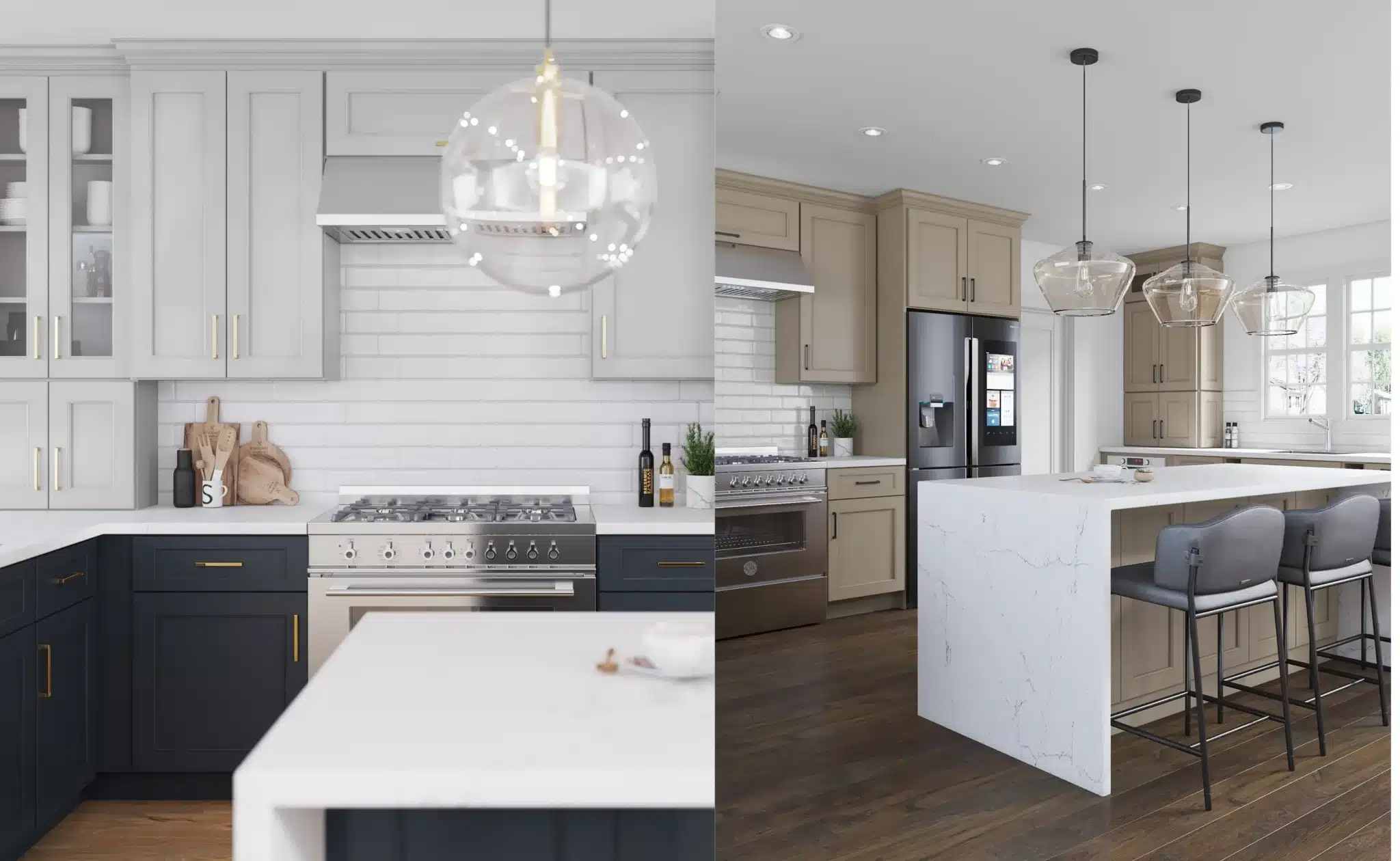
The detail that separates Fabuwood is its frameless lineup, and it is worth getting right because the two frameless lines are built differently. Ovela is frameless with plywood boxes. Illume is also frameless, but its boxes are engineered furniture board rather than plywood. Both are well made and handle nicely, but if you want plywood in a frameless cabinet, the correct Fabuwood pick is Ovela, not Illume. Cubitac does not offer a true frameless line at all, so a modern slab look comes from full-overlay doors on a framed box.
A few build details show where Fabuwood spends its quality budget. Its boxes use metal shelf clips rather than the plastic ones common at this price, reinforced panels that resist warping as humidity shifts, and finished interiors in a natural wood veneer. It also adds EZ-Level drawer fronts, a small mechanical disc that lets an installer nudge a drawer face back into alignment without drilling new holes, so the reveals stay even after a house settles. Cubitac finishes its interiors in a wood veneer too, so on both brands you open the door to a sealed surface rather than raw board.
Drawers and joinery
Both brands use solid-wood dovetail drawer boxes on their wood-drawer lines, and that is the joint you want. Dovetails interlock the front and sides so the drawer face does not pull loose after years of slamming, which is the failure point on cheaper stapled or doweled boxes. Cubitac specs 5/8-inch solid-wood dovetail boxes. Fabuwood uses solid-wood dovetail on Allure and Ovela, and switches to a Blum metal Merivobox system on Illume. Either way, you are getting a drawer built to last, not the budget construction you find a tier below these brands.
Hardware: the clearest quality gap
If one factor decides cabinet quality over twenty years, it is the hardware, because hinges and glides wear out long before a plywood box does. Fabuwood runs Blum across its main collections as standard, the six-way adjustable clip-on hinge and Blum runners, rated for heavy daily cycling. It is included on every main line, not just the premium one.
Cubitac reserves Blum for its premium Imperial line, where you get Blum BLUMOTION slides and clip-on hinges that match Fabuwood’s mechanical feel. The Basic, Prestige, and Presto series list soft-close hinges and undermount slides but do not name Blum, which usually points to an unbranded mechanism. Those work fine out of the box. The questions are long-term feel and how easy replacement parts are to source years later. So the fair hardware comparison is Cubitac Imperial against Fabuwood, because the Cubitac value lines are not playing in the same hardware tier.

Doors, finishes, and color
Cubitac’s strength here is custom color. Many of its styles advertise more than 5,000 color options, which is a real advantage if you have an exact shade in mind. Fabuwood takes a structured route, with door-style families across Shaker, slab, and transitional looks and named finish tiers, including coatings from Sherwin-Williams and Benjamin Moore. You trade some “anything you want” flexibility for finishes that are documented and repeatable, which matters if you ever need to match a piece later.
Door materials are worth checking by line on Cubitac. Painted doors on most cabinets, Fabuwood’s included, use an MDF center panel inside a solid-wood frame, which is standard practice because MDF resists the seasonal movement that cracks painted solid wood at the joints. On Cubitac’s premium Imperial line the frames are solid wood, but some of its lower lines use an MDF door frame as well as an MDF panel, so if a solid-wood frame matters to you, confirm the exact line before ordering. Set realistic expectations for any painted finish, on either brand: over years of humidity swings, fine hairline movement can show at the door joints.
For a frameless plywood look, Fabuwood’s Ovela line is the standout, and you can read more in our Fabuwood frameless cabinet guide.
Customization and size options
This is where the two brands aim at different buyers. Fabuwood is built as a semi-custom line, so beyond the standard sizes you can order modifications like reduced-depth cabinets, height and width changes, and finished cutouts, plus an accessory program for roll-out trays, pull-out waste bins, and similar storage. That flexibility earns its keep when a layout has an odd wall or an appliance that does not fit the stock grid. Cubitac runs the other way, competing hardest on color and finish choice rather than dimensional changes, which suits a standard layout with a specific look in mind. If your space needs the cabinets modified to fit, Fabuwood gives you more room to work; if your layout is standard and color is the priority, Cubitac covers it.
Certifications and quality standards
Both brands meet CARB2 for low formaldehyde emissions and both pass KCMA certification. Fabuwood documents more on top of that, holding TSCA Title VI, ICC-ES, and AWI Premium Grade certifications and packaging its standards into a named program it calls Q12, twelve benchmarks covering Grade-A lumber, finish durability, soft-close action, and more. You can see the full list on Fabuwood’s Q12 page. Cubitac states all-wood construction and CARB2 compliance but does not publish the same stack of third-party certifications. For most kitchens that will not change how the cabinets perform, but if you want documented standards to hand a builder or inspector, Fabuwood gives you more paperwork.
Warranty coverage
Warranty is part of long-term quality, since it tells you how confident the maker is in the build. Fabuwood publishes a current limited lifetime warranty on its named series, with a clear claims procedure, and coverage runs for as long as the first buyer owns the home. The Blum hardware also carries its own separate manufacturer warranty. Cubitac advertises a limited lifetime warranty on its site, but the detailed warranty document available online is an older five-year form limited to the original residential purchaser. If warranty terms matter to your decision, confirm Cubitac’s exact current coverage in writing.
Value for the build
Both lines deliver a lot of cabinet for the money. Sample 10×10 packages from dealer listings show Cubitac from about $3,553 for a Presto Bolt layout up to about $6,847 for Imperial Madison, while Fabuwood examples run from about $4,440 for Value Premium to about $5,748 for Allure in Luna or Fusion. Cubitac owns the lowest entry price, but once you move up to its Imperial line for the better hardware and doors, it can cost more than a comparable Fabuwood Allure kitchen that already includes Blum. The honest way to judge value is line against line, with the same door style and the same hardware, not brand against brand.
What we see from the showroom floor
We have sold and installed Fabuwood since 2014, across our showrooms in Virginia, Maryland, Texas, and Delaware. We do not stock Cubitac, but we see it constantly, because customers come in with a Cubitac quote and ask us to compare the two. That gives us a specific vantage point: years of hands-on experience with how Fabuwood holds up after it is installed, and a clear read on the trade-offs when someone is choosing between the brands.
The pattern repeats almost every week. In the showroom, two all-plywood cabinets look nearly identical, so price tends to drive the decision. The real difference shows up later, in the parts that move. Hinges and drawer glides get opened every day for years, so when a customer is weighing a Cubitac value line against Fabuwood, the first thing we point to is not the box, it is whether the hardware is Blum and whether the warranty is written down. Those are the details that decide how a kitchen feels in year five, not on the day it is delivered. It tracks with what shows up in owner reviews across the category, too: when a value kitchen disappoints, the complaints are almost always about hardware or shipping damage, rarely the plywood box itself.
It is the comment that comes up most in our own reviews. Customers single out our designers by name and the time they put in, getting the doors, drawers, and accessories right for the real layout, and will even sit down with your contractor to confirm the details before the order goes in. A spec sheet will not catch a measurement that is off or an appliance that will not clear a drawer once it is open. An experienced designer does, and that is the part of a kitchen you cannot download.
“Marco was great at helping me pick exactly what I needed. Working with him was hassle-free. The prices are very fair and the selection spans many colors and styles.”
Jason M., Google review
The quality verdict
On core construction, plywood boxes and solid-wood dovetail drawers, these brands are genuinely close, and Cubitac is a better-built cabinet than its budget reputation suggests. Where Fabuwood separates itself is consistency across the catalog: Blum hardware on every main line rather than just the top tier, a frameless plywood option in Ovela, and documented certifications and warranty you can actually read.
If you want the lowest entry price or a very specific custom color and you are buying Cubitac’s Imperial line, Cubitac holds its own. If you want predictable build quality across whatever series you pick, with the better hardware standard, Fabuwood is the stronger choice. That consistency is why we build our showrooms around it.
See Fabuwood quality up close
Feel the door weight, the drawer action, and the finish in person at our showrooms in Fairfax and Alexandria VA, Columbia MD, Houston TX, and Delaware. Bring your measurements for a free design and quote.
Frequently Asked Questions for Cubitac vs Fabuwood
What percentage of 2026 kitchens are two-tone?
Nearly 1 in 4. The 2026 U.S. Houzz Kitchen Trends Study (n=1,780 renovating homeowners) found that close to a quarter of renovators now choose contrasting upper and lower cabinets, and the share has climbed across the last three Houzz reports. The trend concentrates among homeowners ages 30 to 55 doing major renovations rather than cosmetic refreshes.
What’s the most popular two-tone combination right now?
Warm white or off-white uppers over medium-stained wood lowers. In the Houzz contrasting-cabinet data, white leads upper-cabinet colors at 40%, followed by off-white at 19% and wood tones at 17%, while lower cabinets skew toward wood, green, blue, and deep neutrals. Manufacturers are pushing bolder: at KBIS 2026, Black + Light Wood was the single most displayed pairing on the show floor at 18.80% of two-tone combinations.
Should the darker color go on top or bottom?
Bottom. Roughly two-thirds of well-executed two-tone kitchens put the darker or more saturated tone on the lower cabinets, where it grounds the room while the lighter upper draws the eye toward the ceiling. The inverse layout, dark upper over light lower, only works with tall ceilings and strong natural light. Under a standard 8-foot ceiling, dark uppers compress the space.
Does two-tone make a small kitchen look smaller?
Not if the contrast stays soft. A light upper over a slightly darker lower can make a small kitchen feel taller, since the eye travels up toward the lighter tone. The real trap is saturated or high-contrast lower cabinets in a tight room; those do shrink it visually. For galley kitchens or rooms under 150 square feet, gentle pairings like warm white + greige or off-white + light wood beat hard contrast.
What hardware finish works with two-tone cabinets?
Match the metal to the palette’s temperature. Warm palettes (cream, sage, walnut) read cohesive with brass or brushed gold; cooler palettes (white, navy, charcoal) pair better with matte black or brushed nickel. The 2026 Houzz data shows bar pulls dominating over knobs, with brushed nickel leading, then matte black and brushed gold. Size matters too: 5 to 7 inch pulls suit the slim Shaker and flat-panel doors leading 2026.
Can I mix stained wood with painted cabinets?
Yes. It’s the two-tone strategy designers recommend most right now: a painted upper in warm white, cream, or sage over a lower run in stained wood like medium oak, walnut, or hickory. The one rule is undertone matching. Warm wood needs a warm white above it; cool-toned wood needs a cooler white. Get that wrong and the pairing fights itself in real light.
How long do two-tone trends actually last?
The concept has lasted decades; specific pairings age at different speeds. Warm white + walnut, cream + muted green, and greige + wood sit in neutral territory and are the safest bets to still feel current 10 years out. Bolder combinations, like a jewel-tone island or navy with black, photograph well today but carry more dating risk. Pick by how long you plan to live with the kitchen.
What’s the cost difference between single-tone and two-tone cabinets?
About 5 to 10% more on a typical Fabuwood order, so roughly $1,000 to $2,000 on a $20,000 cabinet job, depending on the finishes. Installation labor is the same; both layouts install identically. If new cabinets aren’t in the budget, repainting is far cheaper: Angi puts the national average for painting a full kitchen at around $935, and a two-tone paint scheme costs only marginally more than single-tone since the labor is similar.
Should I match my appliances to the cabinets?
Generally no. Treat appliances as a third element, separate from the two cabinet tones. Stainless steel reads neutral against almost any combination, while matte black appliances work best with warm cabinet palettes. Panel-ready appliances, where the front matches the cabinetry, should match the dominant cabinet color, never the accent.
What lighting works best for two-tone kitchens with bold colors?
LED bulbs with a Color Rendering Index (CRI) of 90 or higher across every light layer. Lower-CRI lighting is why navy cabinets read black, olive greens turn muddy brown, and burgundy goes gray indoors. For color temperature, the layered system most 2026 trend reports recommend runs 2700–3000K for ambient light, 3500–4000K for under-cabinet task light, and 2200–2700K for toe-kick night lighting.
Where can I see two-tone Fabuwood options in person?
IST Cabinets displays two-tone Fabuwood layouts at showrooms in Fairfax, VA, Alexandria, VA, Columbia, MD, Houston, TX, Roselle, IL, and Delaware. Display kitchens rotate seasonally to track current trend data, so you can compare finishes side by side under the same light. Bring your flooring and countertop samples.