
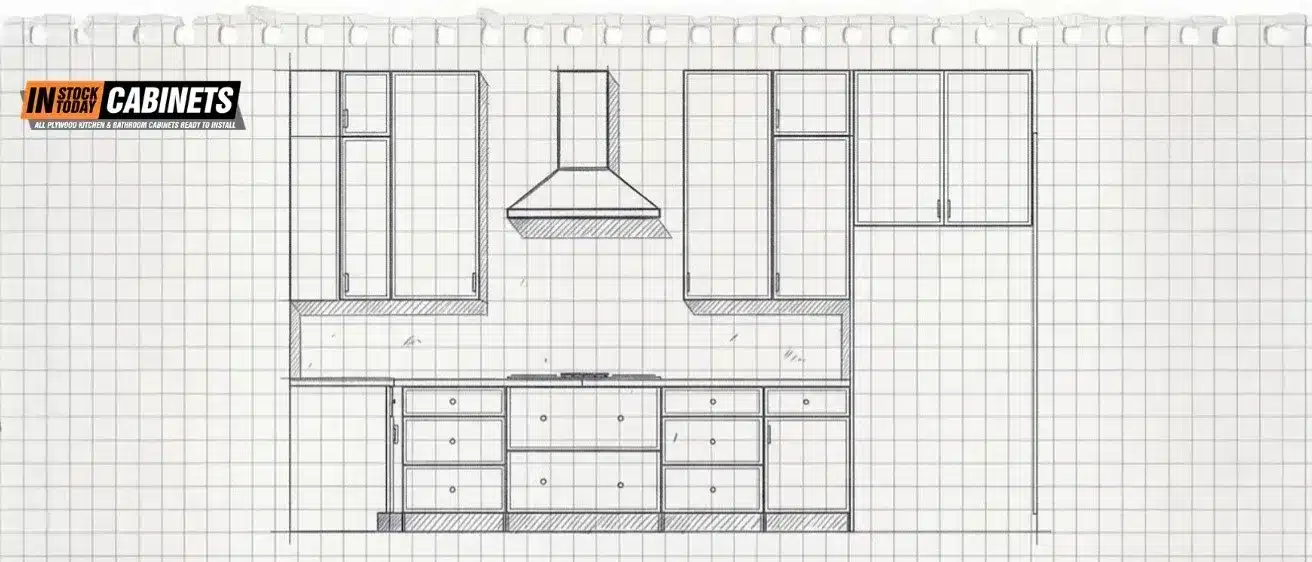
10 quality markers that separate cabinets built to last decades from ones that won’t survive five years — and how to spot them before you spend a dollar.
| Your 10-Point Shaker Cabinet Quality Checklist |
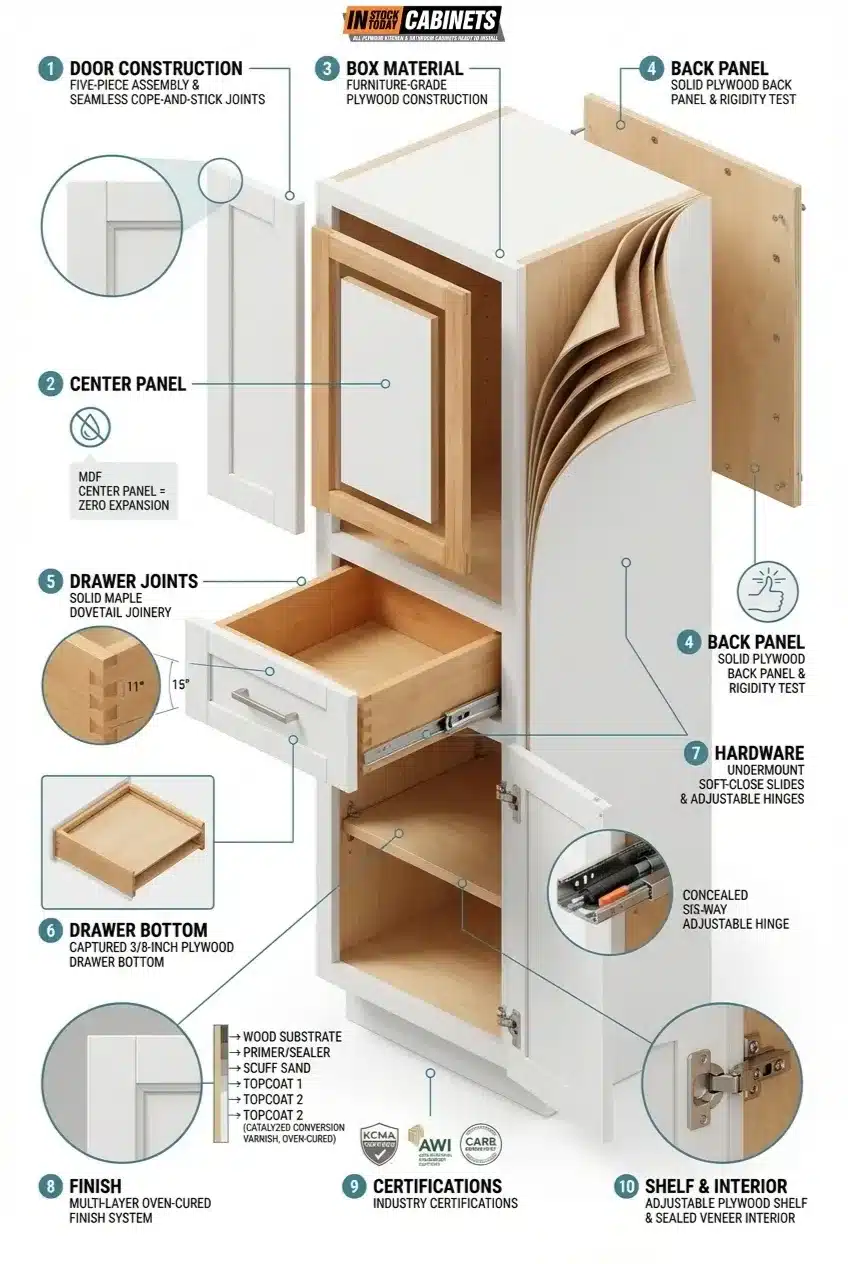
| 1. Door construction — five-piece assembly, cope-and-stick joinery, zero visible gaps |
| 2. Center panel engineering — MDF for painted, veneer-over-stable-core for stained |
| 3. Cabinet box material — minimum 1/2″ furniture-grade plywood |
| 4. Back panel — full 1/2″ plywood, not stapled hardboard |
| 5. Drawer construction — dovetail joints, 5/8″ solid hardwood sides |
| 6. Drawer bottoms — captured in dado grooves, no staples |
| 7. Hardware — full-extension soft-close slides and concealed hinges as standard |
| 8. Finish chemistry — multi-step application, oven-cured topcoat |
| 9. Certifications — KCMA A161.1, CARB Phase 2 compliance documented |
| 10. Edge, shelf, and interior details — sealed interiors, metal shelf clips, finished edges |
Why Shaker Cabinets Demand a Different Kind of Inspection
Two Shaker cabinet doors can look identical from three feet away. Same clean lines, same flat recessed panel, same five-piece frame. One will hold up for thirty years. The other starts failing in three.
That’s the Shaker paradox. The design originated with an eighteenth-century religious community that believed furniture should be functional, free of decoration, and built to outlast the maker. Those principles created something beautiful, but they also created a problem for modern buyers: the style’s simplicity makes it easy to copy and very hard to evaluate at a glance.
Ornate raised-panel cabinetry hides a multitude of manufacturing sins. Elaborate moldings, applied trims, and decorative profiles can obscure misaligned joints, material inconsistencies, and sloppy finishes. Shaker design strips all of that away. Every gap is visible. Every uneven finish catches the light. Every misaligned joint stands out against those clean, unforgiving lines.
That means evaluating Shaker cabinets takes more than a quick visual scan in a showroom. You need to know which construction details actually predict durability and which are just surface-level marketing. This checklist breaks that down into ten inspectable quality markers — the same criteria professional specifiers and architectural woodworkers use to separate cabinets that protect your investment from ones that drain it.
The 10-Point Craftsmanship Checklist
✅ 1. Door Construction: The Five-Piece Test
A proper Shaker door uses five distinct pieces: two vertical stiles forming the height, two horizontal rails establishing the width, and a center panel captured between them. That’s not optional — it’s the DNA of the style.
Classic Shaker stile and rail widths run between 2-1/4 and 3-1/2 inches, producing a sturdy, grounded frame that works with traditional and transitional interiors. Contemporary “Slim Shaker” variations narrow the frame to 1–2 inches, reducing visual mass and expanding the perceived size of smaller kitchens.
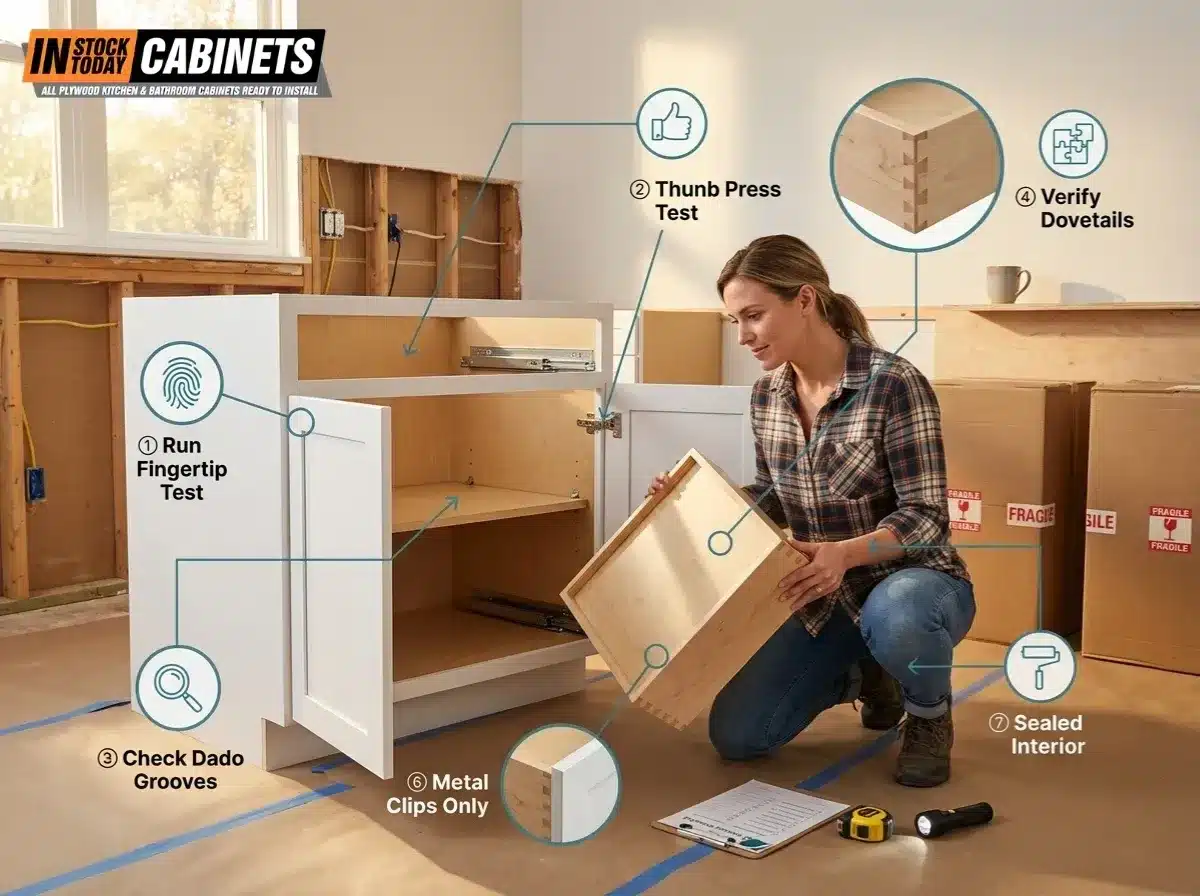
The joint where stile meets rail is the single most critical stress point on the door. Premium doors use cope-and-stick joinery: precisely matched router profiles create an interlocking mechanical bond that exponentially increases glue surface area while physically capturing the center panel. Run your fingertip across the junction. A properly executed joint feels like a single, continuous piece of material. If you detect a gap or a ridge, the tooling was dull, the assembly was rushed, or the wood was improperly dried. Walk away.
One detail most buyers miss: doors taller than 50 inches need a center horizontal rail. Without it, gravitational stress and moisture absorption across a large surface cause warping that typically voids the manufacturer’s warranty.
Dimensional Step-Down Rules for Narrow Doors
When a kitchen layout requires unusually narrow doors, premium manufacturers apply automatic proportional adjustments to maintain structural integrity:
| Standard Stile Width | Min Door Width | Adjusted Stile Width | Slab Conversion Threshold |
| 2-1/4″ | 5-1/8″ to 5-1/2″ | 1-1/2″ | < 4″ to 5″ |
| 1-3/4″ | 4-1/8″ to 5-1/2″ | N/A (Direct to Slab) | < 4-1/8″ |
| 1-1/2″ | 3-5/8″ to 6″ | N/A (Direct to Slab) | < 3-5/8″ |
Source: Eagle Woodworking dimensional specifications.
✅ 2. Center Panel Engineering: The Material Science Most Buyers Get Wrong
Here’s the most misunderstood aspect of Shaker construction: solid wood is not always superior. Wood is hygroscopic. It absorbs and releases atmospheric moisture continuously, expanding and contracting across the grain. For stained doors, that’s manageable — stain penetrates the fibers, so minor seasonal movement stays invisible.
Painted doors are a different story entirely. Paint forms a rigid, inflexible film over the surface. When a solid wood center panel moves — and it will move — the paint cracks along the joints. Hairline fractures appear. Raw wood shows through during dry winter months. This isn’t a defect. It’s physics.
For painted Shaker doors, the center panel should be MDF. Medium-density fiberboard is an isotropic composite — it exhibits virtually zero dimensional movement under normal indoor humidity. Premium manufacturers pair MDF center panels with solid hardwood stiles and rails: dimensional stability where you need it, structural strength where it counts.
For stained collections, look for high-grade natural wood veneer applied over a dimensionally stable plywood or fiberboard core. You get the authentic grain beauty without the warping and twisting that plagues traditional solid panels over time.
✅ 3. Cabinet Box Material: What’s Behind the Doors Matters More
A flawless Shaker door mounted on a substandard box is cosmetic surgery on a crumbling foundation. The cabinet carcass supports the full weight of stone countertops, dishes, appliances, and daily impact. The material it’s made from determines whether the cabinet holds up or falls apart.
Furniture-grade plywood is the baseline for quality. Plywood’s cross-laminated layers create multi-directional tensile strength, resist swelling from moisture contact, and hold screws with enough force to keep hardware tight for decades. Upgrading box side panels from 1/2-inch to 3/4-inch plywood increases screw-holding capacity by roughly 60%.
MDF works well for door panels but falls short as a structural box material — it’s heavier and weaker in spanning applications. Particleboard sits at the bottom: compressed wood dust and resin that acts like a sponge around water. One slow plumbing leak under a particleboard sink base and the entire cabinet is unsalvageable.
✅ 4. The Back Panel: Your Cabinet’s Structural Backbone
This is the component economy manufacturers cut first — and the one that matters most for long-term stability. The back panel functions as a structural shear wall, preventing the entire box from twisting out of square under load.
Budget cabinets use 1/8-inch hardboard stapled to the back, or hollow hanging rail systems that leave the rear mostly open. Press your thumb against the back panel of a showroom sample. If it flexes easily, that cabinet cannot safely anchor to wall studs at multiple points and will rack under the weight of heavy countertops.
Quality specification: Full, continuous, one-piece, 1/2-inch solid plywood back panel. Engineering data shows this reduces cabinet racking by 40% compared to 1/4-inch alternatives. A thick, rigid back also lets installers drive mounting screws at any point on the plane rather than hunting for a single narrow rail.
✅ 5. Drawer Construction: Where Real Engineering Shows
Drawers endure more kinetic stress than any other kitchen component. The repeated pulling force on the front, combined with the downward weight of cast iron, ceramic, and stacked dishware, demands specific engineering to prevent failure.
Dovetail joinery is the gold standard. The interlocking, flared wood pins and tails form a trapezoidal geometry that tightens under tension — the harder you pull the front, the more securely the joint locks. This drastically reduces dependence on glue, which degrades over decades of thermal cycling and humidity changes. Premium specs call for 5/8-inch thick solid hardwood sides with dovetail pin angles between 7 and 14 degrees.
Economy drawers use thinner 1/2-inch plywood, particleboard, or fiberboard sides assembled with stapled butt joints. Those thin metal fasteners rely entirely on limited shear strength. They loosen, the drawer racks, the joints detach. It’s not a question of if but when.
✅ 6. Drawer Bottoms: The Failure Point Nobody Checks
Flip any drawer upside down. What you find there tells you more about overall manufacturing quality than the entire front face of the cabinet.
Economy drawers mount a thin 1/8-inch or 1/4-inch panel directly to the bottom edges of the sides using staples. Under sustained weight, the staples fatigue and pull out. The bottom panel drops into the cabinet below. Every homeowner who’s experienced this knows how it ends: a cascade of damage to the contents and the shelf beneath.
What to look for: A minimum 1/4-inch (ideally 3/8-inch) plywood bottom panel fully captured within a routed dado groove cut into all four interior sides of the drawer box. This dado joint transfers the load laterally into the solid hardwood sides, making blowout physically impossible under normal household use. No visible staples, hot glue, or brad nails.
✅ 7. Hardware: Where Manufacturers Hide the Cost-Cutting
Open any drawer in the showroom. Pull it to full extension. Let it close on its own. That ten-second test reveals more about a cabinet line’s actual quality tier than any spec sheet.
Slides: Full-extension, under-mount drawer glides should be standard — not a $30 per-drawer upgrade. Precision systems like Blum Tandem Plus use ball-bearing carriages rated for 100+ pound dynamic loads and provide entirely frictionless motion. They should also include soft-close dampers, which do more than eliminate noise: the deceleration prevents micro-fractures in wooden joinery caused by repeated impact shockwaves.
Hinges: Heavy-duty concealed hinges with 110-degree opening and integrated fluid dampers. Six-way adjustability is critical — it lets installers achieve perfect alignment even on slightly uneven walls and maintain it over time. These should also be standard inclusions, not upgrades.
A useful benchmark: premium hardware systems are certified for over 100,000 operational cycles without measurable performance degradation. That translates to roughly 27 years of opening and closing a drawer ten times a day.
✅ 8. Finish Chemistry: More Than Meets the Eye
The finish is where chemistry meets craftsmanship. It serves two functions: aesthetics and physical protection of the wood from moisture, heat, and chemical exposure. Economy cabinets get a single thick coat of spray lacquer. Premium cabinets go through a multi-step process: substrate sanding, base coat or penetrating stain, hand-wiping for grain saturation, intermediate scuff-sanding to remove raised fibers, and multiple protective topcoat layers.
The critical difference is in the topcoat chemistry. Air-dried lacquers remain soft at the molecular level — vulnerable to chipping, chemical dulling from cleaners, and permanent water rings. Premium manufacturers use catalyzed varnishes or conversion varnishes cured in high-temperature ovens. The heat forces cross-linking of polymer chains into a dense matrix that resists physical impact, edge chipping, and chemical degradation far beyond what air-dried alternatives can manage.
Test it yourself in the showroom: examine the finish at the sharp 90-degree internal corners where stiles meet rails. The finish should be perfectly even, fully opaque, with no evidence of liquid pooling or exposed raw wood fibers. If those tight corners aren’t flawless, the rest of the finish won’t hold up either.
✅ 9. Certifications: The Only Way to Quantify “Quality”
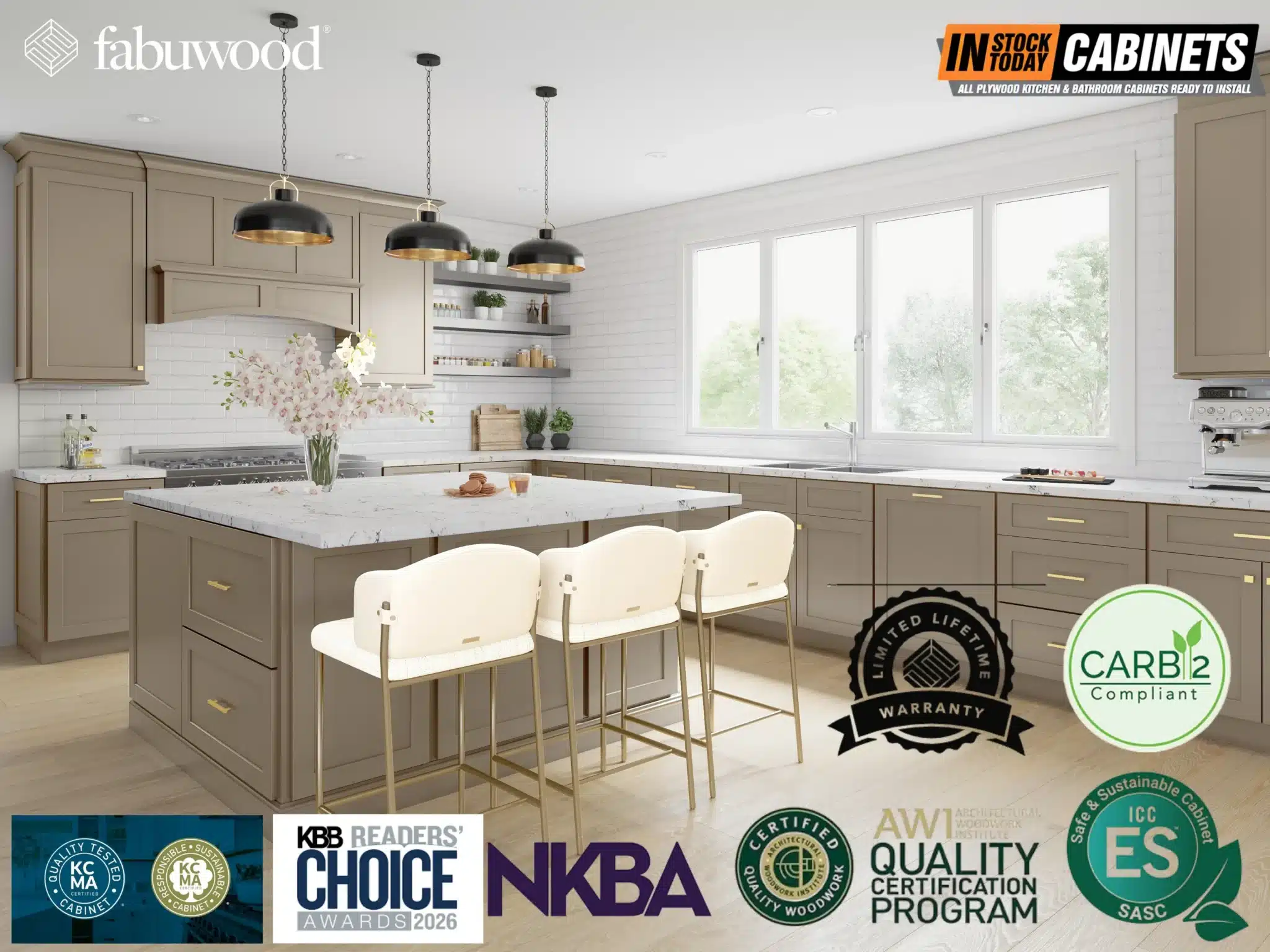
Every manufacturer claims quality. Certifications prove it. Three matter most for residential Shaker cabinetry:
KCMA Certification (ANSI/KCMA A161.1): The Kitchen Cabinet Manufacturers Association runs the North American industry’s most recognized battery of destructive tests. Cabinets that earn this certification have survived shelf loading, 600-pound wall mount stress, 25,000 open-close cycles, joint impact testing, and prolonged chemical exposure. If a manufacturer can’t show KCMA certification, ask why.
AWI Quality Grades: The Architectural Woodwork Institute categorizes cabinetry into three tiers. Economy Grade permits particleboard and staple construction. Custom Grade requires minimum 1/2-inch cores, controlled material selection, and stringent joint tolerances. Premium Grade — the highest echelon — demands zero visible imperfections, 3/4-inch panels throughout, dovetail drawers in finish-grade plywood, and upscale hardware.
CARB Phase 2 / TSCA Title VI: These regulations cap formaldehyde emissions from composite wood products. Compliance guarantees your new cabinets won’t off-gas toxic volatile compounds into your home’s air. Non-negotiable for any responsible purchase.
KCMA Certification Tests at a Glance
| Test Category | What They Do | Why It Matters |
| Static Load | Shelves loaded at 15 lbs/sq ft for 7 continuous days | Proves shelf material won’t sag under real dishware weight |
| Wall Cabinet Integrity | 600 lbs of internal weight applied to mounted cabinet | Confirms mounting rails and back panel can handle stone countertop loads |
| Door/Drawer Cycling | 25,000 open-close cycles on doors and drawers | Simulates 20+ years of daily kitchen use on hinges and slides |
| Joint Impact | 250 lbs of force applied to front joints | Tests face frame adhesion and wood glue strength at stress points |
| Chemical Resistance | Prolonged exposure to vinegar, lemon juice, coffee, and solvents | Validates that the finish resists staining, dulling, and delamination |
✅ 10. Edge, Shelf, and Interior Details: The Finishing Touches That Predict Longevity
These are the details that separate a manufacturer who cares from one just meeting minimum specs:
Shelves: 3/4-inch plywood with front edge banding. Metal alloy support clips — not plastic pins. Adjustable positioning. If a fully loaded shelf of stacked plates sags after six months, the manufacturer saved $2 per shelf and cost you $200 in replacements.
Interiors: Sealed and finished to match or complement the exterior. Raw, unsealed wood inside a cabinet box creates a surface that scratches stored goods and absorbs kitchen moisture, accelerating plywood delamination from within. If you can see and feel unfinished wood inside the box, the manufacturer skipped a critical step.
Edges: Color-matched PVC or wood edge-banding on all exposed edges. No raw plywood layers visible. Radiused (slightly rounded) edges on door frames indicate attention to both safety and finish durability.
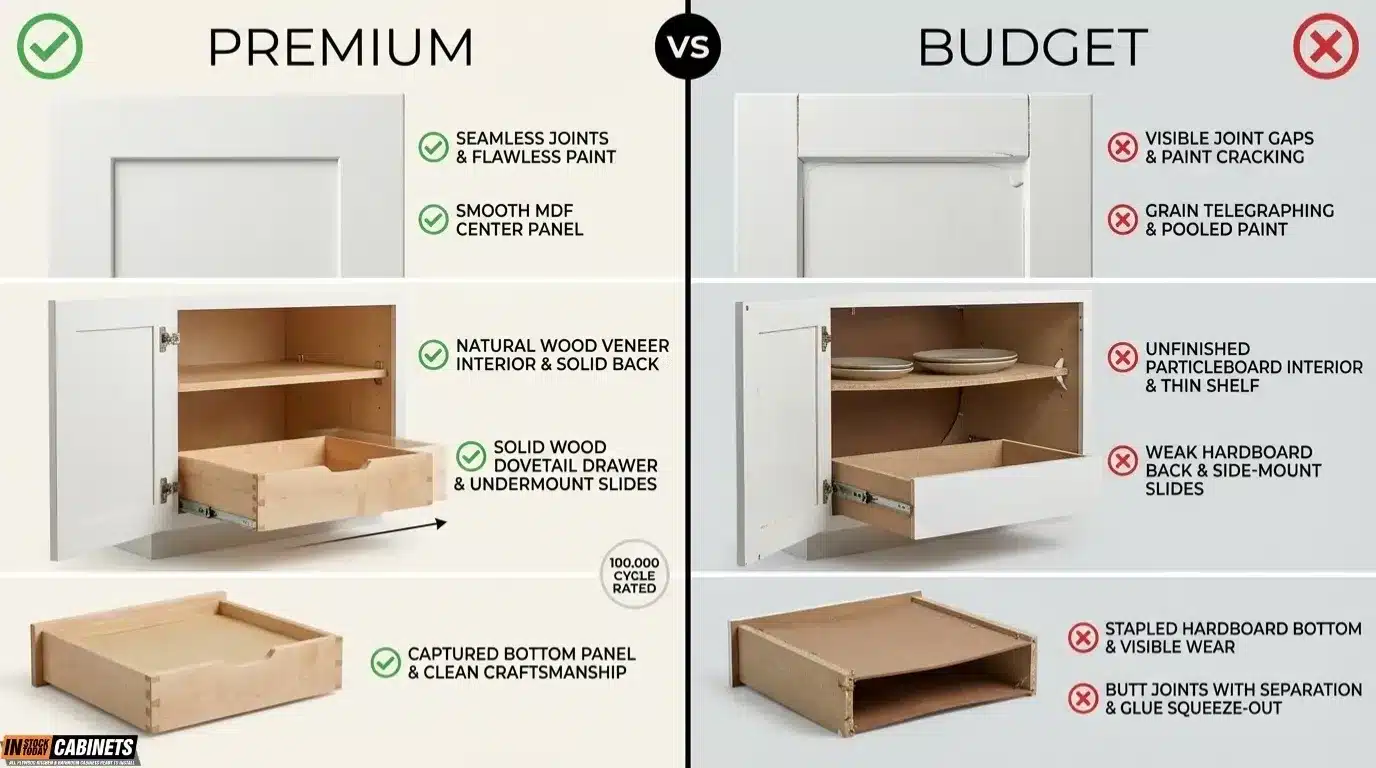
Quality Tiers at a Glance
This comparison maps every checklist item across three manufacturing tiers to help you quickly identify where a given cabinet line falls:
| Quality Indicator | Budget / Stock | Semi-Custom | Custom / Premium |
| Box Material | Particleboard or thin MDF | 1/2″ plywood sides, plywood back | 3/4″ plywood throughout |
| Back Panel | 1/8″ hardboard, stapled | 1/2″ plywood, dadoed | 1/2″+ plywood, full dado |
| Door Joinery | Glue and staple | Cope-and-stick | Cope-and-stick or mortise-and-tenon |
| Center Panel (Painted) | Vinyl-wrapped MDF or thin HDF | Engineered MDF, stable | Precision-milled MDF, zero movement |
| Drawer Construction | Stapled butt joints, thin sides | Dovetail, 1/2″ hardwood | Dovetail, 5/8″ solid hardwood |
| Drawer Bottom | 1/8″, stapled underneath | 1/4″ in dado groove | 3/8″ plywood in dado groove |
| Hardware (Slides) | 3/4-extension epoxy slides | Full-extension, soft-close | Blum Tandem Plus or equivalent, 100 lb+ rated |
| Hardware (Hinges) | Exposed or basic concealed | Concealed, soft-close | 6-way adjustable, 110° Blum |
| Finish | Single coat, air-dried | Multi-coat, catalyzed | Oven-cured conversion varnish |
| Certifications | None | KCMA, CARB Phase 2 | KCMA + AWI Custom or Premium Grade |
| Shelf Supports | Plastic pins | Metal clips | Heavy-duty metal alloy clips |
| Warranty | 1–5 years | Limited Lifetime | Limited Lifetime + structural guarantee |
Red Flags That Signal Poor Craftsmanship
Some warning signs should end the conversation immediately. If you encounter any of these during a showroom visit or delivery inspection, you’re not looking at quality Shaker cabinetry regardless of the price tag or brand name:
Visible gaps at stile-and-rail junctions — indicates dull tooling, rushed production, or improperly dried wood. 1/8-inch back panels that flex under thumb pressure — the cabinet lacks structural rigidity for countertop loads. Stapled drawer bottoms visible from underneath — guaranteed failure under normal kitchen weight. Raw, unsealed interior surfaces — the box will absorb moisture and delaminate prematurely. Vinyl-wrapped doors marketed as “painted” — a fundamentally different and inferior product. Plastic shelf support pins — brittle under sustained load, prone to snapping. No KCMA or CARB certification on file — the manufacturer hasn’t submitted products for independent testing.
Eight Questions to Ask Before You Buy
Bring these to any showroom conversation or dealer meeting. The answers will tell you exactly where a cabinet line sits on the quality spectrum:
- What is the box material? If the answer isn’t “plywood,” ask why.
- What thickness is the back panel, and how is it attached?
- Are the drawer joints dovetailed, and from what material?
- Is the center panel on painted doors MDF or solid wood?
- Are soft-close slides and hinges included in the base price, or are they upgrades?
- What brand of hardware is standard? Is it Blum, Hettich, or equivalent?
- Can you provide your KCMA certification and CARB Phase 2 compliance documentation?
- What is the finish process? How many coats, and is the topcoat oven-cured?
A confident manufacturer answers these immediately. Hesitation, deflection, or “I’ll have to check” on basic structural questions tells you everything you need to know.
The Delivery-Day Inspection
Passing the showroom checklist is step one. Step two happens when the cabinets arrive at your home or job site. Before you sign the bill of lading or authorize installation, every component needs a second inspection under controlled conditions.
Unpack all components and examine every surface — exterior and interior — under bright lighting. Look for transit damage: deep scratches, impact dents, chips, paint bubbles. Verify finish color consistency across all delivered pieces; batch variation between units is a sign of inconsistent factory controls.
Open and close every door and drawer multiple times. Check for smooth kinematic motion and factory-set alignment. Cross-reference delivered dimensions against your architectural plans, paying close attention to custom-sized elements and any slim-shaker step-down adjustments.
If you find discrepancies, photograph them from multiple angles immediately. Accepting visibly flawed goods complicates warranty claims dramatically. Document first, discuss with the dealer second.
Protecting Your Investment: Maintenance That Extends Cabinet Life
Even the best-built Shaker cabinets need proper care to reach their full 20–30 year lifespan. The finish is tough, but it’s not indestructible.
Weekly: Dust all surfaces with a dry, soft microfiber cloth. Wipe grease-prone areas near range hoods with a dilute solution of warm water and mild dish soap. Dry immediately with a clean towel — standing water on any finish is the enemy.
Avoid: Bleach, ammonia-based cleaners, abrasive scouring pads, and harsh solvents. All of these strip the protective topcoat and expose the wood beneath. For stubborn grease stains, use a paste of baking soda and water applied with a soft cloth in gentle circular motions.
Environment: Run exhaust fans and range hoods during cooking to evacuate steam. Wood is hygroscopic — uncontrolled humidity causes doors to expand and contract beyond normal tolerances. Keep cabinets out of sustained direct sunlight, which causes UV fading and finish degradation.
Long-term: Stained cabinets benefit from a restorative wood polish (non-silicone) every few months. Painted cabinets may need minor touch-ups at joints every 3–5 years due to the natural micro-movements of wood beneath the paint film. A full structural refinish of stained cabinets typically aligns with a broader 10-year renovation cycle.
The Semi-Custom Advantage: Premium Specs Without the Custom Price Tag
Historically, checking every box on this list meant commissioning fully custom cabinetry — 6–12 week lead times and price tags that pushed well past $1,000 per linear foot. The economics have changed.
Leading semi-custom manufacturers now deliver the same structural hallmarks: all-plywood boxes, 1/2-inch plywood backs, solid hardwood dovetail drawers, Blum hardware, oven-cured finishes, and KCMA certification. These come as baseline standard features, not costly upgrades. Some codify this through proprietary quality assurance systems — rigorous internal auditing matrices ensuring every cabinet meets a fixed set of engineering criteria before leaving the factory.
The result is a practical middle path. You get the structural performance of bespoke cabinetry with the speed and pricing of a scaled manufacturing operation. For buyers working with contractors on aggressive project timelines, that combination of quality and availability changes the equation entirely.
Frequently Asked Questions for Ultimate Checklist for Shaker Cabinet Craftsmanship
How can I tell if Shaker cabinets are well made?
Check the stile-and-rail joints for gaps (there should be none), confirm the box is plywood (not particleboard), verify the drawers use dovetail joinery, and look for KCMA certification. The 10-point checklist above walks through every quality marker in detail.
What is five-piece door construction?
A five-piece Shaker door consists of two vertical stiles, two horizontal rails, and a center panel. The frame pieces are joined using cope-and-stick joinery, with the center panel floating within grooves to allow for seasonal wood movement.
Is plywood or particleboard better for cabinet boxes?
Plywood outperforms particleboard in every structural category: moisture resistance, screw-holding strength, weight capacity, and longevity. Particleboard absorbs water rapidly and swells irreversibly — one minor plumbing leak can destroy the entire cabinet.
Should the center panel on painted Shaker doors be MDF?
Yes. Solid wood center panels expand and contract with humidity changes, cracking the rigid paint film. MDF is dimensionally stable and maintains a flawless painted surface over decades. This isn’t a cost-cutting measure — it’s better engineering for painted applications.
What is KCMA certification for cabinets?
KCMA certification (ANSI/KCMA A161.1) means cabinets have passed destructive testing for shelf loading, 600-lb wall mount stress, 25,000 open-close cycles, joint impact resistance, and chemical exposure. It’s the most recognized structural durability standard in North American residential cabinetry.
Are Shaker cabinets worth the extra cost over flat-slab doors?
When constructed properly, yes. The five-piece frame-and-panel design is inherently more rigid than a single-piece slab, handles dimensional changes more gracefully, and accepts repairs more easily. The key qualifier is “constructed properly” — a poorly built Shaker door fails faster than a well-built slab.
How long do quality Shaker cabinets last?
Cabinets meeting the full checklist — plywood construction, dovetail drawers, premium hardware, oven-cured finish, and KCMA certification — routinely exceed 20–30 years of functional life. Economy cabinets with particleboard boxes and stapled joints typically last 5–10 years before requiring replacement.
What’s the difference between framed and frameless Shaker cabinets?
Framed cabinets have a solid hardwood face frame attached to the box front, adding rigidity and providing a dense anchor for hinges. Frameless (European-style) cabinets skip the frame, with doors attaching directly to the box sides. Frameless designs offer 10–15% more interior storage and cleaner sightlines but require higher installation precision.
About IST Cabinets
In Stock Today Cabinets (IST Cabinets) is an authorized dealer specializing in premium and semi-custom cabinetry for dealers, contractors, builders, and interior designers across Virginia, Maryland, Delaware, Texas, and Illinois. As a source for Fabuwood’s AWI Premium Grade certified product lines, IST Cabinets combines technical expertise, competitive wholesale pricing, and inventory-based fulfillment with the philosophy: No Wait. No Hassle. Just Beautiful Cabinets.
🌐 istcabinets.com 📧 info@istcabinets.com 📞 (703) 259-9030
Showrooms: Alexandria, VA • Fairfax, VA • Columbia, MD • Houston, TX • Bear, DE