
The kitchen has stopped pretending to be a work zone. It is the room people live in now — the place where conversations start, where guests gather without being told to, and where the design has to carry weight that used to live in the dining room or the living room. That shift is what makes the kitchen accent wall such a different conversation in 2026 than it was even three years ago. Designers are no longer asking which color to paint a single wall. They are asking which material, on which wall, under which light, behind which cabinets, and how that wall will hold up after five years of grease, steam, and weeknight chaos.
This guide is built for the homeowner who has already moved past the inspiration stage and is trying to make a decision. We will cover where the wall should go, how each material actually behaves in a working kitchen, what the realistic cost looks like, and the regional climate considerations that quietly shape what will and will not last in your home. Most of all, we will be honest about the pain points — the issues that come up six months after the contractor has been paid and the photographs have been taken.
The Kitchen Accent Wall
|
1
|
Step One
Choose the Right Wall |
The single most common regret is not the material — it’s the wall. Pick one of these four locations.
|
Best
Wall Opposite the Entry
The first wall your eye lands on when you walk in. Strongest natural focal point.
|
Best
The Cooking Wall
Range + backsplash + ceiling, treated as one continuous architectural plane.
|
|
Best
Behind a Dining Nook
Zones the eating area in open-plan kitchens without putting up a physical wall.
|
Best
End Wall to the Living Area
The transition surface between the kitchen and the rest of the open-plan home.
|
|
2
|
Step Two
Match the Material to the Zone |
Within 18 to 24 inches of the cooktop, your wall sees grease, steam, and heat over 200°F. Outside that zone, the rules relax considerably.
|
Cooking Zone — 18 to 24 inches
Non-porous only
Approved
Ceramic & porcelain tile
Sealed natural stone Glass & mirrored glass Stainless steel panels Sealed quartz slab Not Recommended
Wood paneling & shiplap
MDF panels Standard wallpaper Grasscloth Unsealed plaster |
Dining / Nook / End Walls
Almost anything works
Designer Favorites
Slat wood panels
Limewash & plaster Vinyl-coated wallpaper Brick & stone veneer Botanical murals Functional Options
Magnetic chalkboard
Pegboard wall Open shelving Living & moss walls Cabinet-as-accent |
|
3
|
Step Three
Pick Your Investment Tier |
Installed cost per square foot, including labor. Add a 15–25% contingency for surprises.
|
Tier 1
Budget
$4–$15
Painted accent
MDF panels Peel-and-stick paper Chalkboard wall |
Tier 2
Mid-Range
$12–$30
Limewash & plaster
Shiplap & board-and-batten Vinyl wallpaper Brick veneer |
Tier 3
Premium
$25–$90
Wood slat panels
Ceramic & porcelain tile Stone veneer Stainless steel panels |
Tier 4
Luxury
$100–$500+
Natural stone slabs
Marble installation Bookmatched stone Backlit translucent stone |
|
4
|
Step Four
Match Your Kitchen Style |
| Kitchen Style | Best Materials | Color Direction |
| Modern | Stone slab, limewash, large-format porcelain | Soft gray, mushroom beige, char-brown |
| Traditional & Farmhouse | Vertical shiplap, brick veneer, botanical wallpaper | Cream, navy, deep forest, terracotta |
| Transitional | Limewash, zellige tile, painted shiplap, slat wood | Warm whites, dusty sage, smoky teal |
| Scandinavian / Japandi | Light oak slat panels, hand-pressed tile | Blond wood, off-white, sage, soft black |
| Small Kitchens | Mirror, vertical lines, gloss tile, light tones | Light reflective, single confident tone |
|
200°F
Wall temperatures near gas burners. Why MDF and standard wallpaper fail near the cooktop.
|
30%
Of designers chose dusty sage and terracotta as their dominant 2026 palette.
|
20–30%
Of total visible wall area is the right size for an accent wall — less reads as a stripe.
|
|
!
|
Pro Rules
Designer Pairing Guidelines |
|
Bold cabinets → quiet wall finish
|
Quiet cabinets → expressive wall finish
|
|
Busy floor → simpler accent wall
|
Plain floor → more freedom on the wall
|
|
Textured surface → grazing light
|
Pattern surface → even front light
|
In-stock Fabuwood Cabinetry across Fairfax, Alexandria, Columbia MD, Delaware, Roselle IL, and Houston. Free design consultations to coordinate accent wall material, cabinetry, and countertops.
How to Approach a Kitchen Accent Wall in 2026?
There is a recurring question online and in design forums: are kitchen accent walls outdated? The short answer is that the bad version of the accent wall is outdated. Painting a single wall a strong color simply because the others are beige — with no architectural reason behind the choice — has fallen out of favor for good reason. What has replaced it is something more deliberate. The contemporary accent wall is integrated. It has a job to do. It might be the cooking wall reimagined as a continuous slab of stone running from countertop to ceiling. It might be a textured plaster panel behind a dining nook. It might be a wall of slatted oak that quietly absorbs sound in an open-plan space.
The 2026 design direction is shaped by what designers are calling a tension between quiet luxury and playful maximalism. The base architecture stays calm and integrated. The focal point is rich, narrative, tactile. Sharp clinical corners are giving way to organic curves, rounded islands, arched shelving. Stark all-white kitchens are being replaced with warmer, layered spaces — creamy whites, mushroom beige, smoky teal, deep aubergine, dusty sage. Mushroom beige in particular has emerged as the new foundational neutral, replacing the cool grays that defined the last decade.
Within that shift, the accent wall is no longer a decoration. It is the architectural anchor of the room.
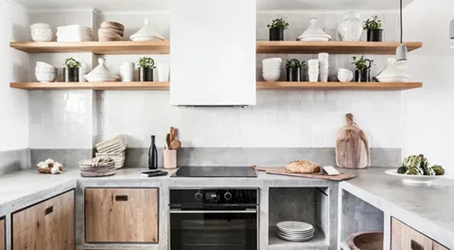
Choosing the Right Wall (This Matters More Than the Material)
The single most common regret homeowners report about their accent wall is not the color or the material — it is the wall they chose. Interior designers describe a poorly placed accent wall the way they describe a badly fitting suit: it looks like the wall is wearing the homeowner, not the other way around.
The best accent wall has a clear architectural reason behind it. In most kitchens, that comes down to one of four locations.
The wall opposite the main entry is the wall your eye lands on the moment you walk into the kitchen. Anchoring this wall gives the room an immediate focal point and helps the eye understand the hierarchy of the space.
The cooking wall — the wall containing the range, hood, and primary backsplash — is the highest-functioning wall in any kitchen. Treating it as a feature, with a continuous stone slab or full-height tile that runs to the ceiling, blends practical splash protection with the strongest visual moment in the room.
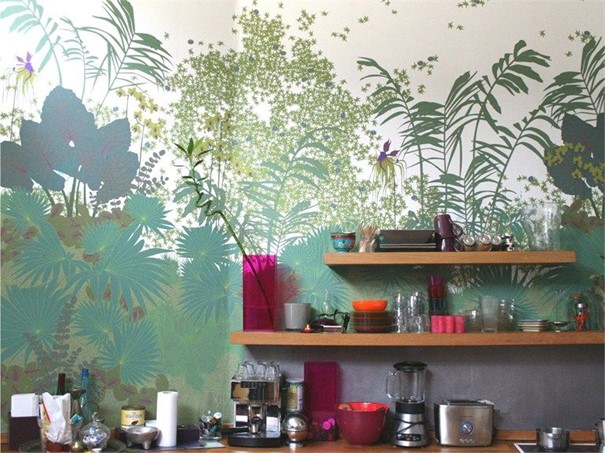
The wall behind a dining nook or banquette carries the accent in open-plan kitchens where the cooking and eating zones flow together. A textured plaster, a botanical wallpaper, or a slatted wood panel here helps zone the eating area without putting up a physical wall.
The end wall visible from the adjoining living area in open-plan layouts is often the most underused wall in the home. Anchoring this wall with a strong material — stone, slat wood, a saturated paint color — creates a transition point between the kitchen and the rest of the house.
The walls to avoid are the ones that defeat the purpose. Walls broken up by multiple windows or doorways will not read as a continuous accent. Sloped or irregular walls make the treatment look unintentional. Walls that cannot be seen from the kitchen’s main entry or from the open-plan living area will simply be missed.
There is also the question of size. A wall that is too small reads as a stripe, not a feature. A wall that is too large becomes the entire room, eliminating the contrast that made the accent wall an accent in the first place. The general rule is that the accent should run from countertop to ceiling (or floor to ceiling on a non-cooking wall), and it should occupy roughly one continuous plane — not a fragmented surface broken up by appliances and trim.
A Word on Kitchen-Specific Concerns
Kitchens are environmentally hostile to most decorative materials. Gas burners can expose nearby walls to temperatures exceeding 200°F, and even electric ranges produce sustained radiant heat. Grease particles float in the air during every meal and settle on every vertical surface within reach of the cooktop. Steam from boiling water and from running dishwashers raises humidity in cycles that paper, wood, and unsealed surfaces are not designed to handle.
These conditions are why so many beautiful accent walls fail within two or three years. The early warning signs are familiar: paint discoloration or bubbling behind the stove, hairline cracks in grout lines, persistent grease stains that no longer wipe clean, and a faint musty odor that appears when the dishwasher runs. The National Kitchen and Bath Association recommends non-porous, easily sanitized surfaces for any wall area near cooking equipment, and that recommendation should drive material selection within the cooking zone — typically 18 to 24 inches around the cooktop.
The honest version of accent wall design accepts this asymmetry. The wall behind the range needs tile, glass, sealed quartz, sealed natural stone, or stainless steel. The wall behind a dining nook can be paper, wood, plaster, or anything else you love. Treating these zones as the same wall is what creates the regret.
Material Comparison: Cost, Durability, and Lifespan
Before walking through individual materials, it helps to see the full landscape side by side. The numbers below come from current 2026 trade pricing and reflect installed costs (material plus labor) for a typical accent wall measuring roughly 50 to 80 square feet.
| Material | Cost per sq. ft. | Difficulty | Grease/Heat Resistance | Estimated Lifespan |
|---|---|---|---|---|
| Painted accent wall | $4 – $7 | DIY-friendly | Low–Medium | 4 – 6 years |
| Limewash / plaster | $12 – $18 | Intermediate | Medium | 8 – 15 years |
| Board and batten | $12 – $18 | Intermediate | Low–Medium | 10 – 20 years |
| Shiplap | $15 – $20 | Intermediate | Low–Medium | 10 – 20 years |
| Wood slat panels | $18 – $25 | Intermediate | Low–Medium | 30 – 50 years |
| Brick veneer | $20 – $30 | Professional | Medium | 30+ years |
| Geometric MDF panels | $10 – $15 | DIY-friendly | Poor | 5 – 7 years |
| Vinyl-coated wallpaper | $20 – $50/roll | DIY-friendly | Good | 10 – 15 years |
| Ceramic / porcelain tile | $15 – $40 | Professional | Excellent | 20 – 30+ years |
| Natural stone (sealed) | $50 – $250+ | Professional | Excellent (sealed) | 25 – 50 years |
| Marble (installed) | $100 – $250+ | Professional | Good (sealed) | 25 – 50 years |
| Backlit translucent stone | $200 – $500+ | Specialized | Excellent | 25+ years |
| Stainless steel panels | $40 – $90 | Professional | Excellent | 30+ years |
Two practical notes on this table. First, every quote should include a 15 to 25 percent contingency for unexpected costs — uneven walls, hidden drywall damage, mold remediation behind older surfaces. These are the discoveries that turn a $6,000 wall into a $9,000 wall, and they are common enough that experienced contractors price for them up front. Second, the lifespan numbers assume the material is installed in an appropriate location. MDF panels behind a stove will fail in two years, not seven. A sealed natural stone slab in a dining nook will outlast the homeowner.
Painted and Wallpapered Walls
The most common starting point for an accent wall is also the most underrated. A single wall painted in a saturated color is the lowest-risk, lowest-cost transformation available, and it remains the design move that scales most reliably across kitchens of every size and style.
The 2026 paint palettes have shifted decisively warmer. Sherwin-Williams’ 2026 Colormix Anthology highlights four families that designers are pulling from heavily: Frosted Tints (pale lavender, celery), Sunbaked Hues (the Armagnac and Coral Island family of desert warmth), Restorative Darks (deep auburn, plum-brown, char-brown), and Foundational Neutrals (white-snow through inkwell black). Benjamin Moore is recommending a parallel approach with deeper Aegean Teal anchoring against lighter Wythe Blue in adjoining rooms — what designers call color flow, where the same family of color carries through multiple spaces in different intensities.
The terracotta-and-sage combination has taken over from the gray-and-white pairing that defined the last design cycle. Roughly 30 percent of polled designers chose dusty sage and terracotta as their dominant 2026 palette, marking a substantial pivot toward grounded, nature-forward color stories. A terracotta wall paired with sage cabinetry strikes a careful balance between organic calm and energetic warmth without tipping into either trendy or rustic.
For paint to work in a kitchen, the finish has to do real work. Standard latex matte paint will not survive the cooking zone. Semi-gloss or satin finishes are essential — they wipe clean, they resist staining, and they hold their color through repeated cleaning. The major paint manufacturers now sell kitchen-grade scrubbable paints specifically engineered for moisture and grease resistance. These are worth the small premium, and they should be the default for any painted accent wall in a working kitchen.
Limewash and Plaster Finishes
Limewash and plaster is the textured-finish trend that has emerged most strongly for 2026. These finishes deliver something paint cannot: subtle surface variation that catches light differently throughout the day, giving the wall a living quality that flat paint simply does not have. Limewash works particularly well on north-facing kitchens because its surface irregularity reflects what limited light enters the room. Modern plaster systems are also available in waterproofed formulations rated for kitchen use, which has expanded their viable footprint considerably.
Vinyl-Coated and Specialty Wallpaper
Wallpaper is where the conversation gets more careful. The industry has solved most of the historical objections through material science. Vinyl-coated wallpaper and non-woven wallpaper are now manufactured specifically for kitchen environments. Vinyl wallpapers use a polyvinyl chloride surface that resists humidity and allows aggressive cleaning. Non-woven variants combine natural and synthetic fibers in a breathable backing that drastically reduces mold risk in spaces with fluctuating moisture.
Beyond durability, modern wallpaper has become a serious design tool. Metallic cork wallpaper combines real organic cork with platinum, copper, or gold metallic foil — a combination that delivers visual depth while naturally absorbing acoustic reverberation, which matters in open-plan homes where sound carries between the kitchen and adjoining rooms. Flocked wallpapers with raised velvet-like patterns and beaded surfaces (like Beaded Brutalist Stripe with its glass-bead texture mimicking pick-hammered concrete) have moved wallpaper into territory that feels closer to an architectural finish than a decorative one.
The exception is grasscloth — the natural arrowroot, jute, hemp, sisal, or reed wallcoverings prized for their organic, serene texture. These remain highly susceptible to water damage, dust accumulation, and grease staining. They are beautiful, but they belong in a peripheral location: a paneled dining nook, a transition hallway, or a wall well removed from the cooking and cleaning zones.
The pain point homeowners report most often with wallpaper is peeling. The cause is almost always one of two things: the homeowner used standard paper-backed wallpaper instead of a vinyl-coated kitchen-rated product, or they installed a peel-and-stick paper on a textured wall that prevented the adhesive from gripping. The fix is straightforward — vinyl-coated wallpaper rated specifically for kitchen and bathroom use, applied to a properly primed and smooth wall.
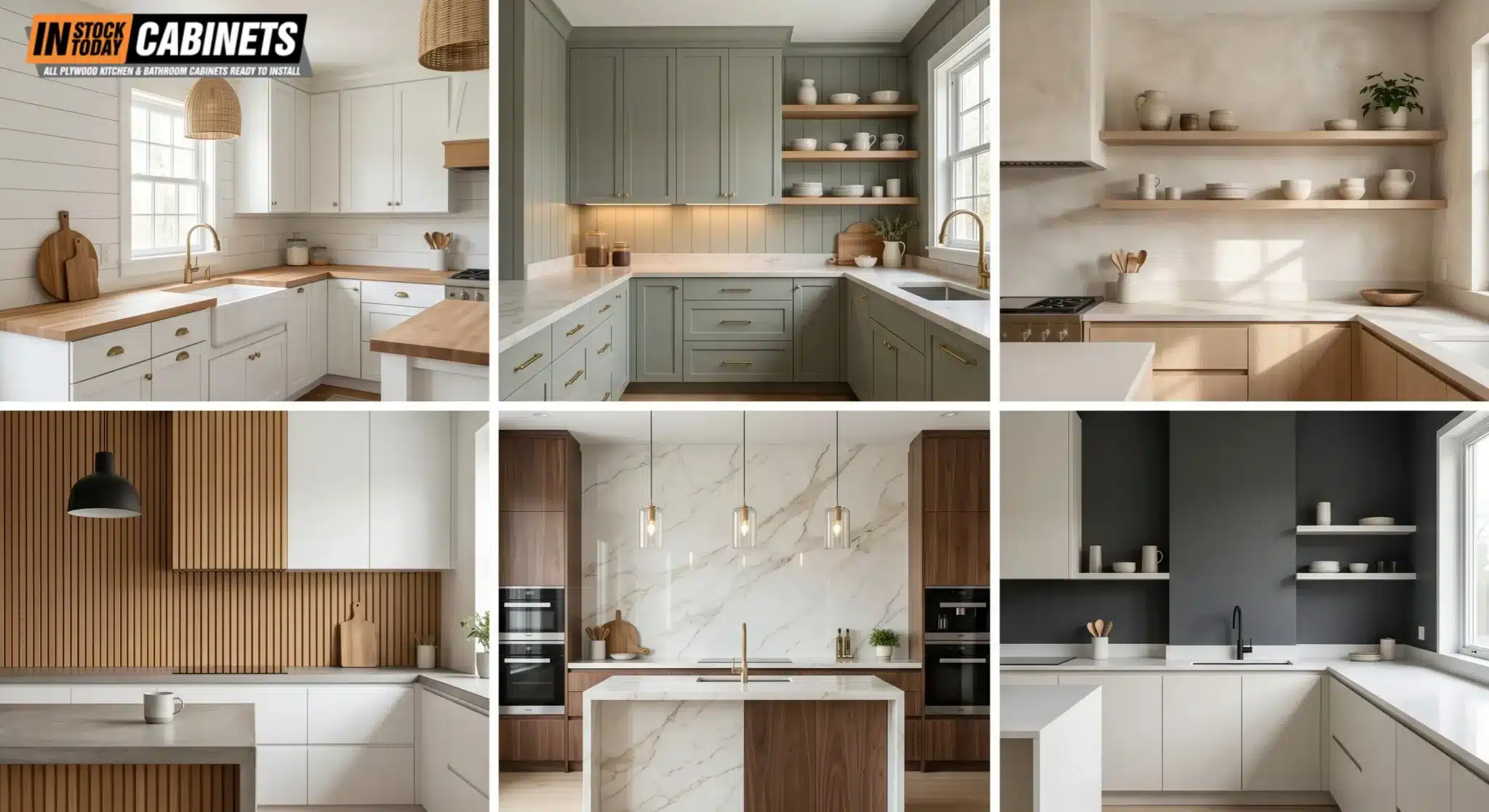
Tile Walls
If there is one material category that deserves the most attention in a working kitchen, it is tile. Tile is functional, durable, easy to clean, and visually capable of carrying the entire design weight of the room when used at scale.
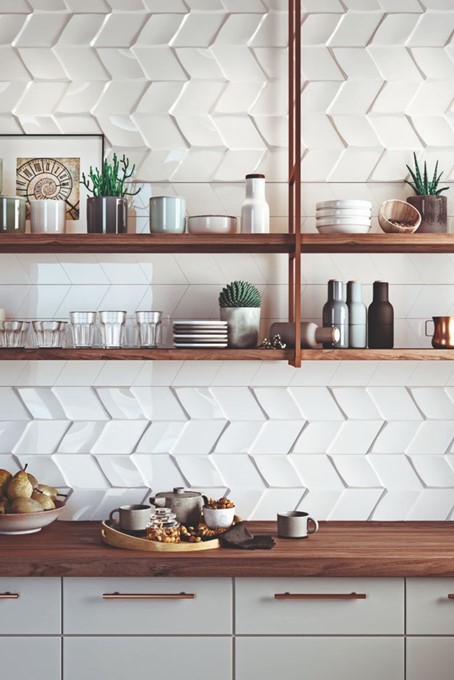
The 2026 tile direction has moved away from mass-produced uniform subway tiles toward handcrafted, gloss-subtle ceramics. The defining quality of these artisanal tiles is intentional irregularity — surfaces that are not perfectly flat, glazes that pool slightly differently from one piece to the next. When arranged in pattern, they reflect light unevenly, which causes the entire wall to subtly shift in appearance as the sun moves across the room. The wall feels alive in a way that perfectly uniform tile does not.
Zellige and Handmade Tile
Zellige tile sits at the center of this trend. Hand-pressed in Morocco from natural clay, zellige carries glaze variation, surface bubbles, and edge irregularities that machine-made tile cannot replicate. A zellige accent wall in soft white or warm green delivers handmade character at scale — and pairs particularly well with shaker cabinetry and natural stone countertops.
Subway Tile, Beyond the Basics
Subway tile is far from finished. The format has simply evolved beyond the standard horizontal stack. Vertical stacks, herringbone patterns, and offset layouts with darkened grout have given the basic subway shape a second life. The choice of grout color matters enormously here. White grout on white tile reads quiet and clean; dark grout on white tile reads graphic and architectural. Designers increasingly recommend a grout color slightly darker than the tile, which conceals minor staining over time and creates a gentle rhythm without competing with the tile itself.
Geometric, Hexagonal, and Mosaic Tile
Geometric and hexagonal tile offers the strongest pattern impact. Honeycomb statement backsplashes, sleek wave tiles, and soft blue stone hexagons have all emerged as 2026 trends. The execution rule is simple: when the tile pattern is doing the visual work, the surrounding cabinetry should stay calm. Designers often pair bold geometric tile with open glass shelving rather than blocky upper cabinets, which keeps the pattern visible and uninterrupted.
Mosaic tile — the small-format glass, ceramic, stone, or metal tiles arranged in intricate patterns — works best in contained applications. A full-wall mosaic installation can quickly read as overwhelming. Used as a strip behind the range, framing an architectural niche, or covering a single contained section, mosaic tile delivers texture and color that larger tiles simply cannot match.
The pain point homeowners report with tile is grout maintenance. Ceramic and porcelain are easy to clean; the grout between them is not. Three practical mitigations help here. Larger-format tiles reduce the total grout area significantly. Epoxy grout (more expensive but vastly more stain-resistant) eliminates most maintenance concerns. And choosing a grout color that conceals staining — a medium gray rather than a stark white — extends the apparent life of the installation by years.
The tile pain point that gets less attention is installation quality. A well-installed tile wall is a 30-year investment. A poorly installed tile wall is a project that needs to be torn out and redone within five years. The difference is almost always the installer. Professional tile setters use wet saws with diamond blades, leveling clip systems that prevent tile lippage, self-leveling laser matrices for large walls, and notched trowels with mortar coverage adequate to prevent hollow spots beneath the tile. Manual snap cutters and basic trowels work for thin ceramic subway tiles, but they fail catastrophically with large-format porcelain, natural stone, or any tile larger than about 12 inches square. When the budget allows for one professional trade in an accent wall project, it should be the tile setter.
Wood Walls
Wood does something to a kitchen that no other material does. It introduces warmth, grain, and a kind of softness that hard surfaces — tile, stone, metal — cannot produce on their own. The 2026 design direction has embraced wood paneling more heavily than at any point in the last decade, with three formats emerging as the dominant treatments.
Slat Wood — The Comeback Story of 2026
Slat wood has become the defining wood treatment of 2026. Vertical or horizontal slats of oak, walnut, or thermally treated pine create a rhythmic surface that catches light along its ridges and recedes into shadow between them. Beyond the visual effect, slat wood walls absorb acoustic reverberation in a way that smooth surfaces cannot — a real benefit in open-plan homes where the kitchen flows directly into the living area and sound carries between them.
The premium acoustic slat panel systems run $50 to $100 per square meter at retail. Installed costs typically land between $1,200 and $5,500 for a standard accent wall. The format works particularly well on a kitchen end wall visible from the adjoining living space, where it serves as the transition material between the two rooms. Lighter oak finishes lean Scandinavian; deeper walnut reads more luxurious. Both age beautifully when properly sealed.
Shiplap, Done Right
Shiplap continues to anchor farmhouse, coastal, and traditional kitchens, but the contemporary version of shiplap looks markedly different from the rustic interpretation of five years ago. Painting shiplap vertically (rather than horizontally) and finishing it in a solid color rather than distressed white makes the format read cleaner, more architectural, and less themed. A dark green or charcoal vertical shiplap wall reads almost nothing like the white horizontal shiplap that dominated farmhouse kitchens during the 2010s.
Reclaimed Wood and Tambour Panels
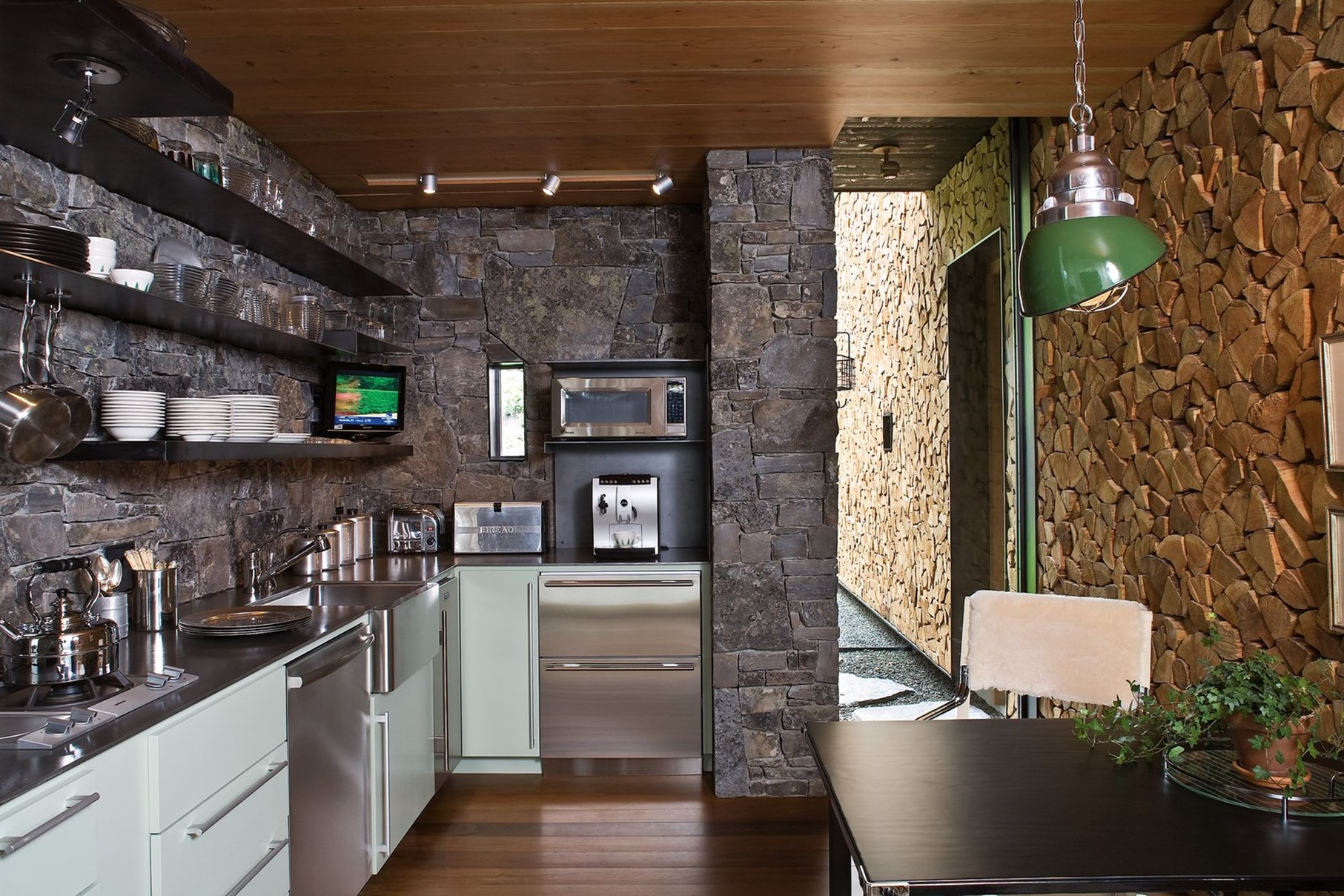
Reclaimed wood and tambour panels sit at the higher end of wood treatment. Reclaimed planks bring genuine age and patina to a wall in a way that no manufactured material can replicate. Tambour — the closely-spaced thin wooden slats originally used for roll-top desks — has emerged as a curved-surface material that wraps around islands, range hoods, and accent walls with remarkable flexibility.
The pain point with all wood walls is the same: kitchens are humid, and humid environments warp unsealed wood. Every wood paneling installation in a kitchen needs to be sealed before installation — not after — and the seal needs to be maintained periodically. Wood walls also collect grease in their grain over time, and the grease in the grain is genuinely difficult to remove without damaging the finish. The mitigation is to keep wood walls out of the direct cooking zone. A slatted oak wall on the dining side of an open-plan kitchen will outlive the cabinets. The same wall behind a gas range will need to be replaced within five years.
Stone and Brick Walls
Stone and brick deliver something that no other material category can match — a sense of permanence, of geological weight, of architectural rootedness. A stacked stone wall behind a range hood does not read as a design choice. It reads as foundation. This is why stone has become the material of choice for the highest-end kitchens of 2026, and why faux-stone and stone-veneer products have evolved so quickly to make the look accessible at lower price points.
Monolithic Stone Slabs
Monolithic stone slabs sit at the top of the luxury hierarchy. The defining 2026 trend is the continuous countertop-to-ceiling slab — a single piece of marble, soapstone, or quartzite that runs unbroken from the counter behind the range up to the ceiling, eliminating the visual fragmentation of grouted tile. This treatment, often executed in materials like Cambria’s Brittanicca Gold Warm or Charlestown quartz, creates an architectural plane that functions as both backsplash and accent wall in a single gesture. The natural veining reads as continuous geological art rather than a decorative pattern.
Stone Veneer and Thin-Brick
Stone veneer and thin-brick offer the same tactile feedback at a fraction of the cost and structural load. Real natural stone slabs require structural reinforcement — they are massively heavy, and a failed installation can damage the wall behind them. Thin-brick and stone veneer products are cut to a fraction of the depth, allowing them to install over standard drywall without specialized framing or footings. The aesthetic difference between premium stone veneer and natural stone, viewed from across a kitchen, is minimal. Brickstone Charcoal 2×10 brick tiles and similar porcelain-based products are engineered to evoke reclaimed historical brick with the low-maintenance durability of contemporary porcelain.
Stacked Stone, Limestone, Travertine, and Slate
Stacked stone, limestone, travertine, and slate all introduce dramatic texture. Stacked stone walls — with their irregular three-dimensional surface — work particularly well behind a range or in a dining alcove where their depth becomes part of the design. Limestone and travertine read warmer and softer; slate reads darker and more architectural. Each of these materials is porous and requires sealing, and the seal needs to be reapplied periodically (typically every two to three years) to maintain stain resistance.
Brick Veneer — Whitewashed and Exposed
Brick veneer — particularly whitewashed or limewashed brick — has become a defining surface of farmhouse and modern-rustic kitchens. The treatment carries genuine character without the structural concerns of real masonry. The grout application matters enormously: an over-grouted “smear” reads historical and European; a recessed sharp joint reads industrial and modern. The same brick can deliver completely different aesthetics depending on the grout treatment.
The pain point with stone and brick is sealing and weight. Both categories of pain are solvable. Annual sealing keeps natural stone resistant to staining indefinitely. Stone veneer eliminates the structural-weight concern entirely. The harder pain point is reversibility — stone and brick are permanent installations. Removing a poorly placed stone wall costs nearly as much as the original installation. This is why these materials should be reserved for walls where the homeowner is absolutely certain about both the material and the placement, ideally after living with the kitchen layout for at least six months.
Mirror, Metal, and Glass
The reflective material category sits in a strange position in kitchen design. It is the most powerful tool available for spatial expansion in a small kitchen, and it is also the easiest to overuse to the point of looking dated. The 2026 direction has narrowed the application — using mirror, metal, and glass as accent rather than as primary surface, and treating them with restraint rather than abundance.
Mirrored Tile and Antique Mirror Panels
Mirrored tile and antique mirror panels create the strongest spatial illusion of any accent wall material. A wall of antique mirror in a galley kitchen visually doubles the apparent depth of the room and dramatically increases the natural light entering the space. The contemporary application is restrained — a single accent wall in a dining nook or behind an island, framed by adjacent walls that read as finished surfaces rather than additional reflection. Distressed and antiqued mirror finishes have replaced perfectly clean mirror as the contemporary preference, since they read warmer and less stark.
Stainless Steel Panels
Stainless steel panels offer something no other material does: they are heat-proof, hygienic, fingerprint-cleanable, and magnetic. A stainless steel accent wall behind a range functions as both backsplash and as a modular organization surface — magnetic spice tins, magnetic knife strips, and magnetic utensil holders all attach directly to the wall. Stainless steel also reflects light deep into the room without the glare problems of mirror.
The visual concern with stainless is that it can read sterile or commercial. The mitigation is pairing — stainless steel paired with warm wood tones (oak countertops, walnut shelving) reads chef-kitchen rather than commercial-kitchen. Stainless paired with charcoal-gray limestone picks up the metallic tones while introducing a warmer textural counterpoint.
Brass, Copper, and Zinc Panels
Brass, copper, and zinc panels are the more romantic version of metallic accent walls. These living metals develop patina over time, oxidizing in response to the kitchen’s specific environmental conditions. The result is a wall that becomes more characterful with age, with localized variations in color that no manufactured material can replicate. The trade-off is that the surface is genuinely changing — homeowners who prefer a static, predictable finish will find this frustrating. Homeowners who appreciate that the wall is becoming a record of the kitchen’s life will love it.
Backlit Translucent Stone
Backlit translucent stone sits at the absolute apex of accent wall design. The technique uses LED light panels mounted directly behind a slab of translucent natural stone — typically onyx, certain quartzite varieties, or semi-precious agate — to illuminate the wall from within. Onyx is the most translucent of these materials, allowing light to penetrate deeply and reveal vibrant internal veining in honey, green, pink, and white. Quartzite offers less uniform translucence but considerably better durability, making it the practical choice for working kitchen environments.
The execution requires precision engineering. The LED color temperature must complement the stone’s natural hues — a cool blue LED behind warm honey onyx will produce a sickly, unnatural appearance, while a warm LED will set the same stone visually ablaze. Many high-end installations use the bookmatching technique, where slabs are cut sequentially from the same block and opened like the pages of a book, creating a perfect mirror-image of the veining across a central seam. When this mirrored geological canvas is illuminated from behind, it functions as a piece of bespoke architectural art rather than a kitchen finish.
This is, predictably, the most expensive accent wall option available. Installed costs typically run $200 to $500 or more per square foot when the LED panel system, structural framing, and material selection are factored in. It is also the most demanding installation, requiring close coordination between the stone fabricator, the lighting designer, and the electrician. For homeowners who want the absolute pinnacle of kitchen accent wall design, however, nothing else competes.
Architectural and Functional Accents
The most interesting accent walls of 2026 are not purely decorative. They do work — they store, they communicate, they organize, they grow herbs. This integration of function into the accent wall reflects a broader maturation in residential design: the recognition that a wall is too valuable a surface to be purely visual.
The Cabinet-as-Accent Approach
The cabinet-as-accent approach treats the cabinetry itself as the accent wall. A floor-to-ceiling run of cabinetry in a saturated color (deep green, charcoal, navy) can carry the visual weight of an accent wall while delivering the storage capacity that defines a working kitchen. This treatment works particularly well when the cabinetry has minimal hardware — slab-front cabinets with integrated finger pulls or push-to-open mechanisms keep the visual surface clean. The Fabuwood Allure line in deep navy or smoky teal is a current example of this approach, where the cabinetry is the design statement and the surrounding walls stay quiet.
Open Shelving Display Walls
Open shelving display walls convert the accent wall into a functional showcase. A single wall of floating shelves displaying ceramics, cookbooks, glassware, and curated everyday items can read as the most beautiful surface in the kitchen — when it is curated with discipline. The pain point that homeowners report consistently is that open shelving “always looks messy.” This is fair. Open shelving is styling work that never ends. The designers who recommend it most enthusiastically also recommend a strict ratio: roughly 70 percent everyday essentials, 30 percent decorative pieces, with a willingness to edit ruthlessly. One short run of open shelves is styling. A whole wall of them is housekeeping.
Magnetic Chalkboard Walls
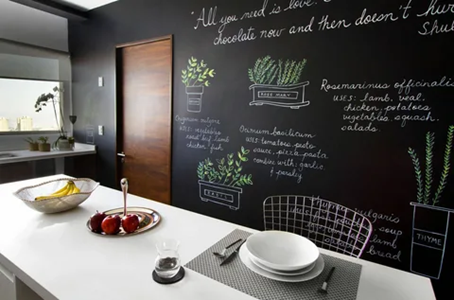
Magnetic chalkboard walls transform an entire architectural plane into a centralized communication and planning hub. The execution requires more technical preparation than most homeowners expect. The wall must be sanded perfectly smooth — orange-peel and knockdown texture interfere with both writing and magnetic adhesion. A magnetic primer (Rustoleum Magnetic Primer is the trade standard) is heavily loaded with iron dust and requires constant stirring during application; multiple thick coats with a dense foam roller are needed before the magnetic pull will hold cardstock or metal spice tins. Once the magnetic base is established, two coats of high-quality latex chalkboard paint complete the wall.
The visual result is striking. A floor-to-ceiling black chalkboard creates a vast plane of negative space that visually recedes, adding depth to the room. A constantly evolving surface — covered in grocery lists, scheduled notes, and temporary artwork — also ensures the kitchen feels lived-in rather than staged. For families with children, the wall doubles as a creative space; for households without, it functions as a household command center.
Pegboard Walls
Pegboard walls have evolved well beyond their workshop origins. Modern kitchen pegboards range from traditional tempered hardboard (the Masonite material that Julia Child famously used in her Cambridge kitchen) to powder-coated steel and acrylic systems. The execution rule is structural: standard 1/8-inch hardboard is too thin to hold cast-iron cookware. For heavy items, 1/4-inch hardboard or steel pegboard is essential. Wooden furring strips must be installed behind the board to create the offset space that allows the hooks to seat correctly.
The aesthetic execution depends on curation. A haphazard arrangement of mismatched tools creates visual chaos. A deliberately organized board — with tools arranged by size or by frequency of use, often painted to match the surrounding cabinetry — creates a deeply satisfying industrial-chic display. Some homeowners take the curation further, using outline painting (tracing each pan’s silhouette onto the board with a white paint pen to mark its proper resting place) which adds graphic charm while enforcing organizational discipline.
Living Walls and Plant Displays
Living walls and plant displays sit at the most ambitious end of functional accent walls. A dense vertical garden of herbs, ferns, and trailing pothos delivers genuine biophilic value — improved air quality, immediate access to fresh culinary herbs, and the psychological benefit of indoor greenery. The technical reality, however, is demanding. Kitchen environments are hostile to most plants: heat fluctuations from ovens, humidity from boiling water, and airborne grease all stress the plant material continuously.
A successful living wall in a kitchen requires a multi-layered substrate system with a waterproof membrane protecting the underlying drywall, a moisture retention layer, and individual plant cassettes. Professional systems weigh roughly 35 kilograms per square meter when fully planted and saturated. Irrigation cannot be handled manually; the system requires an automated drip-irrigation matrix delivering approximately two liters per square meter daily, supplemented by water sensors to detect blockages or leaks before plant die-off occurs. Specialized supplemental grow lighting must be integrated into the surrounding architecture, since the foliage density blocks ambient light from reaching the lower layers.
The maintenance load is significant: nutrient dosing, pest control, pruning to maintain airflow. For homeowners not prepared for this commitment, preserved moss walls — chemically treated to remain visually intact without water, sunlight, or pest management — provide much of the visual and acoustic benefit without the maintenance burden. They sacrifice the air-purifying and culinary benefits of live plants, but they remain beautiful indefinitely with essentially no upkeep.
Designing for Your Kitchen Style
The same accent wall material reads completely differently depending on the surrounding kitchen style. Matching the wall treatment to the broader aesthetic prevents the disconnected look that comes from a beautiful accent wall in the wrong context.
Modern Kitchens
In modern kitchens — slab-front cabinetry, integrated appliances, minimal hardware — the accent wall should add texture rather than color. A monolithic stone slab, a continuous limewash plaster surface, or a wall of large-format porcelain in soft gray reinforces the architectural language without competing with it. Bold colors tend to work against the modern aesthetic, which depends on restraint for its impact.
Traditional and Farmhouse Kitchens
In traditional and farmhouse kitchens — shaker doors, decorative hardware, beadboard ceilings — the accent wall has more permission to be expressive. Botanical wallpaper in a dining nook, painted vertical shiplap, brick veneer behind a range, or exposed-and-sealed natural brick all reinforce the warmth and pattern that define the style. Too-modern materials (slat wood, polished concrete, stainless steel) can feel out of place against shaker cabinetry.
Transitional Kitchens
In transitional kitchens — the hybrid style that has become dominant in 2026 — the accent wall has the most flexibility. Transitional kitchens marry shaker or simple slab cabinetry with mixed materials and a controlled palette. A textured limewash wall, a quietly patterned tile, a single saturated paint color, or a stone slab all integrate well. The unifying principle is restraint: the accent wall should feel intentional rather than dramatic.
Small Kitchens
Small kitchens deserve their own consideration. The directionality of lines on the accent wall fundamentally alters how the room reads. Horizontal lines (horizontal shiplap, horizontal striped wallpaper) stretch the perceived width of the room. Vertical lines (board and batten, vertical tile stacks, slatted wood) elevate the apparent ceiling height. Color choices matter equally: light, neutral tones reflect ambient light and visually expand the space, while reflective surfaces (mirror, gloss tile, polished stone) ricochet light and effectively double the perceived depth. For a small galley kitchen, a single mirrored accent wall opposite a window can transform the apparent size of the room.
The rule for small kitchens is to commit fully to the strategy. A small kitchen with a tentative accent wall — a dark color in a small fragmented patch, a busy pattern in a tight space — reads cluttered. The same kitchen with a confident floor-to-ceiling treatment in a single material reads designed.
Accent Walls Behind Kitchen Cabinets
There is a quietly underused approach to the kitchen accent wall: treating the wall behind the cabinets as the accent. In most kitchens, the wall behind upper and lower cabinetry is invisible — covered by storage, hidden by appliances. But in kitchens with open shelving, glass-front cabinets, or floating-island arrangements, the wall behind the cabinetry becomes part of the design.
A wallpapered backdrop visible through glass-front cabinets creates a layered, curated look — the cabinetry frames the wallpaper rather than hiding it. A textured plaster wall behind open shelving makes the displayed objects read as art rather than as storage. A continuous tile wall that runs behind both the upper cabinets (visible above) and the countertop (visible below) creates a coherence that fragmented backsplashes cannot achieve.
The pairing matters. Bold cabinetry — saturated color, decorative hardware, intricate door styles — calls for a quiet wall behind it: a solid neutral, a subtle textured plaster, a single-tone tile. Quiet cabinetry — clean shaker, slab fronts, minimal hardware — gives the wall behind it permission to do more visual work. The Fabuwood Allure line, with its clean shaker profile, works particularly well against textured accent walls because the cabinetry stays out of the way visually.
For homeowners considering an accent wall as part of a larger kitchen renovation, designing the cabinetry and the accent wall together — rather than choosing the cabinetry first and then trying to layer an accent wall onto an established design — produces a more integrated result. This is the approach that designers consistently recommend, and it is the one that homeowners most often report being happiest with five years later.
Regional Considerations for Accent Wall Design
The same accent wall behaves differently depending on the climate it lives in. Humidity, heating cycles, and even the angle of the sun shift what materials will and will not last. The regional patterns below reflect what designers and contractors in each market consistently recommend.
Northern Virginia, Washington DC, and Maryland
The DMV climate is the most demanding of any region IST Cabinets serves. Summer humidity routinely exceeds 70 percent, winter heating dries indoor air aggressively, and the seasonal swing between the two stresses every porous material in the kitchen. Wallpaper that performs well in dry climates can bubble within a year in Northern Virginia. Unsealed wood paneling will warp over the first humid summer.
The materials that consistently perform in the DMV are the ones engineered for moisture resistance: vinyl-coated wallpaper rated specifically for kitchens, sealed natural stone, properly installed tile, and limewash plaster (which actually benefits from humidity as it cures over time). Slat wood walls work beautifully here, but only when the wood is sealed before installation and located outside the direct cooking zone.
Design-wise, the DMV market has converged around transitional aesthetics — shaker cabinetry, neutral palettes anchored in warm whites and mushroom beige, accent walls in muted blues, deep greens, or textured plasters. The all-white kitchen still appears in colonial and federal-style homes, but it is increasingly being replaced with warmer foundational neutrals across new builds and major renovations. Homeowners in Fairfax, Alexandria, McLean, and the inner Maryland suburbs (Columbia, Bethesda, Silver Spring) gravitate toward sophisticated restraint rather than bold statement walls.
The IST Cabinets Fairfax showroom, Alexandria warehouse, and Columbia, MD showroom all carry samples that demonstrate how Fabuwood door styles pair with regional accent wall materials, and the design consultations include climate-specific material recommendations.
Houston and the Texas Markets
Houston’s climate is even more extreme than the DMV’s, but the variables are different. Year-round humidity is high. Summer temperatures push air conditioning to run nine months of the year. The combination produces a kitchen environment where condensation can form on walls during the AC-to-outdoor temperature differential, and where mold prevention becomes a real consideration in material selection.
The materials that work best in Houston kitchens are aggressively non-porous and properly sealed: porcelain tile with epoxy grout, sealed natural stone, vinyl-coated wallpaper, and limewash plaster systems specifically rated for humid environments. Wood walls are viable but require more frequent re-sealing than they would in a drier climate. Brick veneer, with its natural breathability, performs surprisingly well — it allows minor moisture to escape rather than trapping it behind the surface.
The Texas design vernacular leans warmer and more colorful than the DMV. Terracotta accents, deeper blue palettes, and patterned tile work particularly well against the Texas light, which has a different golden quality than the more neutral Mid-Atlantic light. Western and southwestern influences (handmade tile, exposed beams, warm wood tones) appear more frequently in Houston design than in any other market IST serves.
The IST Cabinets Houston warehouse stocks the cabinet door styles and finishes that pair best with these regional preferences, and the in-stock model means homeowners can complete an accent wall project without the multi-month lead times that custom cabinetry would require.
Delaware
Delaware sits in a transitional climate zone — milder than the DMV, more humid than the inland northern markets. The coastal portions of the state (Bear, Newark, New Castle, Dover) experience marine humidity that brings additional consideration for any natural material installation. The inland portions follow Mid-Atlantic patterns more closely.
The Delaware design aesthetic has become identifiable: clean shaker cabinetry, neutral foundational palettes, restrained color use, and a strong preference for materials that age gracefully over time. Accent walls in Delaware kitchens tend toward textured neutrals — limewash plaster, sealed stone in soft gray-beige tones, vertical painted shiplap. Bold color statements are less common than in either Texas or the DMV’s outer markets.
The IST Cabinets Delaware showroom services this entire market and stocks the door styles (Shaker White, Shaker Grey, Allure series) that pair most reliably with Delaware accent wall preferences.
Illinois and the Chicago Suburbs
The Chicago metropolitan area presents a four-season climate with the most extreme heating-cooling cycle of any IST market. Summer humidity is moderate; winter air is exceptionally dry due to forced-air heating systems running for months at a time. The seasonal swing is the variable that matters most for accent wall design: any material that does not handle the transition between humid summer and bone-dry winter air will fail.
The Roselle, Illinois market reflects this in its material preferences. Sealed natural stone, properly installed tile, kitchen-rated wallpaper, and high-quality painted finishes are the dominant accent wall categories. Wood walls work well when properly sealed, but the seasonal moisture cycling demands more disciplined seal maintenance than warmer climates require. Slat wood acoustic panels are increasingly popular here — they work particularly well in the open-plan layouts common in newer Chicago-area construction.
The aesthetic vernacular leans contemporary and clean, with strong influence from Chicago’s architectural heritage. Mid-century-influenced accent walls, integrated cabinetry-as-accent treatments, and restrained material palettes appear more frequently in Roselle and the surrounding suburbs than in the southern markets IST serves.
2026 Kitchen Accent Wall Trends to Watch
The trends shaping 2026 accent wall design are coherent enough to summarize directly. Quiet luxury is replacing dramatic accent statements — architectural, integrated, tactile materials are winning out over bold color isolated on a single wall. Mushroom beige and warm neutrals have replaced cool grays as the foundational palette, with deeper Restorative Darks (auburn, plum-brown, char-brown) emerging as the preferred accent colors. Textured finishes — limewash, plaster, slat wood, handmade tile — are dominating because they introduce visual depth that flat surfaces cannot.
Floor-to-ceiling treatments are replacing fragmented backsplashes, with continuous stone, tile, or plaster running uninterrupted from countertop to ceiling. Curves and softer geometries are replacing sharp corners across cabinetry and architecture, requiring accent walls to interact with rounded islands, arched shelving, and sculptural elements. Backlit translucent stone has emerged as the apex luxury treatment, with onyx and quartzite setting the standard for what an accent wall can achieve when material, light, and craftsmanship align. Functional integration — pegboards, magnetic chalkboards, living walls, integrated shelving — is gaining ground over purely decorative treatments. The accent wall increasingly does work, not just looks beautiful.
Frequently Asked Questions For Kitchen Accent Wall Ideas
Are kitchen accent walls outdated in 2026?
The bad version of the accent wall is outdated. Painting a single wall a strong color simply because the others are beige — without architectural reason or design integration — has fallen out of favor. The contemporary accent wall is integrated and intentional: a continuous stone slab from countertop to ceiling, a textured plaster panel behind a dining nook, a slatted wood wall that absorbs sound in an open-plan space. These treatments are not outdated. They are the dominant direction in 2026 design.
Where should an accent wall go in a kitchen?
The four best locations are: the wall opposite the main entry (the focal point your eye lands on entering the room), the cooking wall (treating the range backsplash as a continuous design statement), the wall behind a dining nook or banquette (which zones the eating area in open-plan kitchens), and the end wall visible from the adjoining living area (which serves as a transition between the kitchen and the rest of the house). The walls to avoid are those broken up by multiple windows or doorways, sloped or irregular walls, and walls that cannot be seen from the main entry.
Will a dark accent wall make my kitchen look smaller?
A dark accent wall in a small kitchen can read smaller — but it depends on the material and the surrounding context. Dark colors visually advance toward the observer, making the room feel cozier and more intimate, which is sometimes the desired effect. To prevent the small-kitchen-with-dark-wall from feeling cramped, balance the dark wall with lighter cabinetry, reflective surfaces, and adequate lighting. Designers often use a single dark accent wall in a small kitchen specifically to anchor the room without darkening the whole space.
How big should a kitchen accent wall be?
Size matters less than continuity. A successful accent wall typically runs floor-to-ceiling (or countertop-to-ceiling on the cooking wall) and occupies a single uninterrupted plane. A wall that is too small reads as a stripe rather than a feature. A wall that is too large becomes the entire room, eliminating the contrast that defines the accent. The general rule is that the accent should occupy roughly 20 to 30 percent of the kitchen’s total visible wall area.
What is the cheapest kitchen accent wall idea?
A painted accent wall remains the lowest-cost option, typically running $4 to $7 per square foot for materials and DIY-applied labor. Peel-and-stick wallpaper is the second-cheapest at roughly $20 to $50 per roll. Both options are reversible, which makes them ideal for testing color and pattern preferences before committing to a permanent material. The trade-off is durability — paint typically needs refreshing every four to six years in a working kitchen, and peel-and-stick wallpaper rarely lasts beyond two to five years.
Can I have an accent wall behind kitchen cabinets?
Yes — this is one of the most underused approaches in kitchen design. Treating the wall behind glass-front cabinets, open shelving, or floating-island arrangements as the accent wall creates a layered, curated look. Wallpaper visible through glass-front cabinets, textured plaster behind open shelving, or continuous tile that runs behind both upper cabinets and the countertop all read as integrated design rather than fragmented decoration.
Is shiplap still in style in 2026?
Shiplap remains in style, but the contemporary application looks different from the rustic farmhouse interpretation that dominated the last decade. Painted vertically (rather than horizontally) and finished in a saturated solid color (rather than distressed white), shiplap reads cleaner and more architectural. The format works particularly well in transitional and modern-country kitchens, where it adds texture and rhythm without the overtly themed look.
What’s the difference between an accent wall and a feature wall?
The terms are largely interchangeable. Accent wall tends to be the American term; feature wall is more common in British and Australian design vocabulary. Both refer to a single wall whose treatment differs from the surrounding walls in color, material, or texture. Some designers use feature wall to refer specifically to walls treated with materials (stone, brick, wood) and accent wall for walls treated primarily with color, but the distinction is not universally observed.
Looking to Plan Your Kitchen Project?
Designing an accent wall is rarely a standalone project. It works best when planned alongside the cabinetry, countertops, and overall kitchen layout. IST Cabinets stocks Fabuwood cabinetry in popular shaker, slab, and detailed door styles across showrooms in Fairfax (VA), Alexandria (VA), Columbia (MD), Delaware, Roselle (IL), and Houston (TX). All cabinetry is in-stock, with vanities ready in 3 to 4 business days and kitchen cabinets ready in 5 to 7 business days. Free design consultations help homeowners coordinate accent wall material selections with their cabinetry and countertop choices.